




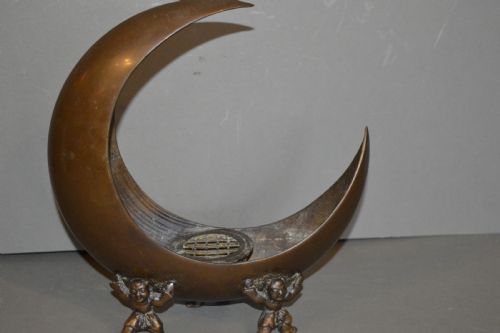

Japanese Bronze Censer
A Japanese bronze censer brings centuries of metalwork mastery into a room, offering tactile warmth and intricate cast detail that catch the eye.
Japanese Bronze Censer
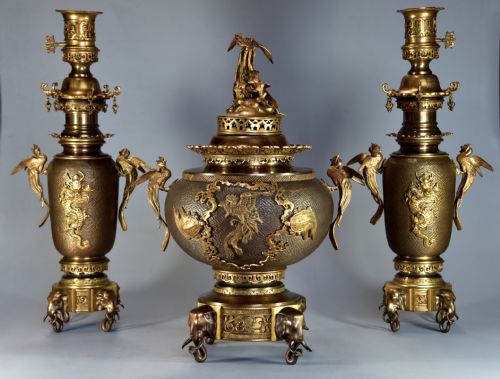
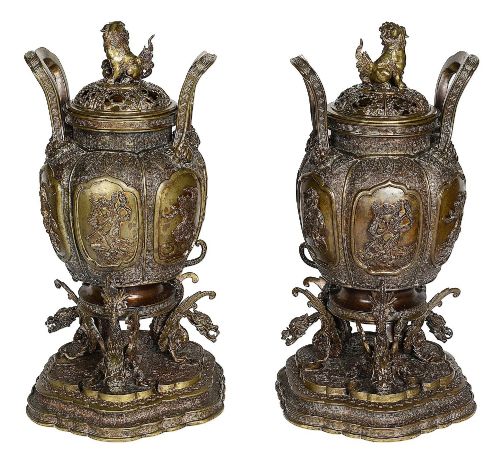
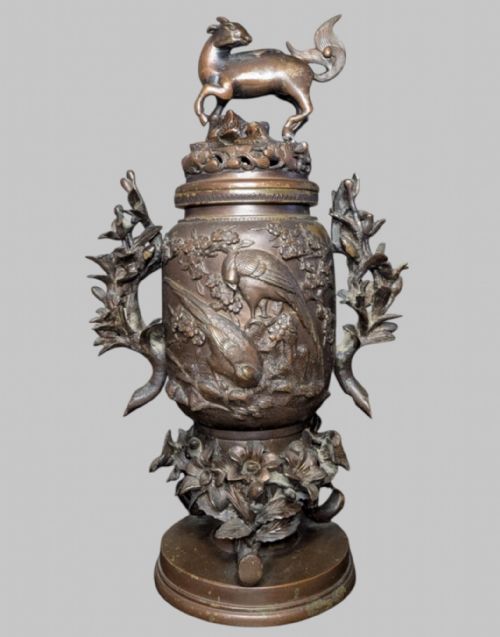
A Japanese bronze censer is an incense burner designed for ritual or decorative display, originating from periods spanning the Edo and Meiji eras. These pieces take various forms, from lidded urns and hanging boat shapes to tripod vessels topped with animal finials like goats or dragons.
Materials and Construction
The foundational material is cast bronze, frequently treated to achieve deep patination or enriched with gilt bronze, parcel-gilt highlights, and silver detailing. Artisans employed sophisticated casting methods to produce complex shapes such as dragons, birds, and rabbits integrated into the body or lid.
Many examples incorporate decorative surface work, utilising cloisonne and champleve enamel alongside gold leaf to accent intricate patterns. Cord elements and subsidiary metal fittings further complete the construction of these vessels.
A goat keeps watch from the lid of one bronze koro, guarding the fragrant smoke within.
Quality and Craftsmanship
Quality in a Japanese bronze censer rests upon the crispness of the casting and the depth of the metalwork. Superior examples show meticulous detail in sculptural elements like animal finials, dragons, and handles, where every scale and feather is rendered with deliberate precision.
The finish of the metal further distinguishes the work, with high-end pieces displaying nuanced patination, controlled gilding, and seamless integration of enamel or silver inlays. Lesser examples present softer casting lines and simpler surface treatments that lack the same sculptural ambition.
The Japanese Bronze Censer Glossary
- Koro
- A traditional Japanese incense burner, often fitted with a pierced lid to release fragrance. These vessels form a core category of the metalwork found here.
- Meiji Period
- The era in Japanese history lasting from 1868 to 1912, known for a surge in highly detailed decorative arts created for both domestic and international markets.
- Edo Period
- The period of Japanese history spanning from 1603 to 1867, representing earlier traditions of craftsmanship before the opening of trade.
- Champleve
- An enamelling technique where troughs or cells are cast into the bronze body and filled with enamel paste before firing.
- Patinated Bronze
- Metal treated with chemicals or heat to alter its surface colour, producing rich browns, blacks, or greens that age gracefully over time.
Japanese Bronze Censer: Frequently Asked Questions
What is a koro?
A koro is the traditional Japanese term for an incense burner, typically featuring a body, a resting base, and a perforated lid designed to let smoke drift through.
These vessels were used in domestic and ceremonial settings, functioning as both scent diffusers and sculptural art objects.
How do I date a Japanese bronze censer?
Dating relies on stylistic markers, historical periods such as the Edo or Meiji eras, and manufacturing techniques recorded in the piece.
Earlier eighteenth-century works tend toward archaic forms, while late nineteenth-century Meiji pieces frequently exhibit elaborate naturalistic animals and mixed metal accents.
Where should I place a censer at home?
A censer suits display surfaces like sideboards, mantlepieces, or dedicated display tables where its three-dimensional form and patinated surface can be appreciated from multiple angles.
Because many examples include delicate elements like figural finials or enamel work, placing them away from heavy household traffic ensures safety.
Are these censers meant for burning incense?
While originally created to hold burning incense, many collectors today treat them purely as decorative works of art.
If you choose to burn incense inside an antique piece, use appropriate heat-resistant liners to protect the historic metal and any interior residue.