


Japanese Bottle Vase
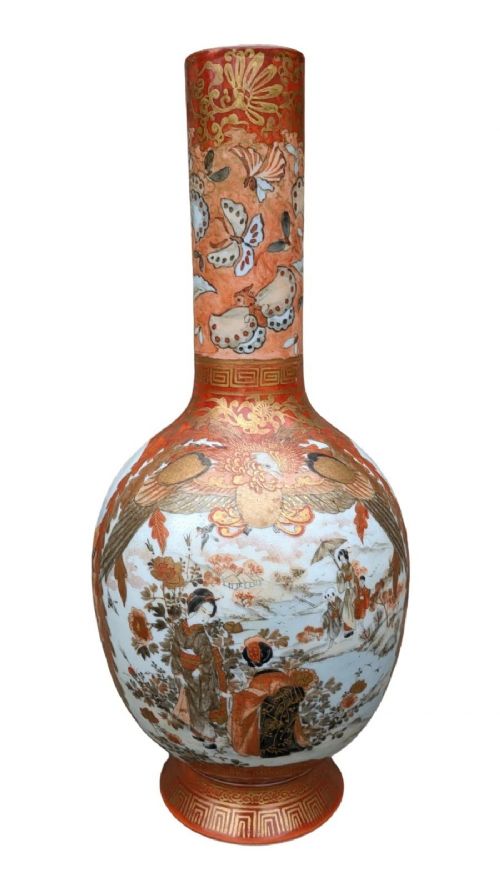
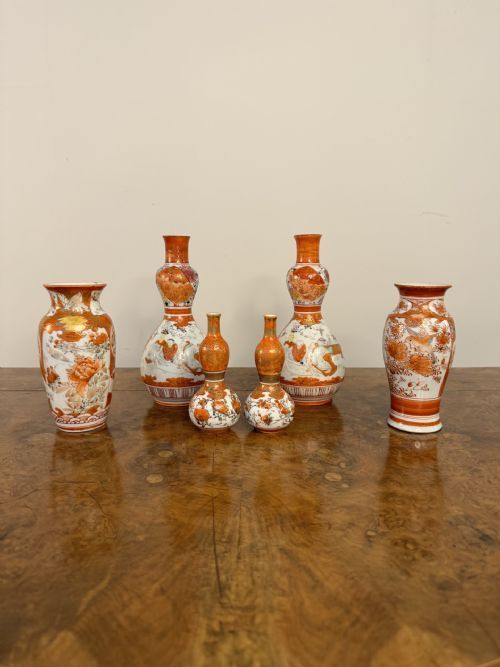
A Japanese bottle vase brings restrained form and painted detail to a room, made for display and appreciated for its slender neck.
Japanese Bottle Vase
When you search for a Japanese bottle vase, you encounter vessels defined by a narrow neck expanding into a rounded or bulbous body. These pieces emerge primarily from the Meiji period and the nineteenth century, alongside earlier examples from the seventeenth and eighteenth centuries. The forms serve both decorative and functional roles, historically designed for specific arrangements of single stems or simply to stand alone.
The most common versions on this page belong to the Japanese Imari and Kutani traditions, featuring distinct palettes of cobalt glaze and enamel. You also meet Satsuma earthenware and cloisonné enamel pieces among the selection. Each style brings different surface textures and decorative motifs to the fundamental bottle silhouette.
How they were made
Potters shaped porcelain and earthenware on the wheel, applying cobalt underglazes before a high-temperature firing. Overglaze enamels and gold leaf were often added in subsequent lower-temperature firings to build up the intricate pictorial surface.
Cloisonné pieces utilised fine brass wires soldered to metal bodies to form cellular compartments, which were then filled with enamel pastes and fired repeatedly.
Listings span multiple eras, including the seventeenth century, Victorian period, and Meiji period, utilising porcelain, earthenware, enamel, and brass.
What varies in quality
Quality rests in the precision of the throwing and the control of the kiln, which determines whether the profile stands true and balanced. Superior pieces display crisp alignment between the slender neck and the body.
The painting separates the ordinary from the exceptional, visible in the brushwork of the cobalt and the clarity of the enamel pigments. Finer examples show deliberate composition and steady hands in the decorative details.
Stevenson & Hancock·Namikawa Yasuyuki
The Japanese Bottle Vase Glossary
- Imari
- A style of Japanese porcelain featuring a palette of underglaze cobalt blue, iron red, and gold. It originated in Arita and was widely exported to Europe.
- Kutani
- A type of Japanese porcelain and pottery known for bold colours and pictorial scenes. Greens, purples, and yellows often dominate the palette.
- Satsuma
- An earthenware ceramic with a pale, crackle-glaze finish, typically decorated with elaborate enamel and gold designs. It became particularly popular for export during the Meiji period.
- Cloisonné
- A technique where metal wires are attached to a base to create bounded areas for enamel pastes. The object is fired and polished to a smooth finish.
- Arita
- The town in Japan where porcelain production first began in the seventeenth century. Pieces from this centre formed the basis of early export wares.
Japanese Bottle Vase: Frequently Asked Questions
What is a Japanese bottle vase?
A Japanese bottle vase is a ceramic or metal vessel characterised by a narrow neck and a rounded body. They were traditionally created for floral display or interior decoration.
These pieces span several centuries of production, with notable examples emerging from the Meiji period and earlier export eras.
How do I identify Imari style?
Imari pieces are generally recognised by their distinct colour scheme combining cobalt blue underglaze with iron red and gold overglaze. The patterns frequently incorporate floral and geometric motifs.
This style was produced extensively in Arita and exported in large quantities to Western markets.
What is Satsuma ware?
Satsuma ware is a distinct type of earthenware featuring a characteristic creamy, crackled glaze. The surfaces are typically decorated with detailed figural scenes and generous amounts of gold leaf.
Most surviving examples date from the nineteenth century and the Meiji period.
How were these vases used?
These vessels served primarily as decorative items within the home, though many were originally made to hold single stems or specialised floral arrangements. Their striking painted surfaces made them centrepieces in both Japanese interiors and European drawing rooms.
Over time, collectors and owners repurposed some examples into table lamps while keeping others strictly for display.