





Japanese Arita Ware Plates
Japanese Arita ware plates are hand-painted porcelain pieces spanning the Edo and Meiji periods, prized for traditional floral and animal motifs.
Japanese Arita Ware Plates
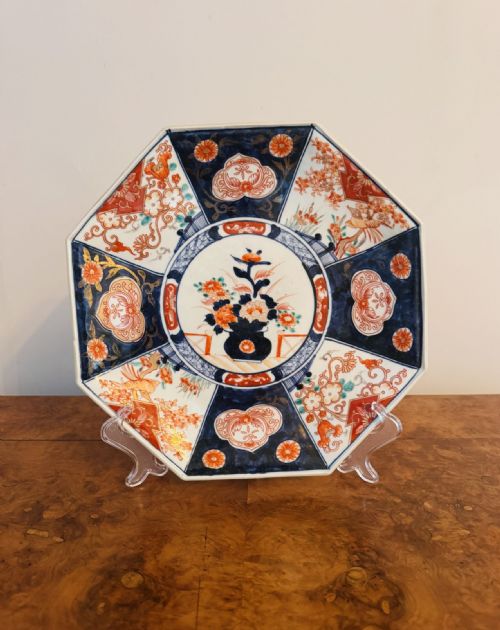
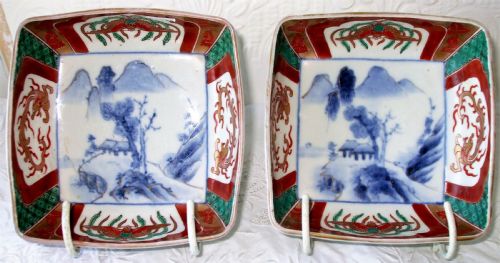
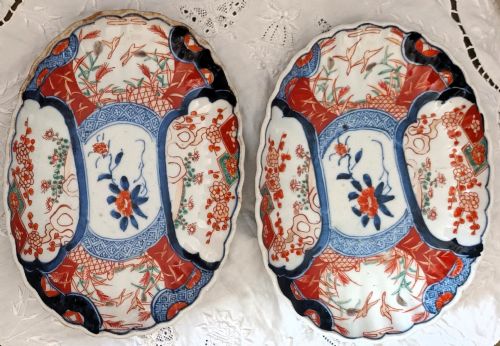
Japanese arita ware plates comprise chargers, dishes and display plates originating from Japan across the seventeenth, eighteenth, nineteenth and early twentieth centuries. These items appear in various forms including oval, hexagonal, square, fan-shaped, clam shell and scalloped edges alongside standard round plates.
The selection ranges from large decorative chargers and deep bowls to matched pairs and larger collections of fourteen plates. Buyers frequently encounter nineteenth century Meiji period Imari porcelain alongside earlier Edo period pieces from the seventeenth and eighteenth centuries.
How they were made
Potters shaped porcelain clay into diverse geometric and natural forms before applying cobalt underglaze, enamel, and glaze. Artisans utilised cobalt underglaze for blue and white designs and added enamel glazes alongside gold leaf and gilding.
Makers decorated surfaces by hand with floral, bird, scroll, and crane motifs. Pieces were fired in kilns, with some items bearing specific marks such as the Fuku mark.
The listings span the seventeenth century to the early twentieth century, incorporating Edo period and Meiji period porcelain.
What varies in quality
Execution of hand-painted detail distinguishes standard items from superior examples. Precision in floral, bird, and scrolling foliate designs indicates higher skill.
Unusual shapes such as fan or hexagonal forms and large chargers command attention through complex moulding and design preservation across centuries.
The Japanese Arita Ware Plates Glossary
- Imari
- A style of Japanese porcelain decorated in underglaze blue, iron red, and gold, named after the port from which it was shipped. This aesthetic defines many pieces produced during the Edo and Meiji periods.
- Arita
- The town in Hizen province where Japanese porcelain production began in the early seventeenth century. Ware from this region encompasses both blue and white designs and polychrome Imari styles.
- Charger
- A large decorative plate intended for display rather than dining use. These substantial vessels often feature complex scrolling foliate borders and central bird or floral motifs.
- Edo Period
- The period in Japanese history spanning from 1603 to 1868. Pieces from this era include early Arita dishes and seventeenth century blue and white porcelain.
- Cobalt Underglaze
- A blue pigment applied to ceramic pieces before glazing and firing. This technique creates the deep blue patterns seen on Arita and Imari plates.
Japanese Arita Ware Plates: Frequently Asked Questions
What is Japanese arita ware?
Japanese arita ware is porcelain produced in and around the town of Arita in Hizen province, starting from the seventeenth century.
Craftsmen created everything from small dishes to large decorative chargers utilising cobalt underglaze, enamel, and gold leaf.
How do I identify Edo period pieces?
Edo period pieces date between 1603 and 1868, encompassing early Arita blue and white designs and seventeenth century items.
Clam shell dishes and specific bowl forms from this era show distinct early potting techniques.
What is Imari porcelain?
Imari is a style of Japanese porcelain featuring a palette of underglaze blue, iron red, and gilt decorations.
Plates and chargers in this style often display intricate floral and bird motifs across various geometric shapes.
How were these plates used?
Many large chargers and decorative dishes served as display pieces in homes rather than functional tableware.
Pairs and matched collections were also utilised for formal presentation and interior decoration.
Are these plates hand painted?
The pieces feature hand-painted floral, bird, and scroll designs executed by skilled artisans.
Painters applied cobalt underglaze and enamel colours directly onto the porcelain body before firing.