


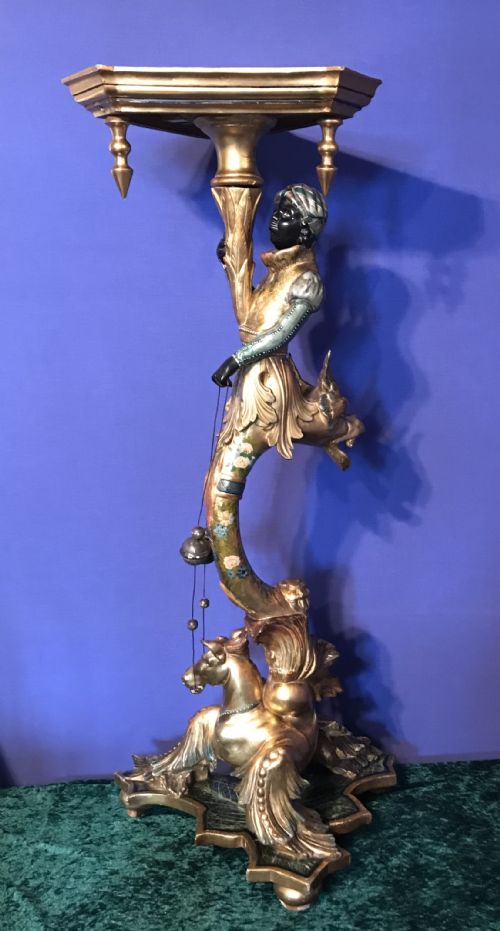


Italian Baroque Style Stand
An italian baroque style stand brings theatrical presence and rich surface texture to a room.
Italian Baroque Style Stand
An italian baroque style stand encompasses candle holders, standard lamps, torcheres, and console tables spanning from the eighteenth century through the nineteenth century and into the nineteen twenties. These pieces draw on classical motifs and dramatic forms, bringing movement and sculptural weight to an interior.
You are most likely to encounter giltwood standard lamps and carved wooden torcheres on this page, alongside occasional console tables and altar-type candle holders. Their origins range across periods including Victorian, eighteen fifty, and nineteen hundred.
The aesthetic leans heavily on exuberant carving, scrolling supports, and gilded surfaces designed to catch candlelight. They function equally as lighting supports, pedestals for display, or standalone furniture pieces.
Materials and Construction
Makers shaped these stands primarily from carved wood, pinewood, and gesso, applying layers of giltwood and polychrome paint to achieve rich decorative surfaces. The underlying timber receives intricate chisel work before the application of gold leaf or paint.
Marble frequently tops console tables, providing a contrasting cool surface to the warm, gilded wooden structures beneath. Glass and fabric occasionally appear in related standard lamps and lighting components.
One enthusiastic nineteenth-century maker evidently decided that a single torchere needed to moonlight as a planter and a pedestal simultaneously.
Assessing Quality and Craftsmanship
The depth and crispness of the hand carving separate finer examples from simpler production, particularly in the rendering of acanthus leaves, scrolls, and figural elements. Sharp undercut details indicate a more skilled hand at the bench.
The quality of the gilding and the preservation of original polychrome paint surfaces heavily influence the visual impact of the piece. Subtle ageing and wear on the gold leaf over gesso reveal the true age and authenticity of the surface.
The Italian Baroque Style Stand Glossary
- Giltwood
- Wood that has been coated with gold leaf over a prepared base layer such as gesso. This finish creates a luminous, reflective surface characteristic of high-status furnishings.
- Torchere
- A tall ornamental stand or candlestick designed to hold a light source. They frequently take the form of highly carved columns or pedestals.
- Gesso
- A plaster-like mixture applied to wood surfaces as a smooth preparation layer for gilding or painting. It allows for fine incised detail before the application of gold leaf.
- Console table
- A table supported by wall brackets or console legs, designed to stand against a vertical surface. They often feature marble tops and elaborate baroque carving.
- Polychrome
- Decorated in multiple colours. This paint technique adds vibrant visual complexity to carved wooden stands and candle holders.
Italian Baroque Style Stand: Frequently Asked Questions
What is an italian baroque style stand?
An italian baroque style stand is a decorative furnishing such as a torchere, standard lamp, or console table featuring ornate carving and giltwood finishes. These pieces originate from various periods including the eighteenth and nineteenth centuries.
They reflect the theatrical and dynamic design principles of the baroque era, utilising rich materials like marble and polychrome paint to create striking focal points in a room.
How were torcheres used historically?
Historically, torcheres served primarily to elevate candles or oil lamps to illuminate large rooms and dark corners. Their elevated platforms positioned light sources effectively above furniture height.
Over time, many of these tall stands were adapted to hold electric lighting or served purely as decorative pedestals for displaying sculpture and plants.
How do I care for giltwood stands?
Giltwood requires gentle handling because the thin gold leaf and underlying gesso are sensitive to moisture and abrasion. Dusting should be done lightly with a dry, soft brush rather than a cloth that might catch on carved details.
Keep these pieces away from direct sunlight and fluctuating humidity to prevent the wood from moving and the gesso from cracking.
How can I tell the age of these pieces?
Dating relies on examining the timber species, the hand tools used in the carving, and the composition of the gesso and gilt layers beneath the surface. Eighteenth-century examples often show deeper patination and hand- forged elements compared to later revivals.
Stylistic shifts between Victorian interpretations and earlier work also provide clues, though many revival pieces closely emulate eighteenth-century forms.