


Inlaid Music Stand
An inlaid music stand brings together fine cabinet-making and functional sheet music storage from the nineteenth and early twentieth centuries.
Inlaid Music Stand
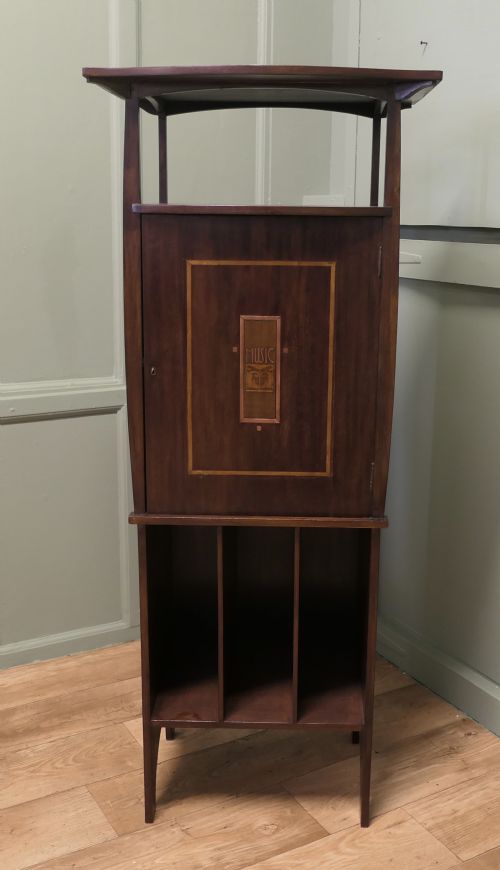
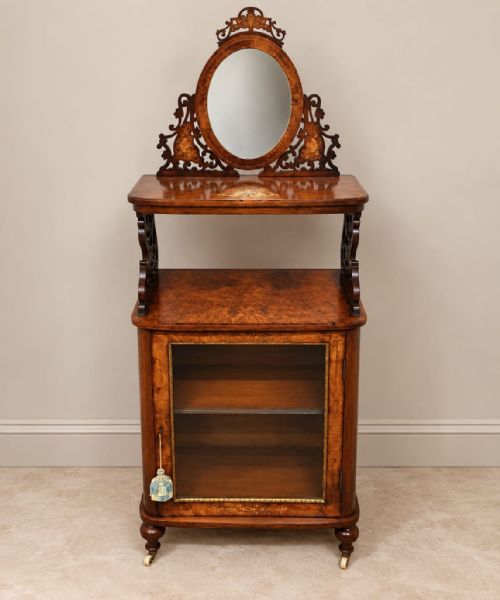
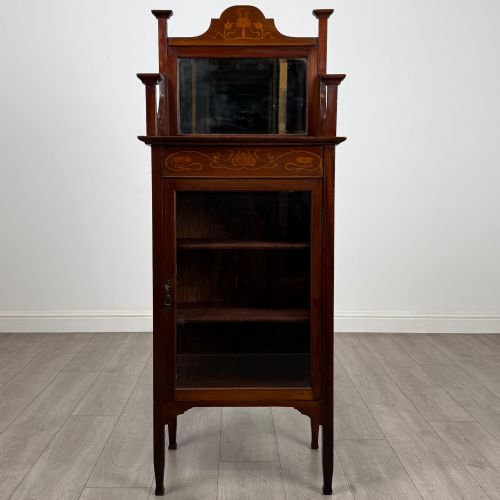
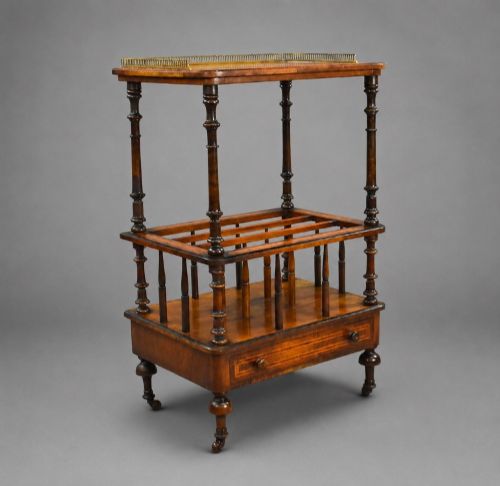
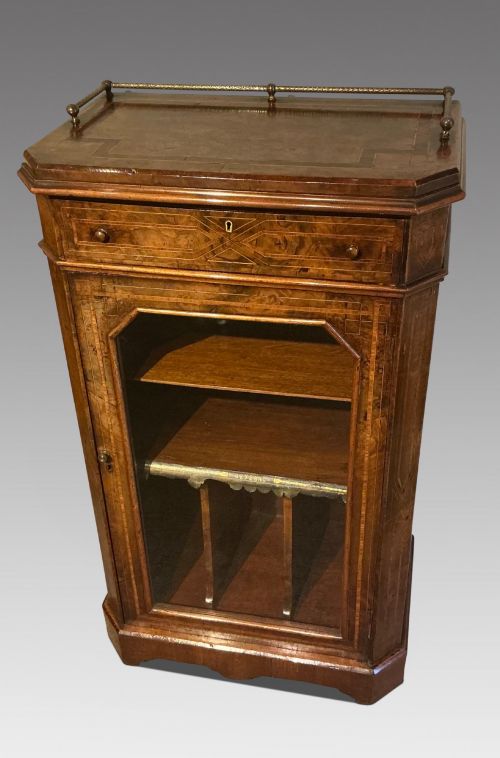
When you search for an inlaid music stand, you find a variety of specialised furniture designed to hold scores, books, and reading materials, predominantly originating from the Victorian and Edwardian eras. The selection spans upright music cabinets, open canterburys, reading tables, and adjustable stands produced in walnut, mahogany, and rosewood. You are most likely to encounter Edwardian mahogany cabinets and Victorian burr walnut canterburys incorporating decorative wood inlay or marquetry.
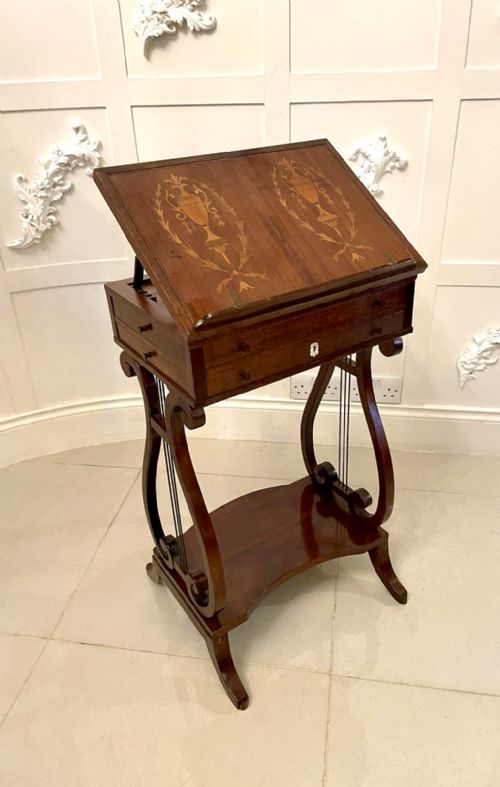
The functional forms reflect the musical habits of period parlours, ranging from compartmentalised cabinets with drop-down or panelled doors to compartmentalised canterburys on castors. Many incorporate brass hardware, lyre-shaped supports, or adjustable reading ledges tailored for practical use in domestic parlours and drawing rooms.
How they were made
Cabinet-makers relied on solid hardwoods and choice veneers, notably mahogany, burr walnut, and rosewood, applied to sturdy framing. Contrasting timbers such as satinwood, ebony, and lighter fruitwoods formed the delicate stringing and pictorial marquetry seen across drawer fronts and top panels.
Structural elements often integrated turned wooden supports, brass hinges, castors for mobility, and adjustable reading ratchets. Surface decoration was finished with hand-applied polish that highlighted the natural grain and the precision of the contrasting inlay work.
Listings feature mahogany, burr walnut, rosewood, and satinwood pieces spanning the Regency, Victorian, and Edwardian periods.
What varies in quality
The distinction between standard production pieces and finer workshop examples lies in the crispness of the cabinetry and the complexity of the inlay. Master makers employed detailed marquetry, balanced timber selection, and substantial brass mounts rather than simpler painted or minimal stringing.
Proportion and mechanical execution also differentiate the range, as adjustable reading stands and compartmentalised cabinets require robust hinges, smooth drawer actions, and sturdy internal partitions that remain aligned over decades of use.
GM Elwood for JS Henry·Collinson and Lock London
The Inlaid Music Stand Glossary
- Canterbury
- A low, freestanding stand with partitioned sections designed to hold sheet music, magazines, or folios. These often feature a single lower drawer and small castors for easy movement across carpets.
- Marquetry
- The art of forming decorative patterns and pictures on furniture using thin veneers of different woods, metals, or shells. This technique defines the detailed floral and geometric motifs found on cabinet doors and tops.
- Stringing
- A narrow strip of contrasting timber inlaid into the surface of a piece to create a fine border or outline. It is a hallmark of Edwardian and Georgian cabinet-making.
- Upstand
- A raised decorative wooden barrier at the back or sides of a cabinet, reading table, or stand. It frequently incorporates carved or inlaid details.
- Lyre
- A symmetrical ornament shaped like an ancient stringed instrument, commonly used as a central support or motif on music stands and reading tables.
Inlaid Music Stand: Frequently Asked Questions
What is the difference between a music cabinet and a canterbury?
A music cabinet is an enclosed piece of furniture featuring hinged doors or drop-down panels designed to keep sheet music concealed and protected from dust. They often include internal shelving or vertical dividers specifically sized for folios.
In contrast, a canterbury is typically an open-sided stand with vertical partitions allowing easy access to magazines and current music sheets, frequently fitted with a small drawer underneath and mounted on castors.
How do I distinguish between Victorian and Edwardian pieces?
Victorian examples tend to use rich, dark timbers such as burr walnut and heavy mahogany, often featuring deeper tones, substantial brass hardware, and elaborate marquetry panels. The construction is solid and formal, reflecting nineteenth-century drawing-room aesthetics.
Edwardian pieces generally present a lighter appearance, favouring satinwood inlay on brighter mahogany or rosewood frames. The designs are often more restrained and slender, aligning with the turn-of-the-century shift towards airier domestic interiors.
Were these stands only used for sheet music?
While originally commissioned to house piano scores and vocal music for Victorian and Edwardian households, their practical compartmentalisation suited other printed media. Many were adapted during their period of use for periodicals, newspapers, and contemporary books.
Today, owners frequently utilise the partitioned sections of canterburys and cabinets for modern magazines, vinyl records, or writing folios alongside their traditional function.
How should I care for an inlaid wooden music stand?
Maintain the finish by keeping the piece away from direct sunlight and sudden temperature changes, which can cause delicate wood veneers and stringing to lift or crack. Dust regularly with a dry, soft cloth and occasionally apply a quality furniture wax to nourish the timber.
Avoid using modern liquid polishes or silicone-based sprays, as these can penetrate the grain and damage historic polished surfaces over time.