
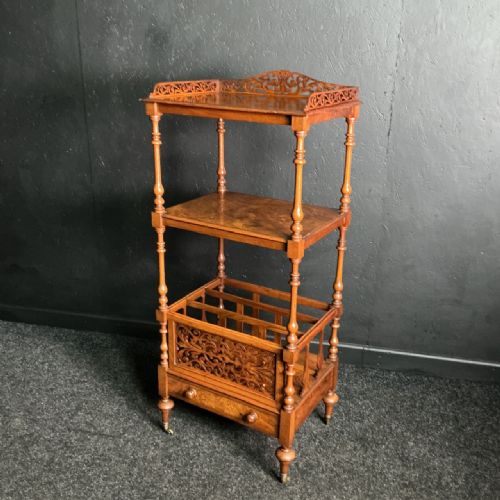
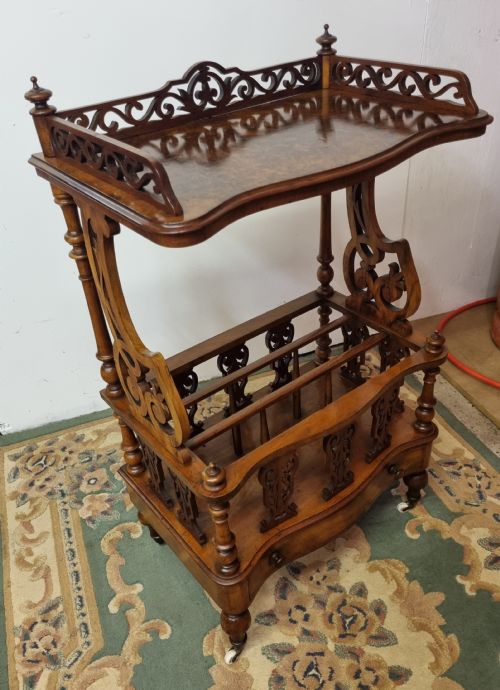
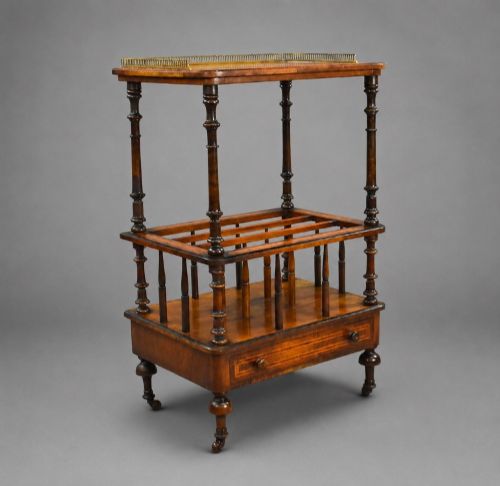
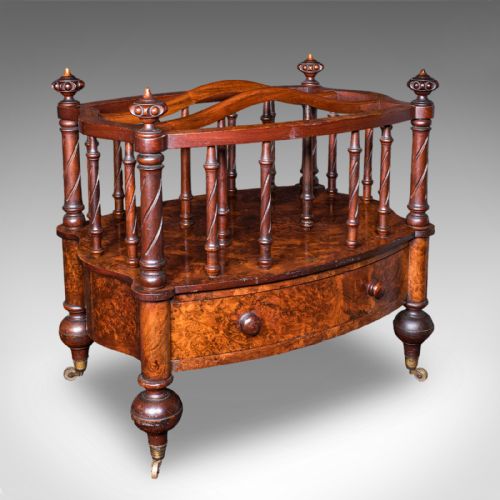
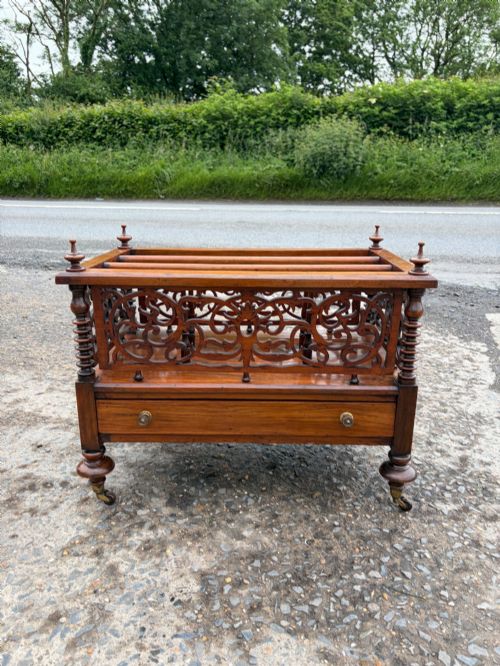


Victorian Walnut Canterbury
These Victorian walnut canterburys bring rich timber and tiered sectioning to a room, offering both character and practical display.
Victorian Walnut Canterburys
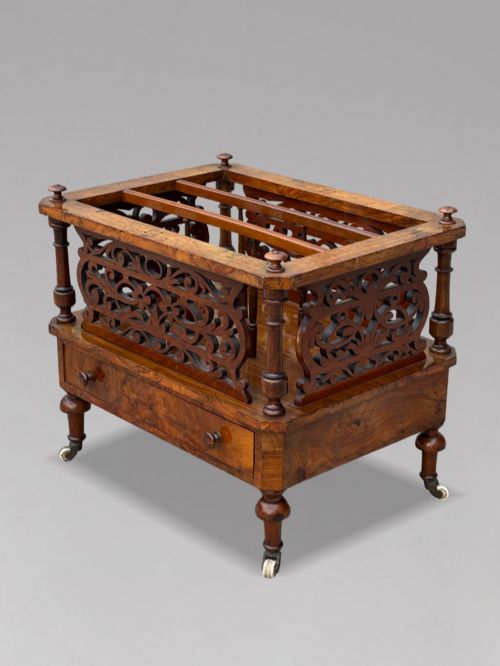
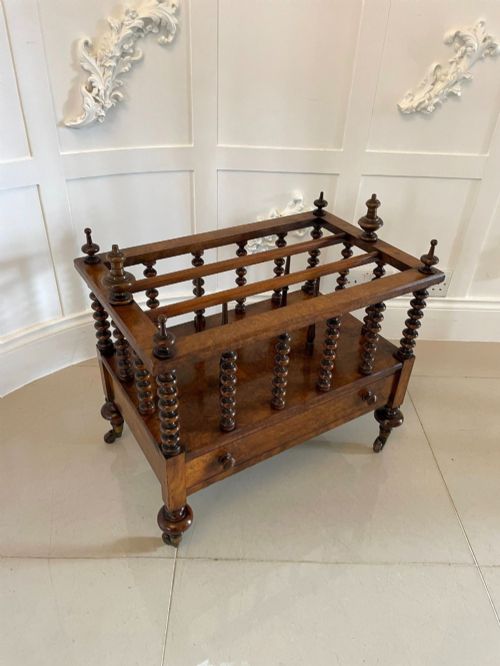
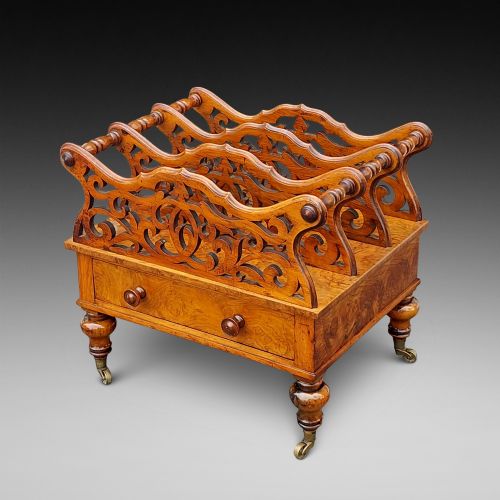
A victorian walnut canterbury is a low stand originally designed to hold sheet music or books in nineteenth-century sitting rooms. The form typically stands on castors with vertical partitions to keep folios upright.
Most examples found here date across the nineteenth century, frequently around eighteen seventy or eighteen sixty. They appear simply as compartmentalised racks or combined with a lower drawer and upper shelving.
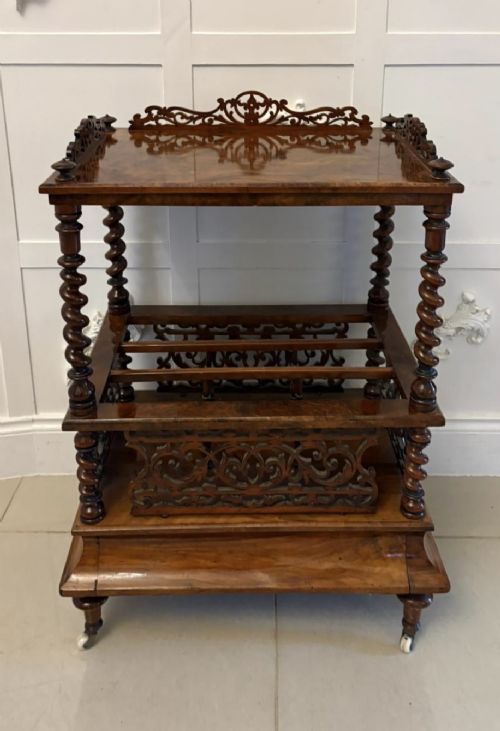
Makers often expanded the basic function, turning these pieces into whatnots, music stands, or combined magazine racks. Walnut and burr walnut dominate the selection, bringing warm tone and striking grain to the domestic interior.

Materials and Construction
Cabinet makers utilised walnut, burr walnut, and figured walnut veneers over secondary timbers, often accenting surfaces with boxwood and ebony inlay. Metal fittings such as brass castors support the base structures.
Construction methods include turned uprights, pierced fretwork panels, and fitted drawers. Ceramic components and metal elements appear on select examples to aid mobility and secure compartments.
Retail Price Guide 2026
Typical UK retail prices for victorian walnut canterbury, calculated from the Sellingantiques database of over a million retail prices indexed since 2003. This retail price guide relies exclusively on Sellingantiques data; no external sources or auction records are used, so the figures do not describe the wider market.
The archive records occasional dome-top designs and combination pieces functioning as music stands alongside standard compartmentalised racks.
Judging Quality
The distinction between standard pieces and the finest examples lies in the selection of wood. Burr and figured walnut veneers with strong, natural patterning elevate the visual weight of the piece.
Hand-worked detail such as fine pierced fretwork, intricate boxwood and ebony inlay, and integrated drawers demonstrate superior craftsmanship. Robust turned supports and clean joinery separate workshop standards.
Edwards & Roberts·T Wilson of London
The Victorian Walnut Canterbury Glossary
- Canterbury
- A low stand with partitions for holding music sheets, books, or magazines, developed during the late eighteenth century and popular throughout the Victorian era.
- Whatnot
- A piece of open shelving furniture used for displaying ornaments and small objects, frequently combined with a canterbury base in nineteenth-century homes.
- Burr walnut
- Timber taken from the abnormal growth of a walnut tree, producing highly prized, swirling grain patterns used for decorative veneer.
- Fretwork
- Ornamental perforated woodwork created by cutting intricate patterns through a thin board, seen on partition dividers and gallery rails.
- Inlay
- A technique where contrasting materials such as boxwood and ebony are inserted into recessed portions of the walnut surface to form decorative motifs.
Frequently Asked Questions
What is a canterbury used for?
These stands were traditionally built to store sheet music, folios, and books near a piano or seating area.
Today, they serve equally well holding magazines, newspapers, or contemporary reading material in a living room.
How do I date a walnut canterbury?
Dating relies on stylistic clues like turned supports, fretwork patterns, and the inclusion of drawers or upper whatnot shelves.
Most pieces belong to the nineteenth century, often aligning with the eighteen sixties and seventies through construction details and timber choice.
Are these pieces freestanding?
Most examples are designed to stand independently in a room, often raised on castors for easy movement across carpets.
Their finished backs and detailed sides allow them to sit away from walls rather than flush against them.
What is the difference between a canterbury and a whatnot?
A traditional canterbury focuses on partitioned sections at floor level for holding upright media or music.
A whatnot incorporates tiered open shelves above the base unit for displaying decorative objects and small ceramics.