
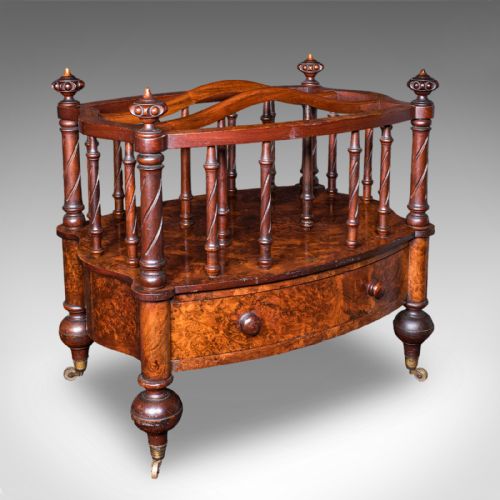
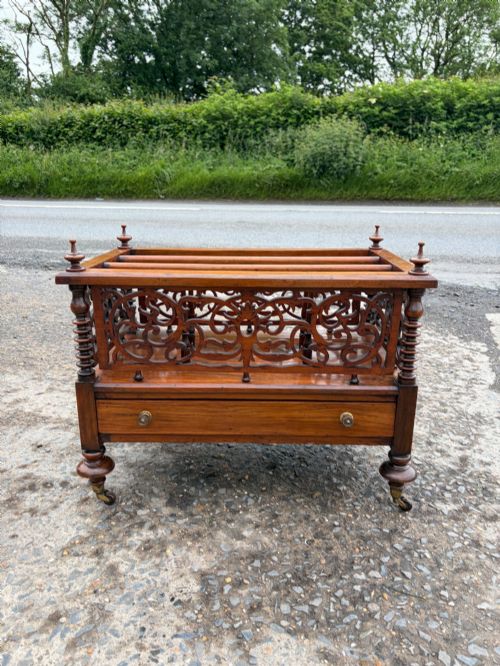
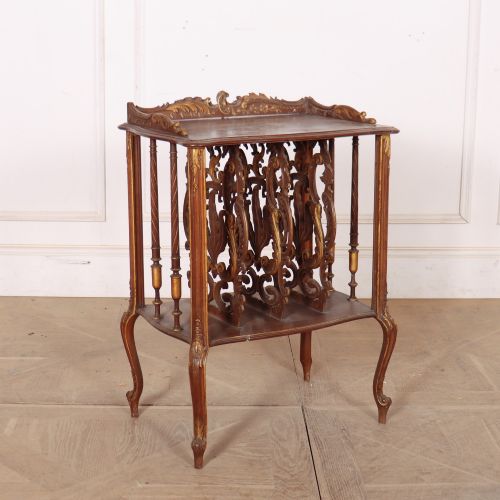


Brown Walnut Canterbury
These brown walnut canterbury pieces combine practical compartmentalised storage with the rich warmth of figured timber.
Brown Walnut Canterbury
A brown walnut canterbury is a low stand traditionally designed for holding sheet music, newspapers and magazines, often fitted with dividers and occasional drawers or work tops. Buyers seeking a brown walnut canterbury will encounter pieces predominantly from the Victorian and Edwardian eras, alongside examples spanning the nineteenth century and Regency period.
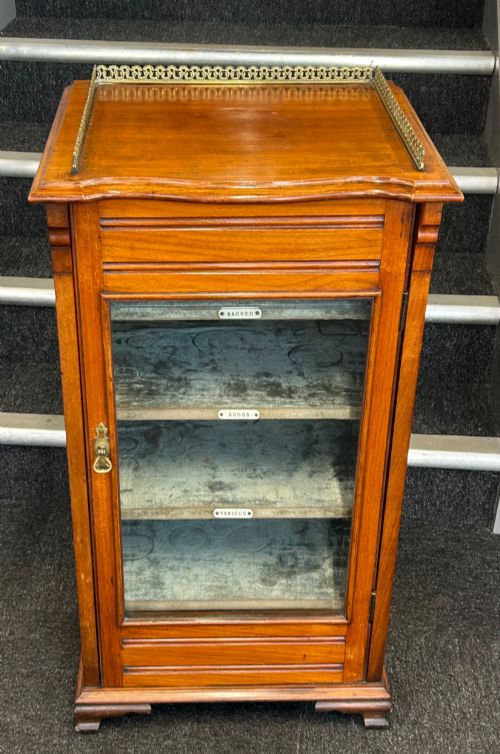
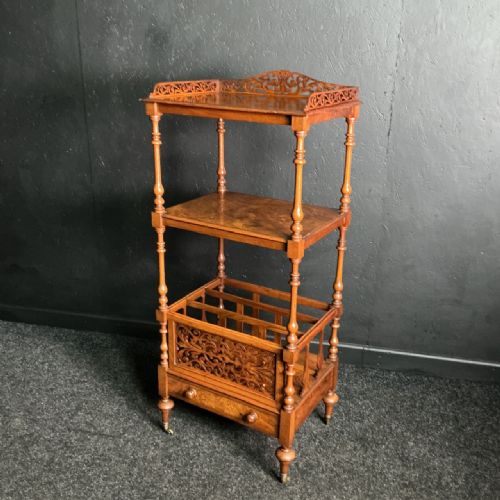
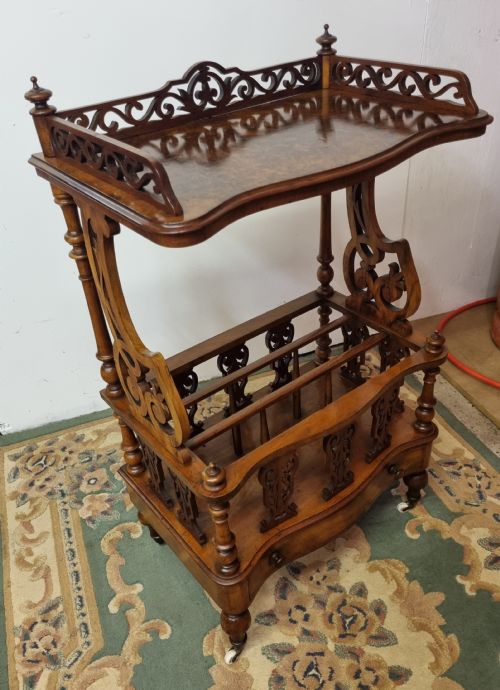
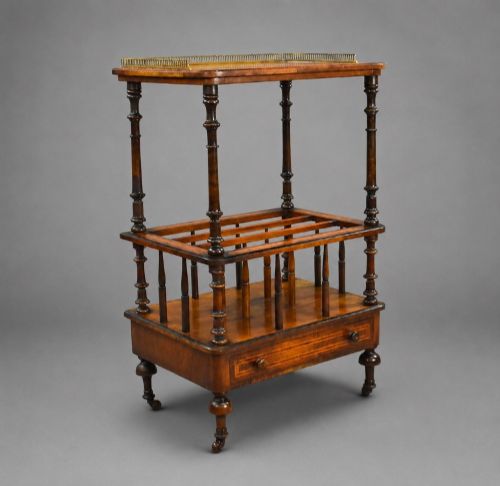
The forms on this page range from classic serpentine and inlaid canterburys to combined whatnots, music cabinets, side tables and magazine stands. Victorian and Edwardian interpretations dominate the selection, frequently utilising burr walnut, black walnut and figured timber veneers.
Many items incorporate functional elements such as fretwork, ceramic or brass castors, and fabric or glass details. Whether configured as a standalone stand, a music cabinet, or a whatnot table, each piece reflects nineteenth-century domestic organisation.
Materials and construction
These items are constructed primarily from walnut and burr walnut, valued for their deep brown colour and distinctive grain patterns. Cabinet makers utilised solid wood alongside figured veneers to create decorative surfaces on tops and drawer fronts.
Inlay, wood inlay, and fretwork provide ornamentation on many nineteenth-century examples, while brass, glass, and ceramic details appear on castors, handles, and cabinet doors. Structural elements often involve turned wooden supports, shaped partitions, and dovetailed drawers.
Some nineteenth-century makers thoughtfully included tiny drawers specifically for storing tuning forks and piano keys.
Quality and craftsmanship
Quality in a brown walnut canterbury rests upon the selection of the timber and the precision of the cabinetwork. Pieces featuring highly figured burr walnut veneers, intricate wood inlay, and refined fretwork represent the upper tier of production.
Substantial proportions, well-turned supports, and integrated drawers or work tops distinguish superior examples from simpler utilitarian racks. The integration of functional hardware, such as original brass castors and fitted internal partitions, marks the difference in standard.
Shoolbred
The Brown Walnut Canterbury Glossary
- Burr walnut
- A specialised timber veneer harvested from the growth excrescences of walnut trees, yielding highly decorative, swirling grain patterns. It is frequently employed on the primary display surfaces of Victorian furniture.
- Canterbury
- A low stand featuring vertical partitions, originally designed for holding sheet music or books. Nineteenth-century versions often incorporate drawers, table tops, or whatnot tiers.
- Whatnot
- A piece of open shelving furniture with multiple tiers used for displaying ornaments or holding books. They are frequently combined with canterbury bases in Victorian designs.
- Inlay
- A decorative technique where contrasting materials such as lighter woods are inserted into recesses within the walnut surface. This creates geometric or floral patterns across panels and table tops.
- Fretwork
- Openwork ornamentation cut into thin sheets of wood using a saw. It appears as delicate decorative panels on the sides or partitions of nineteenth-century stands.
Brown Walnut Canterbury: Frequently Asked Questions
What is a brown walnut canterbury used for?
These stands were originally designed to hold sheet music, newspapers, and periodicals within compartmentalised sections near a piano or seating area. In modern interiors, they function effectively as magazine racks, side tables, or decorative display pieces.
Their compact dimensions allow them to fit easily beside armchairs or against walls while providing useful partitioned storage.
How do I date a Victorian canterbury?
Dating relies on examining the timber selection, construction methods, and decorative styles visible across the piece. Mid-Victorian examples often feature rich burr walnut veneers, turned supports, and elaborate fretwork or inlay.
Later Edwardian versions tend to have cleaner lines, sometimes incorporating glass doors or taking the form of slim music cabinets.
What is the difference between a canterbury and a whatnot?
A canterbury is primarily a low storage stand with vertical dividers designed for papers or music, sometimes featuring a drawer below. A whatnot consists of multiple open display shelves stacked vertically for ornaments and books.
Many nineteenth-century pieces combine both forms, placing a tiered whatnot structure directly on top of a canterbury base.
How do I care for antique walnut furniture?
Maintain walnut surfaces by keeping them away from direct sunlight and heat sources to prevent the wood and veneer from drying out. Regular dusting with a soft, dry cloth preserves the finish without requiring heavy polishes.
Condition the timber occasionally using appropriate wax to maintain the natural lustre of the brown grain.