
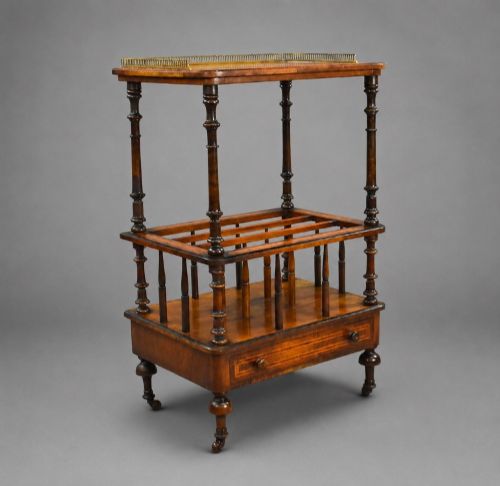


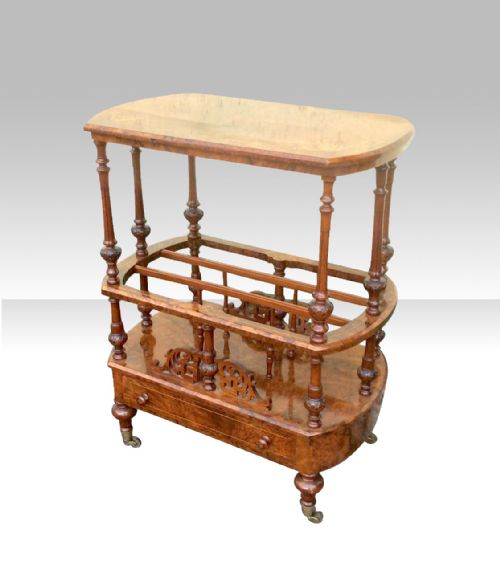


Inlaid Walnut Canterbury
An inlaid walnut canterbury brings together rich burr veneers and delicate stringing to organise sheet music or periodicals with genuine nineteenth-century elegance.
Inlaid Walnut Canterbury
When you search for an inlaid walnut canterbury, you are looking at nineteenth-century pieces designed to hold sheet music, books and papers. The version you are most likely to meet on this page is the Victorian burr walnut Canterbury, often combined with a whatnot tier or a drawer.
These pieces appear in various forms across the Victorian period, including rectangular magazine racks, music cabinets and oval lamp tables. Many examples incorporate dividers for upright storage alongside lower drawers or turned supports.
How they were made
Cabinet makers utilised figured burr walnut veneers over solid timber carcasses to create rich patterned surfaces on these nineteenth-century pieces. Boxwood and contrasting wood inlay formed linear stringing and marquetry details across the tops and panels.
Additional strength and mobility came from turned wooden columns, brass castors, and ceramic elements. Fretwork panels and leather details also appear on specific music cabinets and stands.
Inlaid Walnut Canterbury Retail Price Guide 2026
Typical asking prices for inlaid walnut canterbury among the pieces listed under this phrase on Sellingantiques today, from the lower quarter to the upper quarter. They describe what is for sale here now, not the wider market.
Some nineteenth-century makers integrated small drawers beneath the music partitions so pianists could easily misplace their tuning forks.
What varies in quality
The standard of an inlaid walnut canterbury rests largely on the choice of burr veneer and the precision of the marquetry work. Richly figured grain patterns and crisp boxwood stringing set apart the finest examples from plain or simpler constructions.
Proportion and extra functions also dictate quality. Pieces combining a music cabinet or whatnot tier with lower drawers and substantial turned supports command greater interest than basic magazine racks.
The Inlaid Walnut Canterbury Glossary
- Burr walnut
- A highly figured wood veneer taken from the growth excrescences on walnut trees. It yields complex swirling patterns highly prized by nineteenth-century cabinet makers.
- Canterbury
- A low piece of furniture featuring upright partitions for holding sheet music or periodicals. It frequently includes lower drawers and shelf tiers.
- Whatnot
- An open set of multi-tiered shelves used for displaying ornaments or books. Victorian makers frequently combined this form with the lower section of a canterbury.
- Marquetry inlay
- Decorative patterns formed by fitting contrasting pieces of wood veneer into a prepared ground. It appears across panels and tabletops.
- Fretwork
- Openwork ornamentation cut through thin timber boards. This technique decorates the partition panels of specific music stands.
Inlaid Walnut Canterbury: Frequently Asked Questions
What was a canterbury used for?
These pieces served primarily to store sheet music, books and periodicals near a piano or seating area in nineteenth-century drawing rooms.
Many examples included integrated drawers for smaller accessories or upper tiers to display decorative items.
Are these pieces suitable for modern magazines?
The vertical partitions and upright racks accommodate contemporary periodicals, books and sheet music quite easily.
Their compact footprints make them practical as lamp tables or side units in contemporary living spaces.
What is the difference between a canterbury and a whatnot?
A traditional canterbury focuses on partitioned upright storage for papers, while a whatnot consists entirely of open display shelves.
Victorian makers frequently combined both forms into a single piece featuring shelving above and partitioned storage below.