
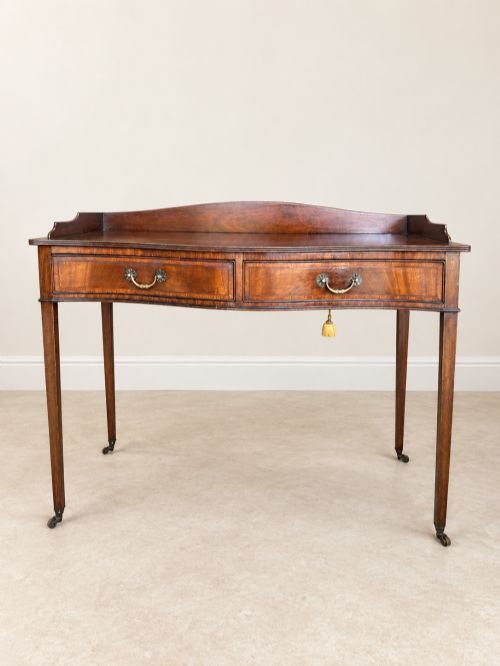
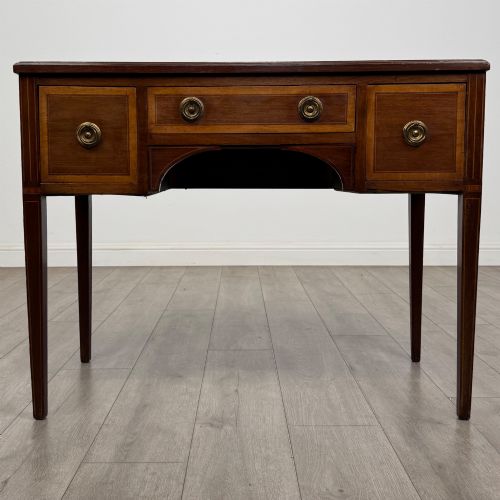
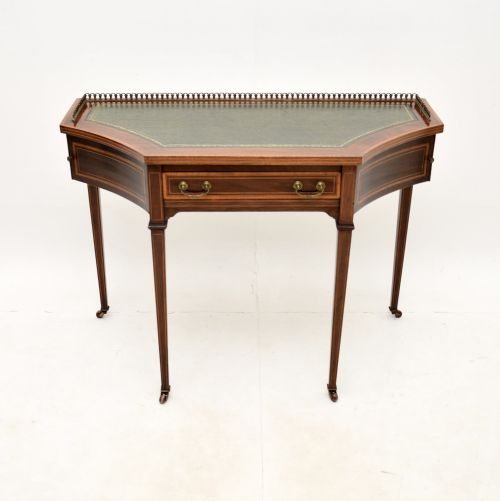
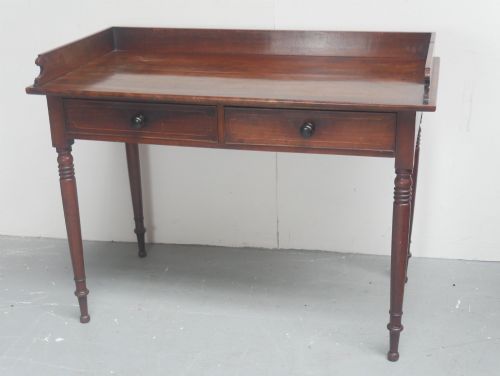

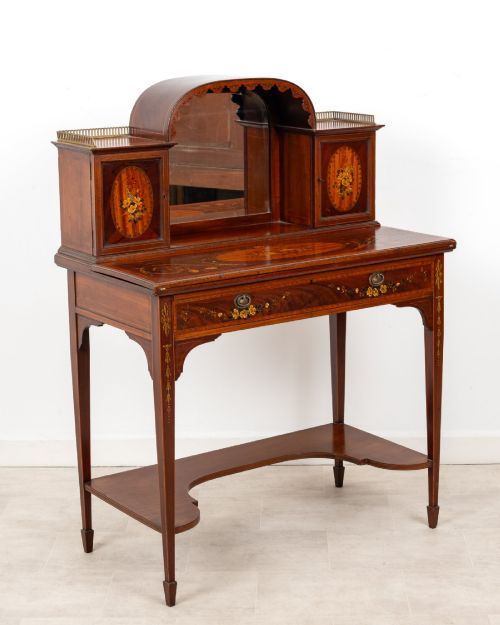

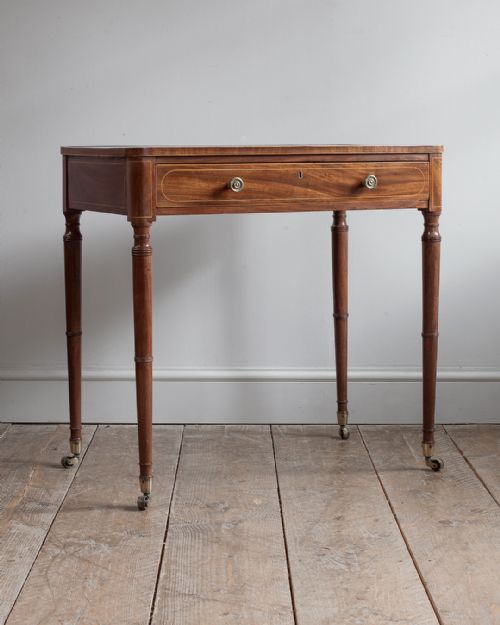

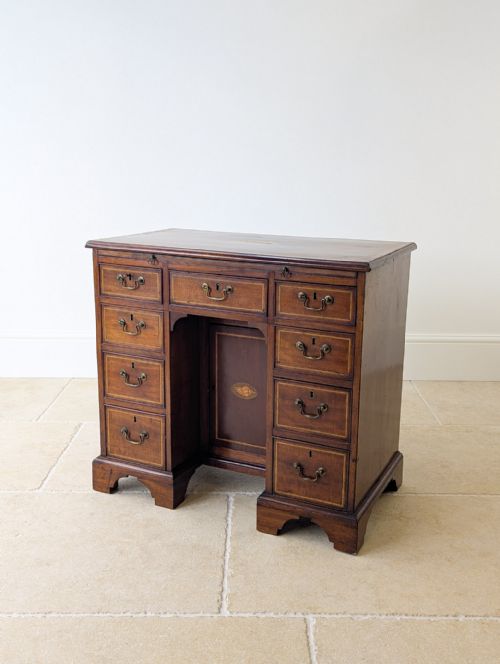
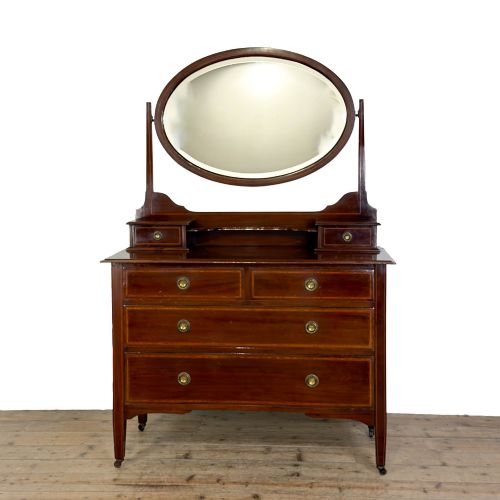

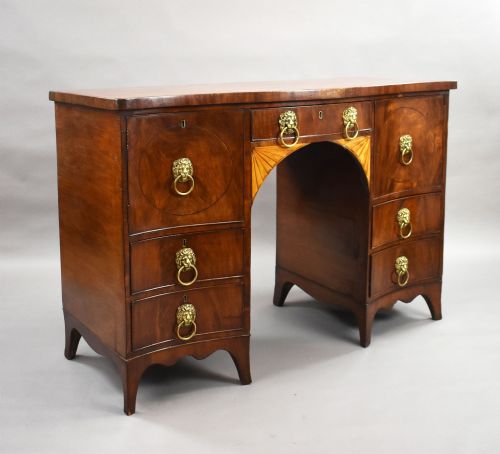

Inlaid Mahogany Dressing Desk
An inlaid mahogany dressing desk brings refined warmth to a room, offering a dedicated writing surface finished with delicate contrasting wood details.
Inlaid Mahogany Dressing Desk
When you search for an inlaid mahogany dressing desk, you encounter pieces spanning from the Georgian and Regency periods through to the Edwardian era and the early twentieth century. These items serve multiple functions as writing tables, dressing tables, and lowboys, often sharing similar proportions and drawer configurations.
The Edwardian examples and Sheraton Revival interpretations appear most frequently on this page, alongside earlier nineteenth-century forms. Makers such as Edwards & Roberts and James Shoolbred produced notable versions of these desks during the late Victorian and Edwardian periods.
Formations range from rectangular kneehole desks and side tables to curved kidney shapes. Certain pieces integrate mirrors for dressing use, while others maintain a clean surface intended purely for correspondence.
Materials and Construction
Cabinet makers utilised solid mahogany and mahogany veneers as the primary structural and visual base for these desks. This timber provides a stable ground that accepts polish well and deepens in tone over the decades.
Satinwood and boxwood inlay create contrasting borders, geometric stringing, and decorative motifs across drawer fronts and tabletops. Brass hardware, leather inserts, and occasionally glass or marble tops complete the construction details found in the evidence.
The listings show mahogany combined with satinwood, boxwood, brass, leather, and glass across Georgian, Regency, Victorian, and Edwardian periods.
Assessing the Standard of Workmanship
Quality rests in the crispness of the inlay work and the selection of the mahogany grain. Finer pieces display precise, tight boxwood and satinwood banding that follows the contours of curved kidney tops without lifting or gaps.
The handling of secondary timbers inside the drawer boxes and the weight of the brass fittings indicate the level of craftsmanship. Desks bearing signatures or stamps from established firms like Edwards & Roberts or James Shoolbred often reflect superior execution in their carving and joinery.
Edwards & Roberts·James Shoolbred·Maple & Co.
The Inlaid Mahogany Dressing Desk Glossary
- Inlay
- A technique where pieces of contrasting timber, such as satinwood or boxwood, are set flush into the mahogany surface to form decorative patterns. This adds visual complexity without altering the flat plane of the desk.
- Kidney shape
- A curved, asymmetrical desk profile resembling a kidney bean. This form is particularly common among Edwardian inlaid writing and dressing tables.
- Kneehole desk
- A form featuring a central recess for the user's legs, flanked by pedestals or banks of drawers. Georgian and later nineteenth-century makers frequently utilised this layout.
- Lowboy
- A small, low table with drawers, typically raised on four legs. Georgian examples in mahogany often serve as precursors to later dressing and writing tables.
- Sheraton Revival
- A late nineteenth and early twentieth-century style inspired by the designs of Thomas Sheraton. Pieces in this style frequently incorporate fine mahogany veneers and delicate inlaid decoration.
Inlaid Mahogany Dressing Desk: Frequently Asked Questions
How do I tell a dressing table from a writing desk?
Dressing tables often incorporate mirror frames or shallower top compartments designed for personal grooming items. Writing desks focus on flat or leather-lined surfaces intended for correspondence and paperwork.
Many period examples served interchangeable functions, acting as both dressing tables and writing desks depending on the room and the owner's needs.
What is the difference between Edwardian and Georgian desks?
Georgian desks originate from the eighteenth and early nineteenth centuries, featuring robust proportions and often classical architectural lines. Edwardian pieces reflect lighter, revivalist aesthetics, frequently employing delicate satinwood inlay and kidney shapes.
Construction methods also shift over time, with Edwardian workshops utilising more standardised internal components while maintaining traditional dovetailing.
How should I care for an inlaid mahogany surface?
Keep the wood away from direct sunlight and strong heat sources to prevent the mahogany from fading and the delicate boxwood or satinwood inlay from drying out. Regular dusting with a soft, dry cloth maintains the finish without building up heavy wax residues.
Apply a quality beeswax sparingly only when the wood appears dry, buffing it gently to preserve the natural sheen of the polish.
Where does satinwood appear on these desks?
Satinwood is typically used for contrasting banding, oval medallions, or stringing lines that trace the borders of tabletops and drawer fronts. Its pale, golden hue stands out vividly against the darker red tones of mahogany.
In some pieces, entire drawer fronts or decorative panels feature satinwood veneer to create a striking two-tone visual effect.