


Indian Carved Hall Table
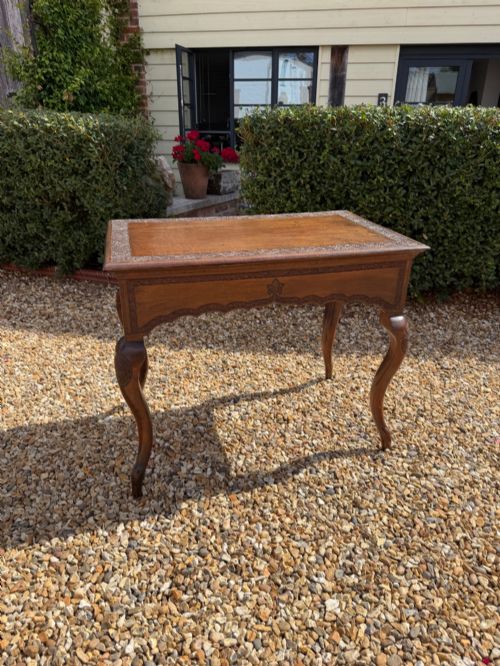
These pieces are solid Indian carved hall table forms, built for narrow spaces and grand entrances alike.
Indian Carved Hall Table
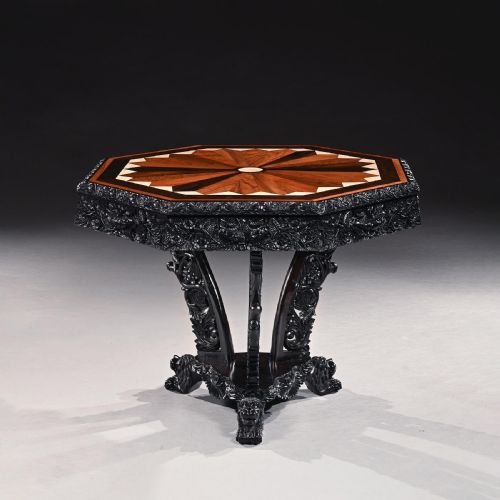
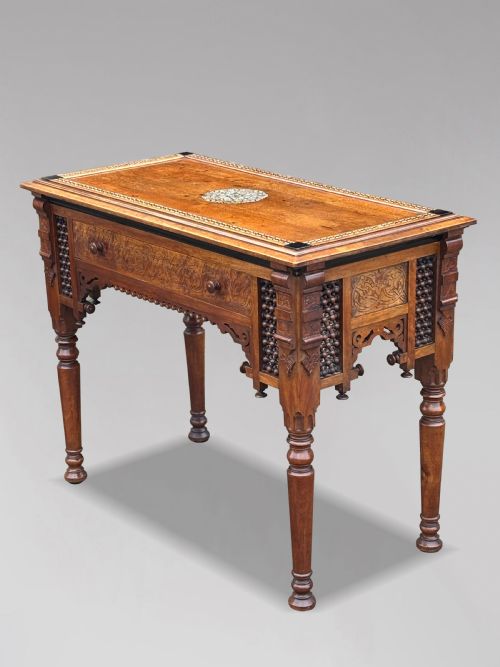
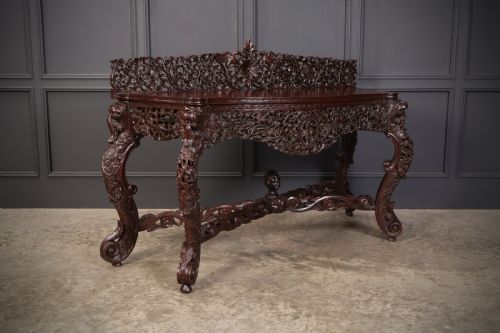
An Indian carved hall table brings together dense regional hand-carving and British colonial domestic forms. When looking for an Indian carved hall table, one encounters console tables, centre tables, occasional tables, side tables, and even hall benches.
The objects stem predominantly from the 19th Century, including specific years like 1860, 1880, 1900, and the Victorian period. They bridge cultures through Anglo-Indian, Aesthetic Movement, Moorish, Burmese, and Oriental Export styles.
Materials and Construction
Cabinetmakers utilised rich timber species such as teak, rosewood, padauk, ebony, walnut, coromandel, and general hardwood. These dense woods provided a stable canvas for deep, figurative and geometric carving.
Selected examples incorporate bone inlay and specimen wood marquetry to create striking contrast against the dark carved surfaces.
Listings feature 19th-century periods, including 1860, 1880, and 1900, constructed from teak, rosewood, ebony, padauk, and bone inlay.
Assessing Craftsmanship
Quality rests in the crispness of the hand-carving and the choice of dense, highly figured timbers like coromandel or ebony over standard hardwoods. Tables with intricate bone inlay or complex structural turns show greater workshop investment.
The sophistication of the colonial design integration, whether Anglo-Indian or Burmese, dictates the visual weight and balance of the finished piece.
The Indian Carved Hall Table Glossary
- Anglo-Indian
- Furniture made in India during the British period, combining local carving traditions with European forms.
- Padauk
- A heavy, durable tropical timber with a distinct reddish-brown tone, favoured for carved colonial tables.
- Bone Inlay
- The technique of embedding small pieces of bone into wood to form geometric or floral patterns.
- Console Table
- A table designed to stand against a wall, frequently supported by ornate brackets or carved legs.
Indian Carved Hall Table: Frequently Asked Questions
What is an Indian carved hall table?
An Indian carved hall table is a 19th-century colonial piece created using dense tropical hardwoods and intricate hand-carving techniques.
These tables were built for hallways and reception rooms, merging local craftsmanship with British domestic furniture forms.
Which woods were used?
Common timbers include teak, rosewood, padauk, ebony, walnut, and coromandel.
Some pieces also feature contrasting bone inlay and multi-wood specimen marquetry.
How do I date these tables?
Dating relies on recorded periods from the 19th century, including specific dates around 1860, 1880, 1900, and the Victorian era.
Stylistic markers like Aesthetic Movement influences or regional Ceylonese and Burmese details help narrow the origin.
Where should I place one?
Console and side tables suit narrow corridors, hallways, and entrance spaces where a shallow footprint is required.
Centre tables function well as statement pieces in larger rooms, provided there is walking space around them.