

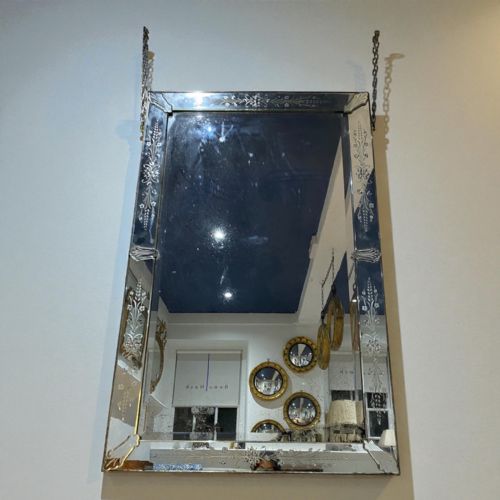
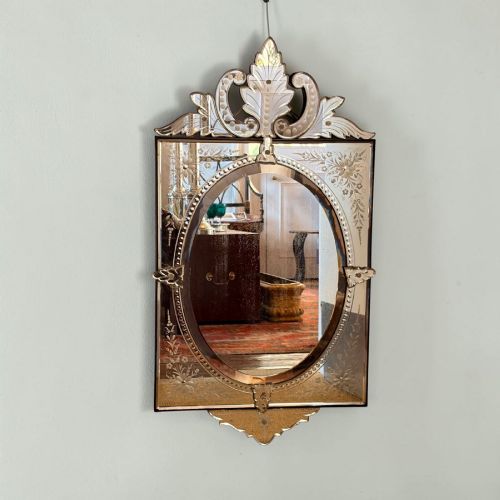
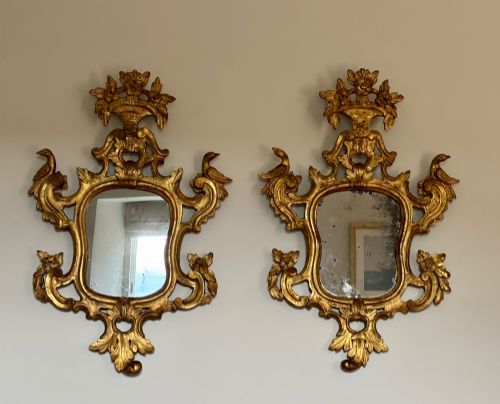


Hanging Venetian Wall Mirror
A hanging venetian wall mirror brings luminous depth and intricate glasswork to an interior, shaped by centuries of Italian design.
Hanging Venetian Wall Mirror
A hanging venetian wall mirror represents a distinct tradition of Italian mirror-making, spanning from the eighteenth century through to the early decades of the twentieth century. These wall mirrors appear in varied interpretations, from eighteenth-century examples to later twentieth-century iterations.
Buyers encountering this search phrase find pieces defined by Venetian and Rococo styles, executed as wall mirrors. The selection encompasses carved gilt-wood frames, cut and etched glass surrounds, and distinct coloured glass borders.
The most traditional forms feature elaborate glass elements or giltwood frames, whilst simpler painted versions also surface. These objects serve as functional wall pieces that double as decorative centrepieces reflecting light across a room.
How they were made
Makers utilised wood, gesso, and giltwood to construct the structural frames of these mirrors, often carving intricate Rococo motifs by hand. Silver-leaf and gold-leaf applications provided the rich metallic surfaces seen on eighteenth-century and later period pieces.
The glass components involve mirrored glass and silvered mirror plates, frequently enhanced with engraved, cut, and etched decoration. Some examples incorporate specialist glasswork, such as a ruby red border surrounding the central plate.
Hanging Venetian Wall Mirror Retail Price Guide 2026
Typical asking prices for hanging venetian wall mirror among the pieces listed under this phrase on Sellingantiques today, from the lower quarter to the upper quarter. They describe what is for sale here now, not the wider market.
Listings span from the eighteenth century through the nineteenth and twentieth centuries, employing materials like giltwood, gesso, and etched glass.
What varies in quality
The distinction between standard and exceptional pieces rests upon the finesse of the hand-carving and the complexity of the glasswork. Elaborate giltwood frames and deeply etched plates demonstrate superior craftsmanship compared to simpler painted alternatives.
Age and material preservation further differentiate the range, as genuine eighteenth-century construction and untouched silver-leaf carry greater historical significance than twentieth-century interpretations.
The Hanging Venetian Wall Mirror Glossary
- Giltwood
- Wood carved and coated with gold leaf or metal leaf. This traditional finish creates a bright reflective surface that catches natural light.
- Rococo
- An ornate artistic style characterised by asymmetrical curves, scrollwork, and natural motifs. It heavily influences the frames of many Italian mirrors.
- Foxed
- Age-related deterioration of the mirror plate backing, resulting in dark spots and a mottled appearance. This chemical change develops naturally over long periods.
- Gesso
- A plaster-like mixture applied to wood frames to provide a smooth base for gilding. Artisans carved intricate details directly into this layered preparation.
Hanging Venetian Wall Mirror: Frequently Asked Questions
How do I hang a heavy antique mirror?
These wall mirrors require secure fixings anchored directly into structural wall studs or masonry using appropriate weight-rated brackets. Professional installation is strongly recommended for larger giltwood and glass-framed pieces.
Ensuring the hanging wire or integrated D-rings match the total mass prevents frame distortion and accidental structural failure over time.
Are these mirrors genuinely eighteenth century?
Authentic pieces carry period characteristics within their construction methods, wood ageing, and mercury or early silver-leaf backing techniques. Cross-referencing material wear helps establish true historical origin.
Later twentieth-century interpretations often replicate earlier Venetian styles whilst utilising contemporary glass-cutting methods and modern adhesives.
What causes foxing on the glass?
Foxing occurs when atmospheric moisture penetrates the protective backing behind the silvered glass plate over decades of exposure. This oxidation process creates characteristic dark patches and clouding.
Many collectors value foxing as a sign of genuine antiquity and authentic material ageing rather than a fault.
How should I clean the glass?
Maintenance requires a soft, dry microfibre cloth to gently remove dust from both the glass plate and delicate frame surrounds. Liquid cleaners must be avoided near vulnerable edges and antique silvering.
Keeping moisture away from the frame joints preserves gesso, giltwood, and sensitive cut-glass elements.