




Hand Painted Corner Cupboard
A hand painted corner cupboard turns wasted wall space into a focal point with colour and character.
Hand Painted Corner Cupboard
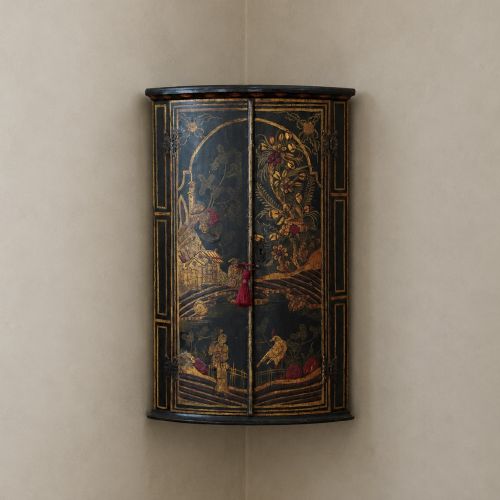
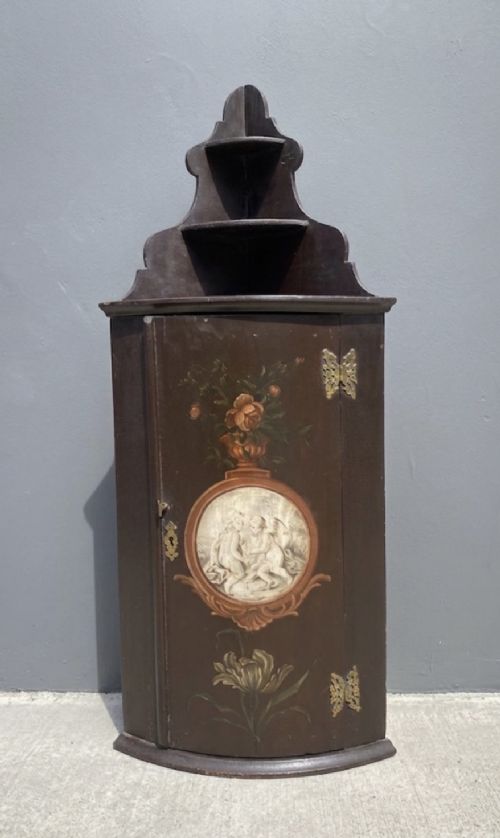
When you search for a hand painted corner cupboard, you encounter timber cabinets designed to fit snugly into room angles, finished with decorative painted surfaces. These pieces range from compact wall-mounted cabinets with internal shelves to taller two-door floor models and barrel back formats.
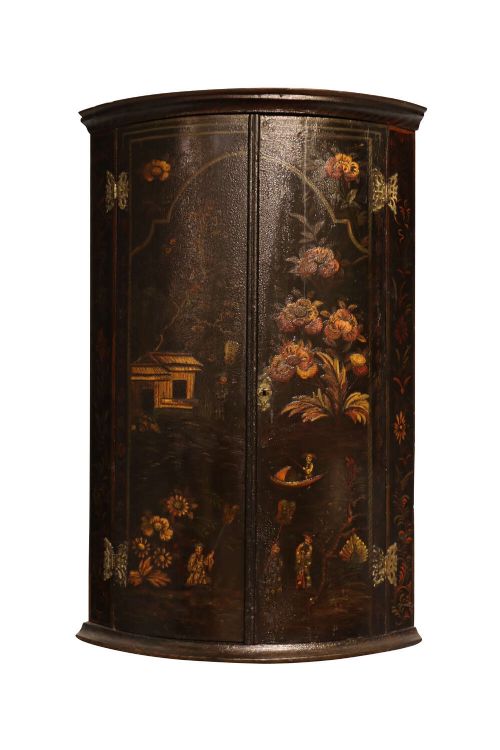
The selections span distinct regional traditions and decorative movements, from Georgian Chinoiserie and black lacquer to Scandinavian folk art, Gustavian white finishes, and Italian Rococo. You are most likely to meet 18th-century and 19th-century examples featuring bow fronts, flat panels, or glazed upper sections.
Makers utilised these painted surfaces to introduce narrative scenes, floral motifs, and gilded highlights into domestic interiors. Whether rendered in subtle Scandinavian neutrals or bold Venetian polychrome, each cabinet serves as both practical storage and decorative art.
How they were made
Carpenters constructed the carcases using traditional timbers such as pine, oak, and satinwood, shaping the curved bow fronts and corner joints to fit domestic angles. Iron hinges, brass escutcheons, and latches secure the doors while adding functional hardware detail to the exterior.
Artisans applied multiple layers of paint, lacquer, or gilt over prepared wood surfaces to achieve smooth or textured finishes. Chinoiserie pieces often involved intricate japanning techniques, building up raised motifs before applying fine brushwork and varnish.
One miniature cabinet recorded in the archive is a tiny dolls child chair in the Hindeloopen style, dated 1796.
What varies in quality
Quality rests in the fidelity of the painted surface, the preservation of the original pigments, and the crispness of the joinery. Finer pieces display confident brushwork and nuanced colour blending, whereas simpler items rely on more straightforward folk motifs.
The structural integrity of the timber carcase and the retention of original brass or iron hardware distinguish superior examples. Cabinets that maintain their untouched decorative schemes command greater appreciation than those with heavy later overpainting.
The Hand Painted Corner Cupboard Glossary
- Chinoiserie
- European decorative style inspired by Chinese art, featuring imaginary landscapes, figures, and pavilions rendered in paint or lacquer. This aesthetic appears frequently on 18th-century black lacquer and japanned corner cabinets.
- Bow front
- A convex, outwardly curving cabinet front that softens the sharp angles of a room. This shape adds visual movement and depth to standard corner furniture.
- Japanning
- European imitation of East Asian lacquerwork involving layered varnishes and metallic dust. Artisans baked and polished these surfaces to create glossy, durable finishes.
- Gustavian
- Swedish neoclassical style characterised by pale painted finishes, restrained carving, and lighter proportions. These cabinets often utilise soft greys, creams, and muted blues.
- Barrel back
- A cabinet interior featuring a curved, semicircular back panel designed to neatly house rounded shelves. This construction was popular in Georgian and Edwardian corner cupboards.
Hand Painted Corner Cupboard: Frequently Asked Questions
How do I hang a wall corner cupboard safely?
Wall-hanging corner cupboards require sturdy fixings anchored directly into masonry or internal timber studs to support the weight of the timber carcase and contents. It is advisable to utilise heavy-duty brackets that engage securely with the internal frame.
Because these cabinets concentrate weight at an angle, professional installation ensures the piece remains stable and flush against both adjoining walls.
What is the difference between Georgian and Gustavian painted cupboards?
Georgian painted cupboards often embrace rich black lacquer, Chinoiserie motifs, and gilded details designed to catch the candlelight in formal reception rooms. They lean towards theatrical decorative schemes.
Gustavian cupboards, originating from Sweden, favour lighter neutral tones, restrained neoclassical lines, and matte painted finishes suited to maximising daylight in northern European homes.
How do I care for antique painted surfaces?
Antique painted and lacquered surfaces require gentle dusting with a soft, dry microfibre cloth rather than wet cleaning agents or harsh chemical polishes. Moisture and modern detergents can lift fragile historic pigments.
Keep painted cupboards away from direct sunlight and steady heat sources to prevent the underlying timber from shrinking and the paint layers from crazing or flaking.
Were these cupboards always meant for corners?
These cabinets were purpose-built with angled backs specifically to utilise awkward room corners that standard rectangular furniture could not occupy. They maximised floor space in smaller domestic rooms.
While some wall-hanging variants function as corner cupboards, others utilise barrel backs designed to nestle tightly into the precise ninety-degree junction of two walls.