
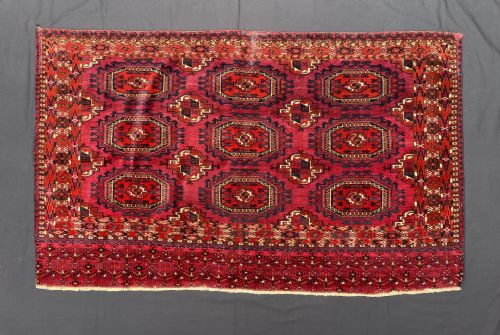


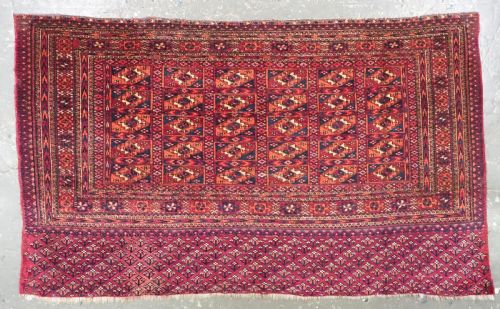


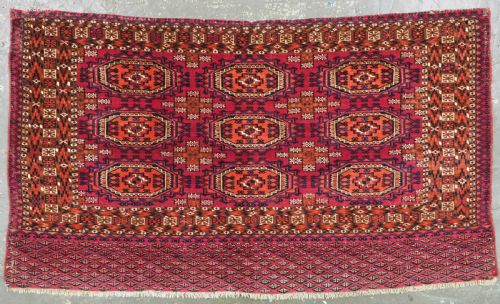


Hand Knotted Wool Chuval
These hand knotted wool chuval pieces are tribal bags from Central Asia designed for household storage.
Hand Knotted Wool Chuval
A hand knotted wool chuval is a traditional Turkmen tribal storage bag originating from Central Asia, including regions like the Akhal Oasis and Afghanistan. These pieces functioned historically as tent bags for bedding and household goods.
The version most commonly met on this page is the chuval face, often preserved as a textile fragment or rug rather than a complete bag with its plain weave back. Formats range from smaller rug sizes down to fragments, reflecting centuries of nomadic utility.
Tribal groups such as the Tekke, Yomut, Ersari, Saryk, and Salor created these textiles, each applying distinct design traditions. Collectors encounter specific gul patterns and structural formats across periods spanning the eighteenth through the early twentieth centuries.
Materials and construction
Makers utilised wool for the pile and foundation, employing hand knotting techniques to build dense, durable textile surfaces. Natural dyes provided the deep colour palettes seen across tribal and nomadic pieces.
Construction methods include complete examples featuring plain weave wool backs and flat woven details, alongside individual faces separated from their original storage structures. Artisans structured the weaving to withstand heavy domestic use within nomadic encampments.
Nomads wove these heavy storage bags on portable ground looms while moving across Central Asian deserts.
Factors determining quality
Quality separates through the density of the hand knotting and the precision of the wool work. Finer knotting allows intricate gul motifs to appear with sharp definition.
The clarity and depth of natural dyes dictate visual success, alongside the integrity of surviving elem panels and border structures. Complete structural preservation, such as retaining the plain weave back, influences how a piece represents its original form.
The Hand Knotted Wool Chuval Glossary
- Chuval
- A large tribal bag made by Turkmen nomads for storage. These items formed an essential part of nomadic household furnishings.
- Gul
- A medallion motif repeated across Turkmen carpets and bags. Each tribal group utilised specific gul designs to identify lineage.
- Elem
- The decorated lower panel of a chuval or main carpet. This section often displays floral or geometric motifs distinct from the main field.
- Torba
- A smaller tribal hanging bag produced in Turkmen weaving traditions. These pieces are distinct from the larger storage chuval format.
Hand Knotted Wool Chuval: Frequently Asked Questions
What is a hand knotted wool chuval?
A hand knotted wool chuval is a traditional tribal storage bag produced by nomadic groups in Central Asia. They served practical domestic purposes within tents.
Today these textiles survive as rug formats, wall art, or textile fragments appreciated for their distinctive tribal designs.
Who made these tribal bags?
Nomadic tribes of Central Asia, specifically groups such as the Tekke, Yomut, Ersari, Saryk, and Salor, produced these woven items. Each tribe maintained distinct design vocabularies.
Regions like the Akhal Oasis and Afghanistan yielded these characteristic tribal textiles during the nineteenth and early twentieth centuries.
How were chuvals used originally?
Nomadic families utilised chuvals inside tents to store bedding, clothing, and household goods. Their sturdy wool construction protected contents during transit.
Over time, many bags were separated from their plain weave backs, leaving individual decorative faces to survive as textile art.
How do you identify different tribal designs?
Tribal attribution relies on examining the repeating gul medallions and the layout of the elem panels. Different groups such as Tekke or Yomut favoured specific geometric configurations.
Structure, wool quality, and natural dye usage also provide clues to the specific origin of each piece.