


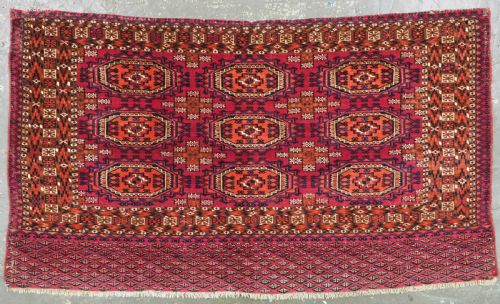


Antique Camel Bag Face
An antique camel bag face brings rich tribal geometry into a room, offering genuine nomadic textiles woven by Turkmen groups.
Antique Camel Bag Face
An antique camel bag face represents a specific category of tribal textile, originating from Turkmen groups such as the Tekke, Yomut, Ersari, Saryk, and Salor. These pieces take the form of torbas or chuvals, which served originally as utility bags for nomadic transport and storage before being separated into wall hangings or small rugs. The examples seen here date from the eighteenth century through to the nineteenth century, including periods around eighteen-eighty and nineteen hundred.
The format usually involves a flat-woven or pile-woven textile fragment displaying traditional guls, such as the aishk gul or the salor 'shemle' gul design. Many surviving pieces retain hanging loops or show evidence of their former life as bag faces, while others exist purely as textile fragments or small rugs. Buyers encounter distinct tribal variations, including Ersari torbas and Tekke chuval faces, each carrying the specific design grammar of its maker.
Materials and construction
The construction relies primarily on wool and silk, utilising natural dyes to achieve the deep reds, browns, and secondary tones characteristic of Turkmen weaving. Silk highlights often appear alongside wool pile or embroidery, adding textural contrast and catching the light across the central guls.
Weavers constructed these tribal textiles using traditional knotting and weaving techniques, sometimes incorporating structural elements like hanging loops attached directly to the top edge. The materials reflect pastoral nomadic resources, where durable wool formed the structural base and natural dye baths provided lasting colour.
Camels carried these bags across the desert before their decorative faces ended up hanging quietly on twentieth-century living room walls.
Factors of quality
Quality rests in the crispness of the tribal guls and the density of the weave, where finer knots and precise geometric layouts distinguish superior examples. The presence of silk highlights and the retention of original hanging loops or complete formatting add considerable interest to a textile fragment.
The depth and stability of natural dyes also set pieces apart, alongside the clarity of the design arrangement, whether a Yomut aishk gul or a Tekke multiple gul layout. Condition plays a role, though age-related wear on eighteenth-century and nineteenth-century pieces remains standard for functional nomadic items.
The Antique Camel Bag Face Glossary
- Torba
- A small Turkmen bag used traditionally for household storage inside a tent. These pieces often feature a prominent face design.
- Chuval
- A larger Turkmen tent bag used for storing bedding and household goods. The face of the bag is frequently preserved as a decorative textile.
- Gul
- A primary medallion or repeating floral motif characteristic of Turkmen carpet and textile design. Different tribes utilised distinct guls to signal identity.
- Fragment
- A surviving portion of a larger historical textile. Many older examples exist in this state due to heavy historical use.
Antique Camel Bag Face: Frequently Asked Questions
What is a camel bag face?
A camel bag face is the decorative front portion of a large storage bag used by nomadic Turkmen tribes. These items were mounted on animals or kept inside tents for storage.
Over time, many of these functional bags were separated into individual panels, leaving collectors with the decorative face as a textile wall hanging or small rug.
How do I hang a textile fragment?
Many surviving chuval faces and torbas feature original hanging loops attached to the top edge. This makes them straightforward to mount on a wall using a thin rod or batten.
For pieces without loops, professional conservators can attach a discreet sleeve or support backing to distribute the weight evenly across the wool.
How do I identify tribal designs?
Tribal attribution relies on the specific guls and border motifs woven into the piece. Tekke, Yomut, Ersari, and Saryk weavers each used distinct medallion shapes and colour palettes.
Reference books on Turkmen carpets help match particular guls, such as the aishk gul or the salor 'shemle' design, to their specific origins.
Are these pieces from the nineteenth century?
The listings span the nineteenth century, with specific examples dated around eighteen-eighty, eighteen-seventy, and mid-nineteenth century. Earlier examples from the seventeen-fifties also appear.
Testing natural dyes and examining the wool structure helps confirm the age and nomadic origin of each textile.