

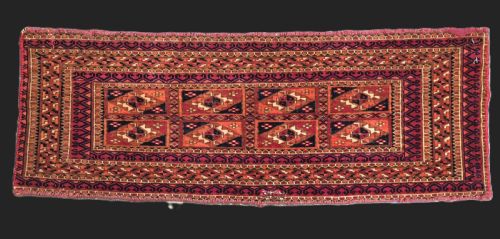


Hand Knotted Torba Face
These hand knotted torba face examples are Central Asian nomadic storage bag fronts woven by Turkmen tribes, prized for their rich tribal guls.
Hand Knotted Torba Face
A hand knotted torba face represents the front portion of a traditional Turkmen storage bag, originating from the tribal weaving traditions of Central Asia. These textiles were produced across the Trans-Caspian steppes by groups such as the Tekke, Yomut, Ersari, and Saryk tribes. They served practical domestic functions within nomadic tents before surviving as collectible tribal art.
The version most commonly encountered on this page is the nineteenth-century torba or mafrash face displaying repeating guls or medallion motifs. Pieces frequently date from the mid-nineteenth century through to the early twentieth century, encompassing smaller bag faces and occasional fragments. They display distinct tribal layouts including Salor, Kepse, and 'aina gul designs.
Materials and construction
The construction relies fundamentally on wool, often hand-spun, combined with cotton elements used in the foundation or structural areas. Artisans utilised natural dyes to achieve deep red grounds alongside ivory and darker contrasting tones. The knotting is densely executed, particularly on finer examples originating from mid-nineteenth-century looms.
Weavers arranged traditional motifs such as chuval guls, curled leaf patterns, and ikat-inspired designs across the wool surface. The resulting textile is durable yet flexible, reflecting the nomadic requirement for utilitarian objects that could withstand daily camp life. Surviving pieces often show the cut edges where the front was separated from the original bag backing.
Listings feature works spanning from eighteen-fifty to nineteen-twenty, utilising hand-spun wool, cotton, and natural dyes across Turkmen tribal traditions.
Distinctions in quality
Quality depends upon the density of the weave and the precision of the knotting executed by the nomad weaver. Finer examples exhibit extremely tight construction with crisp delineation of complex tribal guls and secondary ornaments. Coarser pieces display broader motifs with less structural refinement.
The clarity and saturation of the natural dyes significantly influence the visual impact of the textile. Superior pieces maintain vibrant yet harmonious colour balances across the wool ground, whereas lesser examples may show duller tones. The complexity of the design layout, such as multi-gul arrangements, also separates standard tribal work from master-woven pieces.
The Hand Knotted Torba Face Glossary
- Torba
- A small Turkmen storage bag used for household goods inside a yurt. The face is the decorative front panel that survives independently today.
- Gul
- A primary medallion or repeating floral-derived motif characteristic of Turkmen carpet and textile design. Each tribe utilised distinct forms to signify its identity.
- Mafrash
- A rectangular storage bag or bedding chest used by nomadic tribes. Its face is frequently encountered as a flat textile fragment.
- Tekke
- A major Turkmen tribe known for producing finely knotted torbas with symmetrical guls and rich red colour palettes. Their weaving is often exceptionally precise.
Hand Knotted Torba Face: Frequently Asked Questions
What is a torba face?
A torba face is the decorative front panel of a traditional Turkmen storage bag made by nomadic weavers in Central Asia. These panels were cut from utilitarian bags and preserved for their intricate tribal designs.
They display characteristic guls and motifs that identified the specific tribe or clan that produced them on the steppes.
How were these bags used?
Nomadic families used torbas inside tents to store personal possessions, household goods, and small valuables. They hung against lattice walls or served as functional containers during migration.
Over time, the decorative fronts outlived their practical utility and became collected as tribal textile art.
How do I date a torba face?
Dating relies on examining the wool quality, the natural dye palette, and the structural characteristics of the weave. Pieces from the mid-nineteenth century generally display finer knotting and deeply saturated natural colours.
Later examples from the early twentieth century often incorporate simpler layouts or different structural foundations.
What are tribal guls?
Guls are repeated geometric medallions woven into Turkmen textiles to represent specific ancestral clans and tribal affiliations. Variations in their drawing help attribute a piece to groups like the Yomut, Tekke, or Ersari.
These motifs form the primary visual structure of almost every torba face.