





Green Watercolour River Painting
Green watercolour river painting captures British waterways through pigment and paper, offering buyers a serene historic landscape for the wall.
Green Watercolour River Painting
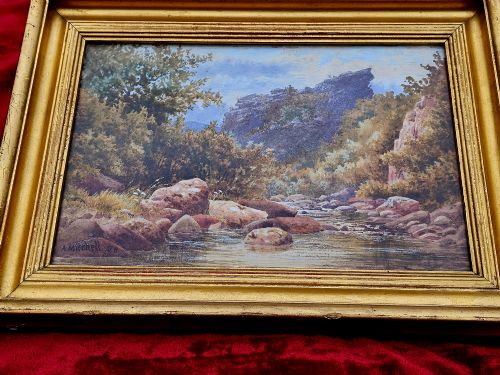
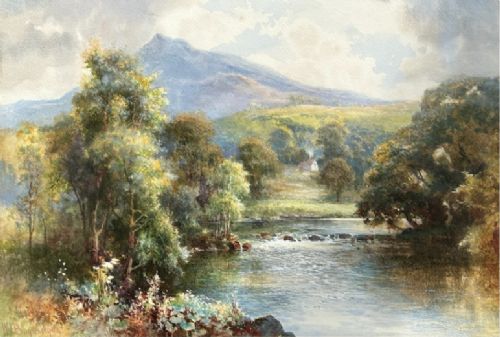
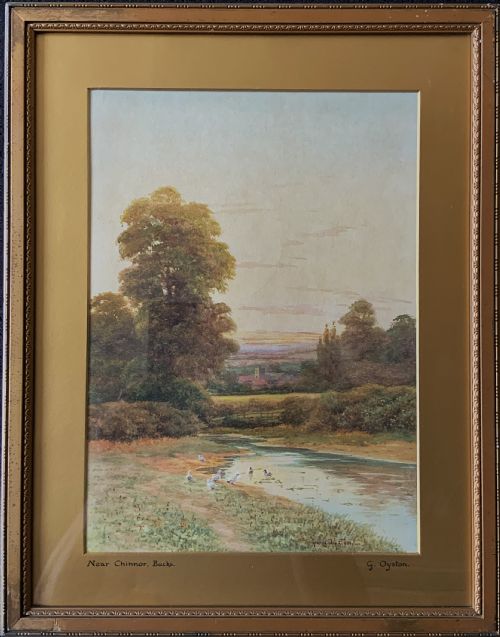
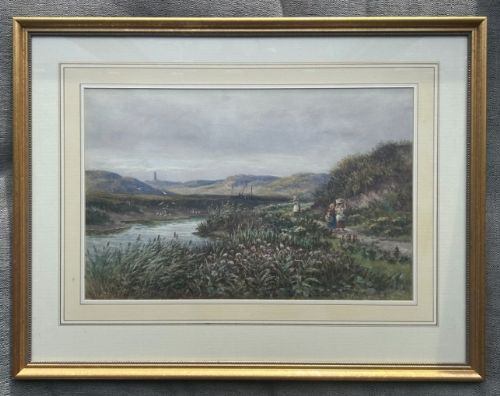
A green watercolour river painting depicts streams, rivers, and lakes across the British countryside, often set within rural valleys or near historic villages. These artworks span from the eighteenth century through the Victorian era and into the early twentieth century, reflecting the changing aesthetic of the British and English schools of landscape art. Buyers meet works executed on paper, frequently presented behind glass within wooden and gilt frames.
The most common examples on this page date from the late nineteenth century to the early twentieth century, capturing scenes from the Thames Valley to Yorkshire and Wales. These watercolours show pastoral life, featuring figures by the water, cattle watering, or fishermen on locks, rendered in varied shades of green. Such pieces belong to the broader category of fine art paintings and wall art, prized for recording nineteenth-century and Edwardian topography.
Materials and Technique
Artists applied watercolour pigment suspended in water directly onto paper, utilising the white of the unpainted paper to create luminosity and light. The palette relied on various green watercolours mixed with earth tones to render foliage, grass, and riverbanks across English and Welsh landscapes.
Finished watercolours were mounted behind glass and housed in wooden frames, sometimes accented with gilt mouldings to complement the composition. This framing protected the delicate paper and water-soluble pigments from atmospheric moisture and dust over successive centuries.
Listings span from the 18th century to the 20th century, utilising paper, wood, glass, and gilt materials.
Assessing Quality
Quality rests in the handling of the watercolour pigment, where confident brushwork creates depth in the river currents and surrounding foliage. Superior examples demonstrate a precise control of light and atmospheric perspective across the landscape.
The distinction between standard works and finer pieces also lies in the provenance and the artist's reputation, such as those exhibited at the Royal Academy. The subtlety of the green tones and the preservation of the paper support further differentiate the works.
Alfred Young Nutt·A. Mitchell·William Joseph Boyes·George Oyston·Henry John Kinnaird·Thomas Hunn·David Cox Jnr·J Laporte·Colin H Greenwood·Alfred Grey·Harold Lawes·Frederick G Coulridge·John Hobson Nicholson·Percy Lancaster·Thomas James Lloyd·Frederick Williamson·William Tatton Winter·William Bradley·Amos Green·William Hoggatt·Thomas Pyne·Henry Sykes·Frederick George Coleridge·Ebenezer Wake Cook·Henry John Sylvester Stannard
The Green Watercolour River Painting Glossary
- Watercolour pigment
- Finely ground colour mixed with a water-soluble binder, applied to paper with water. It allows for transparent washes that capture light.
- British School
- A loose grouping of artists working in Britain from the seventeenth century onwards. It encompasses landscape painters influenced by local topography and naturalism.
- Gilt frame
- A wooden picture frame covered with a thin layer of gold leaf or metallic gold paint. It adds a traditional decorative border to works on paper.
- Backwater
- A part of a river that is stagnant or lies off the main current. Painters frequently depicted these quiet stretches for their stillness.
Green Watercolour River Painting: Frequently Asked Questions
What periods do these paintings cover?
The works span from the eighteenth century through the nineteenth and twentieth centuries, encompassing Georgian, Victorian, and Edwardian periods.
Most surviving examples date from the late nineteenth and early twentieth centuries, reflecting the popularity of landscape painting during those eras.
Where were these river scenes painted?
Artists painted locations across Britain, including the Thames Valley, Yorkshire, Wales, and the Isle of Man.
Popular subjects featured specific rivers and rural spots such as the Wye Valley, the River Wharfe, and local village backwaters.
How should I frame and hang a watercolour?
Watercolours require framing behind glass to protect the paper and water-soluble pigments from humidity and atmospheric pollutants.
Keep them away from direct sunlight to prevent the green pigments from fading over time.
Who painted these watercolours?
The selection includes works by notable members of the British School, Royal Academy exhibitors, and regional landscape artists.
Many pieces are signed by the artists or documented through nineteenth-century exhibition records.