



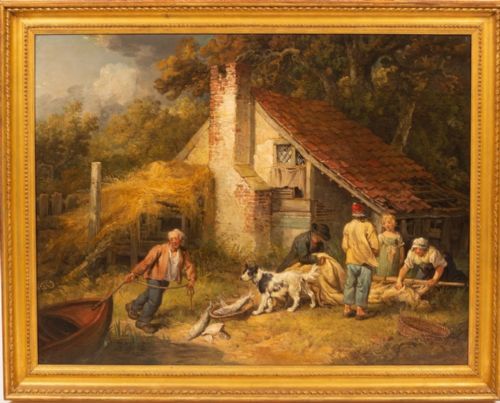
Antique Fisherman Painting
An antique fisherman painting brings the coastal and riverbank life of past centuries directly into a room.
Antique Fisherman Painting
An antique fisherman painting captures maritime, river and coastal scenes across the Victorian period through to the 1940s. Buyers will find works depicting figures hauling nets, tending boats or walking homeward with a catch.
The selections range from detailed nineteenth-century British and continental watercolours to impressionist oils on canvas and panel from the early twentieth century. Regional depictions include Cornish harbours, Scottish highlands and Mediterranean shores.
Most examples present traditional rural or maritime toil rather than grand historical narratives. They reflect a nineteenth and early twentieth-century preoccupation with ordinary labour and topography.
Materials and Techniques
Artists painted these subjects using oil paint and watercolour on supports of canvas, wood panel, mahogany panel and heavy paper. Watercolours frequently relied on washes with pencil or charcoal underdrawing.
Oil works often utilised layered brushwork on primed canvas or board, framed in gilt wood or simpler wooden mouldings. Some pieces incorporate mixed media elements like charcoal or ink on canvas.
Listings show a strong representation of 19th-century and 1900s British watercolours and oils depicting coastal labour.
Distinctions in Execution
Quality rests in the handling of light, atmospheric perspective and the naturalistic rendering of figures within a landscape. Stronger pieces display confident brushwork and accurate proportion rather than rigid repetition of motifs.
The handling of the medium - whether fluid washes in watercolour or textural impasto in oils - differentiates professional composition from amateur output. The integration of the fisherman into the wider topography dictates the visual weight of the work.
George F Pennington·Gustave Vidal·André Prévot-Valéri·James Kyd·Ralph Todd·Thomas Pyne·James George Bingley·James Ward·Alfred Graham·Sonia Mervyn·Fred Dade·George Marks·Edward William Cooke·Louis Bélanger·William J Callcott·Arvid Mauritz Lindstrom·William F Hulk·Samuel Bough
The Antique Fisherman Painting Glossary
- Impressionism
- A nineteenth-century painting style focusing on transient effects of light and ordinary subject matter. It prioritises open brushwork over rigid academic finish.
- Newlyn School
- An art colony based in Cornwall during the late nineteenth and early twentieth centuries. Painters associated with it focused on realistic depictions of local fishing communities.
- Watercolour
- A paint consisting of pigment suspended in a water-soluble vehicle, typically applied to paper. It relies on the white of the paper to show luminosity through transparent washes.
- Impasto
- Paint applied thickly to a canvas or panel, standing out from the surface. This technique leaves visible brush or palette knife marks that catch the light.
- Provenance
- The chronological history of the ownership of a work of art. It helps establish authenticity and origin.
Antique Fisherman Painting: Frequently Asked Questions
What periods do these paintings cover?
The works span from the nineteenth century through the 1940s, encompassing Victorian, Edwardian and early twentieth-century movements.
Key regional styles such as the Newlyn School and continental impressionism also appear within this timeline.
Where were these fishing scenes typically set?
Settings range from British coastal ports in Cornwall, Devon and Scotland to continental locations including Normandy, the Côte d'Azur and the Bay of Naples.
Artists frequently recorded local working practices specific to these geographic regions.
Are these works signed by the artists?
Many examples feature artist signatures, inscriptions or studio attributions inscribed on the front or verso.
Unsigned works are frequently attributed to specific regional schools based on technique and subject matter.