
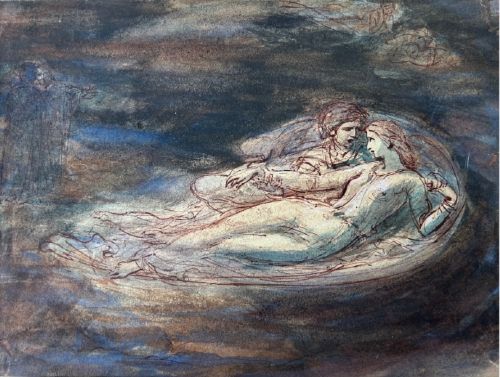


Brown Wash Watercolour Art
Brown wash watercolour art captures monochromatic and tonal landscape scenes using sepia and ink pigments.
Brown Wash Watercolour Art
When buyers search for brown wash watercolour art, they seek works defined by monochromatic or sepia pigment applications on paper. These pieces range from Georgian sketches to Modern British landscapes, spanning the nineteenth and twentieth centuries.
The versions most commonly met on this page include nineteenth-century British school landscapes, marine scenes, and maritime depictions executed in watercolour and sepia ink.
Works appear in formats such as original paintings, drawings, and portrait paintings, often framed in gilded wood or glass.
Materials and methods
Artists created these works by applying watercolour pigment and sepia ink onto paper supports, utilising washes to build tonal depth and shadow. Monochrome palettes relied heavily on brown tones and ink lines to define architectural and natural forms.
Framing materials such as gilded wood and glass protected the delicate paper substrates from environmental damage while complementing the tonal qualities of the monochrome pigments.
The listings span the Georgian, Victorian, and twentieth-century periods, utilising paper, ink, watercolour, and gilded wood.
Assessing quality
Quality in these works rests on the precision of the ink lines and the subtlety of the wash gradients used to create depth and atmosphere. Finer examples display confident brushwork and tonal control that bring clarity to architectural and landscape details.
The condition of the paper support and the retention of pigment intensity without fading or heavy foxing also separate superior examples from more compromised works.
Tom Clough·Robert Richard Scanlan·William Wyld·Henry Barlow Carter·Thomas Pyne·Fred Lawson·Rowland H Hill·Thomas Lound·Thomas Brabazon Aylmer
The Brown Wash Watercolour Art Glossary
- Brown wash
- A monochrome watercolour technique using diluted brown or sepia pigment to create tonal shadows and depth. It forms the primary basis of these historical works.
- Sepia ink
- A brown pigment derived from cuttlefish, used extensively for linear sketching and tonal washes in historical drawings. It provides the characteristic warmth found in many period landscapes.
- Watercolour pigment
- Finely ground colour particles suspended in a water-soluble binder, applied to paper to create transparent or translucent layers. This medium defines the core of the listed artwork.
- Gilded wood
- Wood frames treated with a thin layer of gold leaf or gilt paint, commonly used to house historical watercolours. They enhance the visual presentation of the paper works.
Brown Wash Watercolour Art: Frequently Asked Questions
What is brown wash watercolour?
Brown wash watercolour is a monochrome painting technique that utilises diluted brown pigments or sepia ink to build tonal shadows and form upon paper.
Artists used this method to create atmospheric landscapes and architectural studies with considerable depth before applying full colour.
How are these artworks framed?
Many of these historical works are preserved behind glass within wooden frames, often featuring gilded finishes that complement the sepia tones.
Original framing materials help protect the fragile paper supports from dust and moisture over time.
How do I date a watercolour?
Dating relies on stylistic evidence, artist signatures, paper types, and framing methods recorded across the Victorian, Georgian, and twentieth-century periods.
Inscribed titles and known biographical dates of the artists also provide reliable chronological markers.
Where were these scenes painted?
The subjects range from Yorkshire harbours and rivers to Italian landscapes and marine views around coastal towns.
Artists travelled extensively to capture topographical views and maritime scenes across Britain and Europe.