




Green Velvet Footstool
A green velvet footstool brings rich texture and practical comfort to a room, drawing on centuries of fine upholstery and timber framing.
Green Velvet Footstool
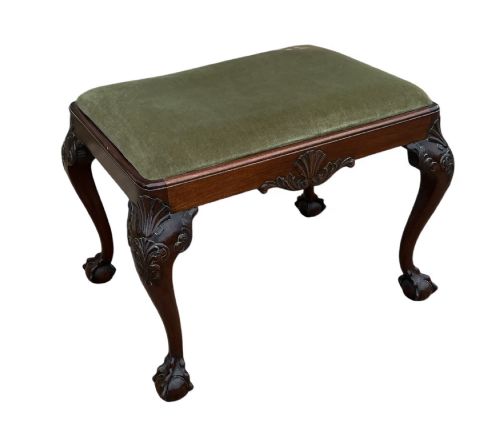
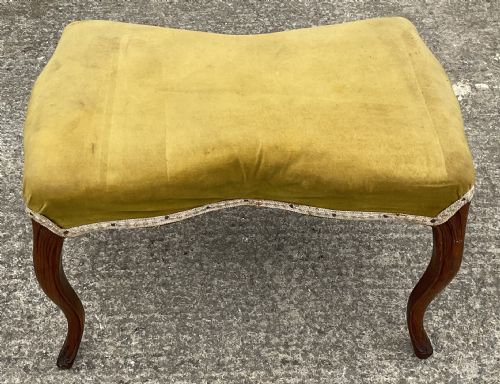
When you search for a green velvet footstool, you encounter a variety of forms ranging from compact Victorian gout stools to large centre stools and revival window seats. These pieces combine soft textile upholstery with robust wooden frames shaped across different historical periods.
The versions you are most likely to meet on this page span the Victorian era, the Edwardian period, and various twentieth-century revivals. They frequently employ mahogany, walnut, rosewood, or beech as structural timber to support the padded top.
How they were made
Makers constructed the frames using hardwoods like mahogany, walnut, and rosewood, often turning, carving, or inlaying the timber to match the prevailing style. Giltwood and stained beech also appear among the structural materials recorded in these listings.
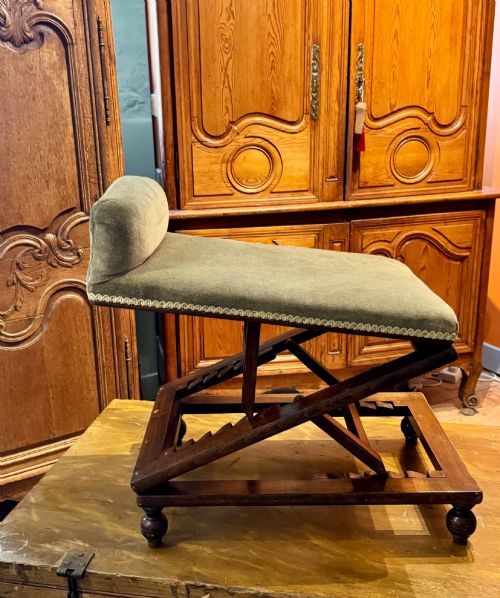
Upholsterers applied textile and velvet over padding to create the seat, sometimes incorporating adjustable mechanisms for gout stools or piano stools. Brass fittings occasionally provided functional adjustments or decorative accents on these frames.
Green Velvet Footstool Retail Price Guide 2026
Typical asking prices for green velvet footstool among the pieces listed under this phrase on Sellingantiques today, from the lower quarter to the upper quarter. They describe what is for sale here now, not the wider market.
Some nineteenth-century examples hide adjustable mechanisms, proving that Victorian comfort could be surprisingly mechanical.
What varies in quality
The refinement of the wooden frame determines much of the piece's distinction, visible in the elegance of the proportions and the crispness of any carved detail. Well-drawn frames with balanced legs and sound joinery stand apart from simpler constructions.
The integration of the upholstery with the timber structure also defines the standard of the work. High-quality examples maintain tight lines and appropriate textile tension that complement the underlying period design.
The Green Velvet Footstool Glossary
- Gout stool
- An adjustable footstool designed to elevate and support the foot of someone suffering from gout. These items often feature a mechanism to alter the angle of the padded surface.
- Centre stool
- A freestanding stool finished on all sides intended to sit in the middle of a room rather than against a wall. They frequently appear in larger proportions with substantial timber frames.
- Window seat
- An elongated stool designed to fit beneath a window, combining seating with low proportions. Georgian examples often display particularly elegant framing and proportions.
- Giltwood
- Wood that has been treated with gold leaf or a gold-coloured finish. This technique highlights carved details on formal nineteenth-century frames.
- Metamorphic
- Descriptive of furniture that transforms from one form to another, such as a footstool with an adjustable reading or resting angle. These pieces utilise mechanical hinges and ratchets.
Green Velvet Footstool: Frequently Asked Questions
What is a gout stool?
A gout stool is an adjustable footstool specifically designed to support the foot at an elevated and often angled position. These pieces frequently include mechanical ratchets to alter the incline.
They appear in nineteenth-century contexts and combine wooden frames with padded velvet or textile upholstery.
How do I date a wooden stool?
Dating relies on identifying the timber species, the turning or carving style, and the construction methods used in the frame. Periods such as the Georgian era or the Victorian period dictate specific proportion and ornamentation.
Comparing the stylistic markers of the wood with known revival styles helps narrow down the decade of manufacture.
Where should I place a centre stool?
A centre stool is designed to stand freely in the middle of a room rather than being pushed against a wall. Because they are finished on all sides, they act as focal points in larger spaces.
They pair well with conversational seating arrangements or in the middle of dressing rooms and libraries.
What woods were used for these stools?
Maker workshops utilised hardwoods including mahogany, walnut, and rosewood for their strength and rich grain. Softer timbers like beech also appear, frequently stained to imitate more expensive woods.
In more decorative pieces, giltwood provides a bright, gilded surface finish.