


Green Marble Vases
Green marble vases bring monumental classical weight and rich mineral colour to a room, channelling centuries of European taste.
Green Marble Vases
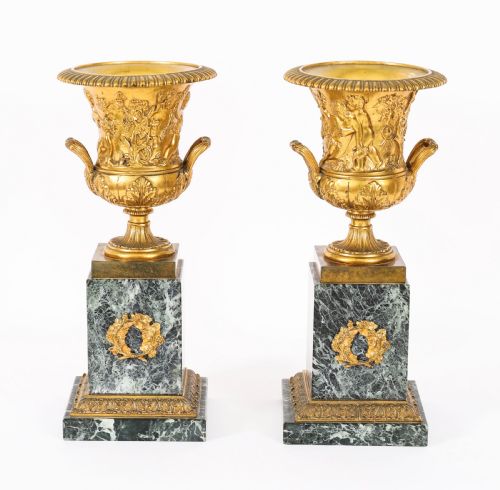
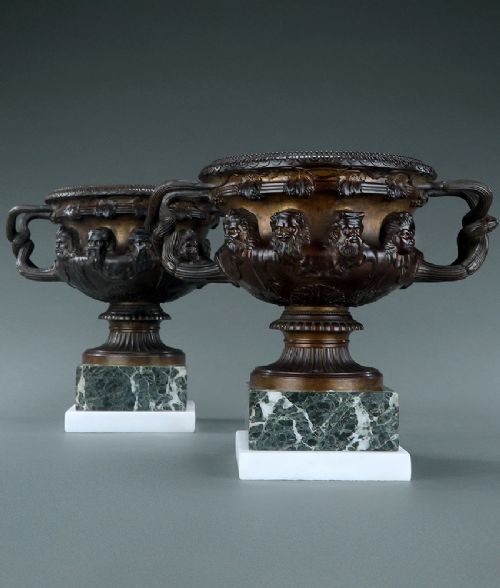
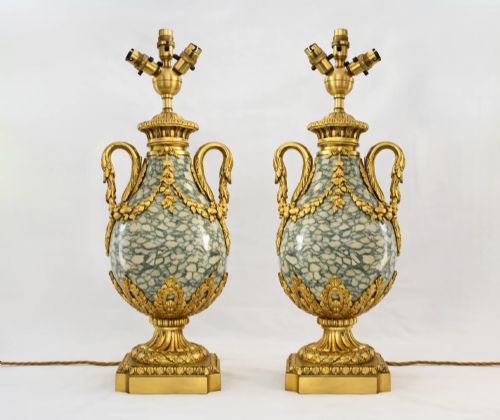
Green marble vases are substantial decorative objects produced largely in the nineteenth century, drawing inspiration from classical antiquity and the Grand Tour. Buyers seeking green marble vases will most frequently encounter pairs of French and Italian urns, cassolettes, and table lamps dating from the mid-nineteenth century to the early twentieth century.
The aesthetic is rooted in revivalist movements, spanning Neoclassical, Louis XVI style, and French Empire designs alongside later Art Deco examples. These pieces often incorporate classical architectural forms such as pedestal urns, column-mounted bodies, and footed plinths designed to display the distinctive patterning of the stone.
Materials and construction
The primary construction combines turned and polished variegated green marble with cast metal mounts in gilt bronze, ormolu, or silvered bronze. Stonemasons shaped the marble bodies on lathes to achieve smooth, symmetrical profiles that highlight the natural veining and deep green hues of the mineral.
Metalwork components, including handles, collars, bases, and acanthus-leaf details, were produced via traditional casting methods and finished by hand. These bronze and ormolu mounts were then fitted mechanically or secured with adhesives to the stone carcasses.
Assessing quality and execution
Quality in these pieces is dictated by the depth and movement of the marble's natural veining coupled with the crispness of the metal mounts. Superior examples display tightly fitted bronze or ormolu elements that hug the stone contours precisely without excess gaps.
The distinction between standard decorative items and finer works lies in the weight and proportion of the casting, alongside the polish and stability of the marble itself. Heavier gauge metalwork and more complex stone turning indicate higher production standards.
Michel Decoux
The Green Marble Vases Glossary
- Cassolette
- A decorative vessel featuring a reversible lid that transforms an urn into a burner or candleholder. This dual-purpose form is frequently encountered in nineteenth-century French decorative arts.
- Ormolu
- Finely ground high-carat gold mercury-gilded onto a bronze base. The technique produces a rich, warm metallic lustre characteristic of luxury French mounts.
- Grand Tour
- A cultural journey undertaken by wealthy young Europeans in the eighteenth and nineteenth centuries to collect classical antiquities and revival souvenirs. Many stone vases derive their inspiration from this tradition.
- Garniture
- A set of three or more matching ornamental objects, typically comprising a central clock flanked by vases or candelabra. These sets were designed for display on mantelpieces.
Green Marble Vases: Frequently Asked Questions
Are these vases waterproof?
Most antique stone vases were created strictly for display rather than holding water and fresh flowers. The internal cavities may be unsealed or fitted with metal liners that are no longer watertight.
Using them for dry arrangements or simply leaving them empty preserves the interior stone and prevents moisture damage to older joints.
How do I clean green marble?
Cleaning requires only a soft, dry or slightly damp cloth to remove surface dust without disturbing the stone polish. Avoid acidic solutions, household detergents, or abrasive cleaners which can etch the marble surface and strip the natural shine.
Metal mounts should be dusted gently, taking care not to apply moisture directly onto gilt bronze or ormolu surfaces.
Can these be wired as lamps?
Several period examples were either originally manufactured as table lamps or converted later in their history. The conversion process typically involves running a cord through the centre without altering the primary stone structure.
Professional rewiring ensures the internal components meet contemporary electrical safety standards while retaining the antique base.
How can I tell the period?
Dating relies on examining the style of the metal mounts, the turning technique of the marble, and the assembly methods used inside the base. Nineteenth-century pieces often feature hand-cut threads, heavy bronze castings, and distinctive patination consistent with age.
Comparing the stylistic motifs against documented Neoclassical or Art Deco design periods helps narrow down the decade of manufacture.