


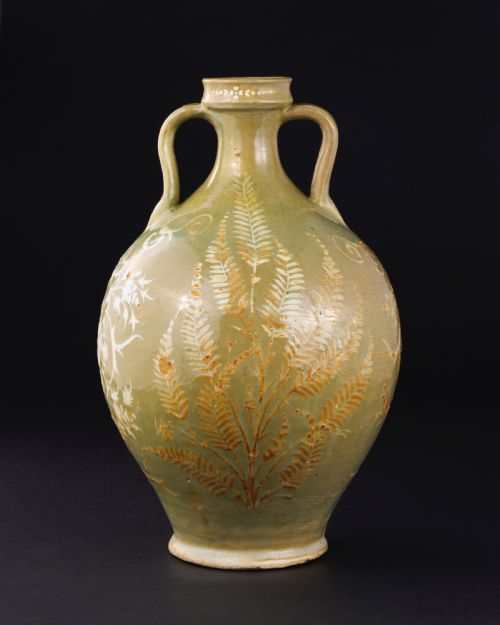


Green Handled Pottery Vases
Green handled pottery vases combine earthy ceramic bodies with striking coloured grips, offering an eclectic mix of regional folk traditions and studio craft.
Green Handled Pottery Vases
Green handled pottery vases encompass a diverse selection of ceramic vessels ranging from 17th century Persian wares to Victorian studio pieces. When searching for green handled pottery vases, collectors encounter forms such as confit jars, amphora vessels, and decorative majolica.
The pieces on this page span several centuries, including 19th century European examples and earlier Asian dynasties. Makers utilised distinct regional styles, moving from French country earthenware to Arts and Crafts studio pottery.
How they were made
Potters shaped these vessels primarily from earthenware, terracotta, and porcelain, applying rich glazes and enamel finishes to the ceramic surface. Celadon glaze and slipware techniques appear frequently across the historical periods represented.
Makers integrated handles directly into the vessel bodies during the throwing or moulding stage, often highlighting these grips with contrasting green glazes or enamel details.
Ducks and lotus flowers peacefully inhabit a Song dynasty celadon jar while a dragon coils around a nearby cloisonné tree bark.
What varies in quality
Quality rests in the execution of the glaze, the balance of the vessel form, and the crispness of the hand-modelled handles. Finer examples display deliberate control over the kiln firing and pigment application.
Artisanal provenance and documented studio origins elevate individual pieces, distinguishing standard utilitarian wares from accomplished artistic expressions.
Makuzu Kozan·Sir Edmund Harry Elton·Ulisse Cantagalli·Brannam Art Pottery·Mason
The Green Handled Pottery Vases Glossary
- Majolica
- Tin-glazed earthenware decorated with opaque metallic oxide colours, popular in Italian and European pottery traditions.
- Celadon
- A pale green jade-like glaze originating in Asian ceramic traditions, achieved through iron oxide in a reduction kiln.
- Terracotta
- Unglazed or glazed fired clay of a brownish-red colour, commonly utilised for large jars and Mediterranean vessels.
- Slipware
- Pottery decorated with a thin mixture of clay and water applied before firing to create surface patterns.
Green Handled Pottery Vases: Frequently Asked Questions
How do I clean an antique ceramic vase?
Dust gently with a soft dry cloth and avoid submerging porous earthenware or terracotta in water.
Keep pieces away from direct sunlight to protect the stability of the historical glazes and enamels.
Were these vessels used for flowers?
Many forms served utilitarian storage roles, such as confit jars and amphora vessels, rather than functioning as floral displays.
Over time, collectors repurposed various jars and handled vessels purely for decorative interior display.
How can I tell the period of a pottery vase?
Examine the base material, glaze characteristics, and potting techniques to align the object with known historical eras.
Maker marks, registration numbers, and stylistic markers such as Arts and Crafts or Majolica provide further chronological clues.
What is the difference between earthenware and porcelain?
Earthenware is fired at lower temperatures, resulting in a porous body that requires a glaze to hold liquids.
Porcelain utilises refined white clay fired at high heat, producing a vitrified, non-porous structure.