





Gothic Church Candlesticks
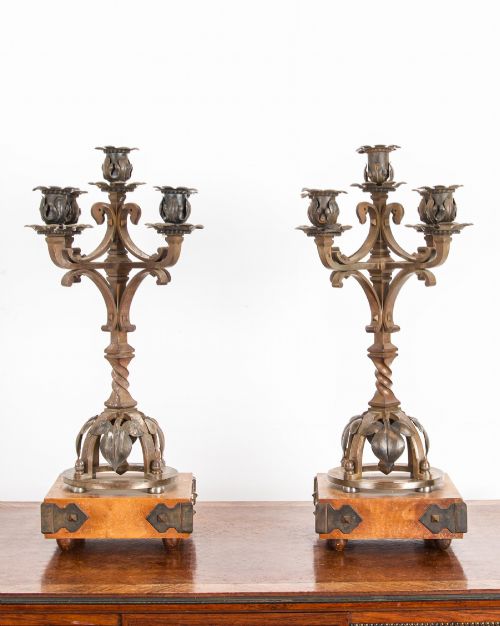
Gothic church candlesticks bring architectural form and heavy metalwork into domestic rooms, standing as tall prickets or multi-branch lights.
Gothic Church Candlesticks
When you search for gothic church candlesticks, you encounter monumental altar pieces and heavy floor-standing holders originating mainly in the nineteenth century and the early decades of the twentieth. These items span Victorian Gothic Revival designs alongside French ecclesiastical and Amsterdam School interpretations, reflecting liturgical use in various ecclesiastical settings.
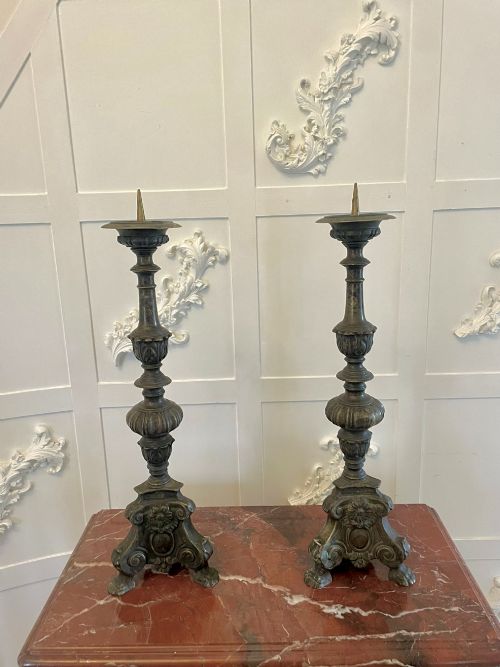
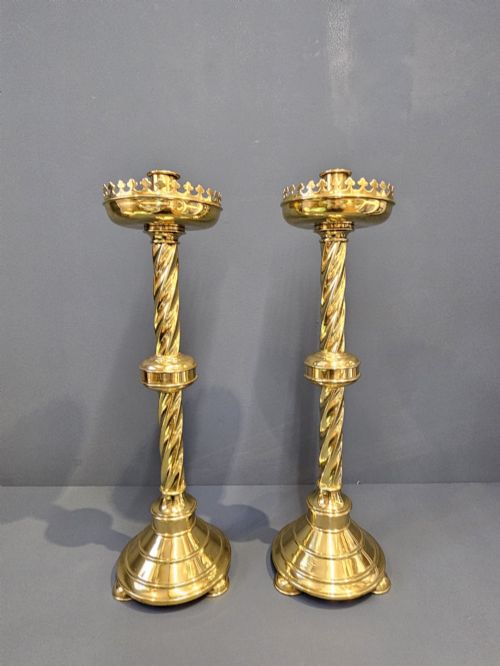
The version you meet most often on this page is a tall pair of brass or wrought iron candlesticks, frequently featuring pricket tops designed to hold large candles directly on a central spike. Pairs dominate the selection, though sets of four and single floor candelabra appear among the listings.
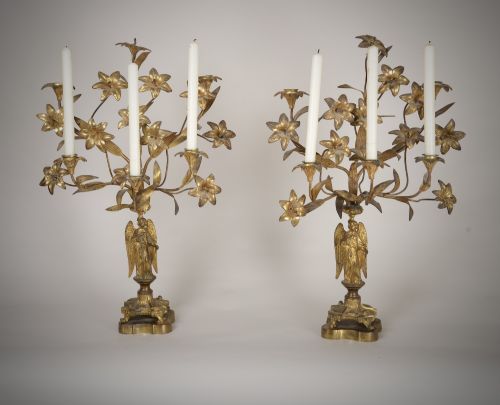
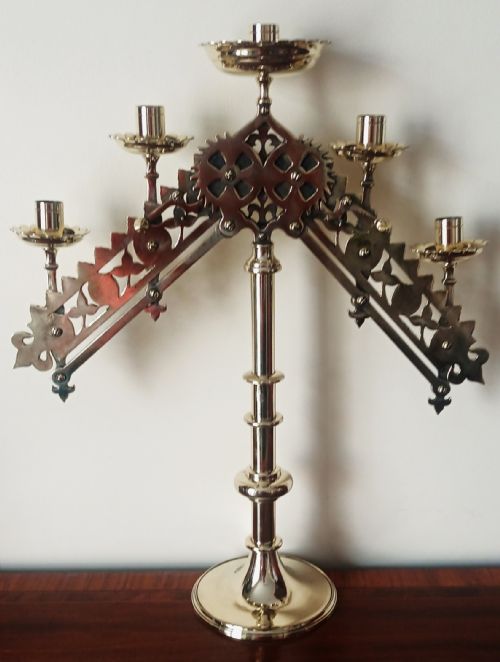
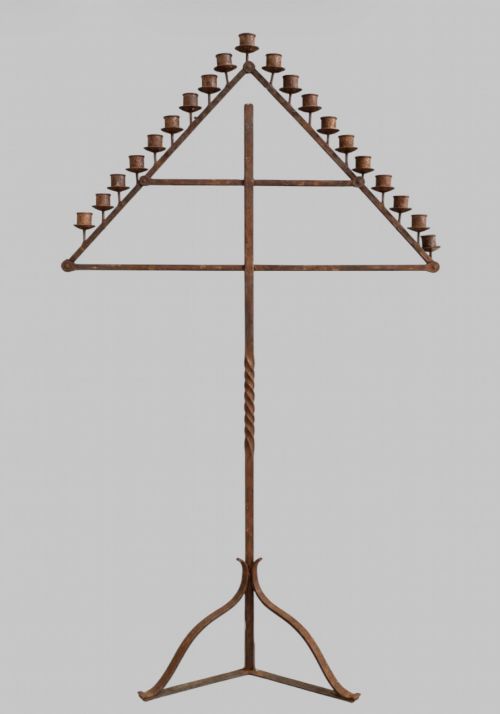
Beyond standard table heights, the selection includes converted lamps, articulated candelabra with multiple branches, and massive floor-standing torchères. Their origins trace across English, French, and continental workshops working within recognizable Gothic architectural idioms.
Materials and Construction
Heavy brass and cast bronze form the backbone of these pieces, often paired with wrought iron for structural strength in floor-standing models and multi-candle candelabra. Workshops utilised sand casting for complex bases and nozzles, finishing surfaces with patination or occasional gilding.
Construction relies on threaded central rods, heavy pins, and structural riveting to support the considerable height and weight of altar metalwork. Artisans incorporated decorative knops, drip pans, and triangular or multi-footed bases to balance tall vertical stems.
Materials span heavy cast brass, bronze, wrought iron, and gilt metal, appearing in both table heights and floor-standing formats.
Assessing Quality
Quality rests upon the weight of the metal and the crispness of the Gothic casting, where sharper trefoils, quatrefoils, and mouldings indicate superior workshop execution. Heavy gauge brass and solid bronze command attention over lighter plated alternatives.
Proportion and structural integrity define the better examples, ensuring tall stems remain upright without lean and that heavy bases provide stable support for pricket spikes.
T Thomason & Co
The Gothic Church Candlesticks Glossary
- Pricket
- A sharp metal spike on top of a candlestick designed to secure a wax candle with a recessed base. This form predates socket holders and remains standard on altarware.
- Gothic Revival
- An architectural and decorative style popular during the nineteenth century that revives medieval pointed arches, tracery, and vertical emphasis. It shapes the ornamentation found on these ecclesiastical pieces.
- Candelabra
- A branched candlestick holding multiple lights from a single base. Articulated versions allow the branches to swing or adjust.
- Torchère
- A tall ornamental stand or heavy candlestick designed to carry a large light source. They function as architectural statements in room corners.
- Knop
- A decorative knob or swelling on the stem of a candlestick. It provides a secure grip when lifting heavy altar pieces.
Gothic Church Candlesticks: Frequently Asked Questions
How do I use gothic church candlesticks at home?
These tall pieces suit placement on large sideboards, mantels, or directly on the floor as architectural statements. Pair them with thick pillar candles to match the scale of the original pricket spikes.
Ensure stable placement away from foot traffic due to their considerable height and weight. Many examples also arrive converted to table lamps for everyday interior lighting.
Are these pieces actually from churches?
The majority originate from ecclesiastical settings, chapels, and convents across England and France. Their sturdy construction and liturgical forms reflect intended use on altars and in choirs.
Over time, many migrated from religious contexts into domestic interiors as collectors sought out heavy ecclesiastical metalwork.
How do I date a nineteenth-century brass candlestick?
Examine the casting method, base construction, and weight of the metal. Mid-Victorian pieces from the 1850s and 1860s often display crisp Gothic Revival ornament cast in heavy brass.
Later items from around 1900 show stylistic influences like the Amsterdam School, integrating simpler geometric forms and iron elements.