
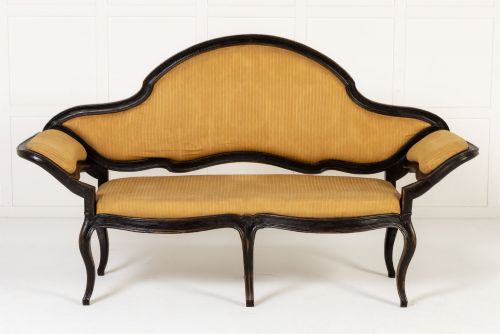


Gold Frame Settee
These gold frame settee pieces bring gilded grandeur and seating presence into a room, spanning eighteenth-century origins to nineteenth-century revivals.
Gold Frame Settee
A gold frame settee combines carved woodwork finished in gilt with upholstered seating, taking the form of sofas, two-seat couches, and larger salon pieces. These items emerge across distinct historical styles, including Regency, Italian Rococo, and Louis XV and XVI revivals from the eighteenth and nineteenth centuries.
The pieces listed here showcase varied structural forms, from double scroll-ended English sofas to large country house seating and French canapes. Walnut, beech, and ebonised wood frequently form the structural framework beneath the gilt finish, paired with textile coverings.
Buyers encounter examples originating from English and continental workshops, reflecting shifts in taste from strict Regency lines to exuberant Rococo curves. Each piece provides a substantial seating focal point shaped by the aesthetic preferences of its period.
Construction and materials
Makers shaped these frames from dense timbers such as beech, walnut, and mahogany, often applying ebonised treatments or metallic giltwood surfaces to achieve the desired visual weight. Carved wooden elements define the arms, rails, and legs, reflecting the stylistic vocabulary of the period.
Upholstery relies on traditional textile coverings including damask and velvet, fixed to internal frames using brass fixings and traditional stuffing methods. Structural integrity depends on the precise joinery of the wooden chassis to support the weight of multiple sitters.
Some pieces manage to be both a sofa, a settee, and a couch all at once.
Judgments of quality
The refinement of the carved woodwork dictates the visual hierarchy of these pieces, separating boldly sculpted scrolling arms and crisp floral motifs from simpler, flatter mouldings. The depth and execution of the gilt surface layer similarly influence the overall presence of the object.
Proportion and scale play a crucial role in distinguishing finer examples, where the relation between the length of the seat and the height of the back maintains visual balance. The choice of primary timber and the integrity of the underlying frame construction further separate standard production from more ambitious commissions.
The Gold Frame Settee Glossary
- Giltwood
- Timber coated with gold leaf or gilt paint to create a lustrous metallic finish. This surface treatment defines the primary visual characteristic of these frames.
- Canape
- An ornamental sofa or settee featuring an upholstered back and seat within a decorative wooden frame. French examples often display curved rails and cabriole legs.
- Regency
- A British design period spanning the early nineteenth century noted for classical restraint and occasional Egyptian or Grecian motifs. Pieces from this era often feature distinctive scroll ends.
- Damask
- A reversible figured fabric with patterns woven into the ground, commonly utilised for upholstery on formal period seating. It provides a textured surface that complements gilded wood.
Gold Frame Settee: Frequently Asked Questions
What periods do these settees come from?
The available selection spans from the eighteenth century through the nineteenth century, encompassing Regency and various French revival styles.
Dates range across specific years like eighteen-eighty and eighteen-ninety alongside broader nineteenth-century and eighteenth-century periods.
Which woods appear in the frames?
Makers utilised timbers such as beech, walnut, and mahogany to construct the structural chassis of these seating pieces.
Ebonised wood and giltwood surfaces frequently cover these underlying materials to achieve the finished decorative effect.
What upholstery fabrics are used?
Textiles on these pieces include woven damask and plush velvet, complemented by brass detailing where appropriate.
These materials cover the seats and backs of two-seat and three-seat configurations.
How do French and English styles differ?
English pieces often reflect Regency or country house proportions with scroll ends and carved mahogany or giltwood frames.
French models tend toward Louis XV and XVI revivals featuring gilt painted canape forms and curved walnut structures.