
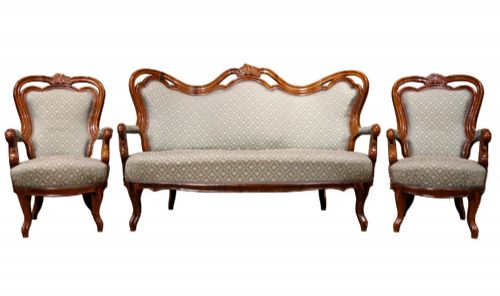


French Rococo Settee
A french rococo settee brings organic curves and elaborate carvings into a room, offering an elegant focal point for formal seating.
French Rococo Settee
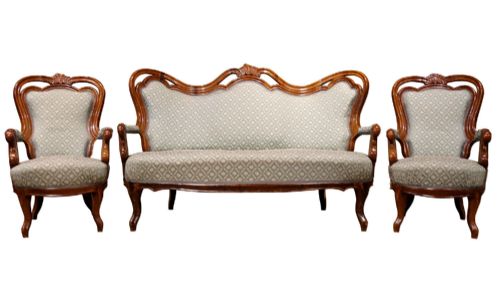
A french rococo settee embodies the flowing lines and asymmetrical ornamentation characteristic of the Louis XV style and its later revivals. Buyers looking at this page encounter seating forms ranging from compact two-seat couches and window sofas to large salon suites originating across the nineteenth century.
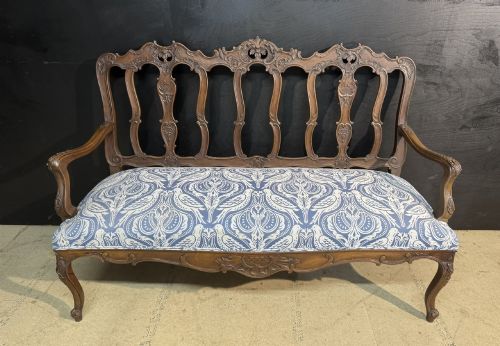
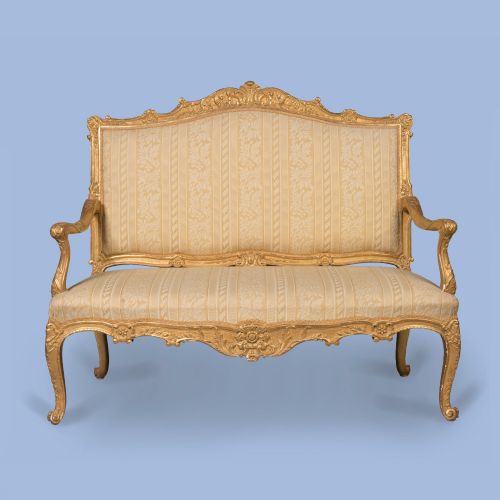
The surviving pieces demonstrate a clear preference for continental craftsmanship, particularly French and German interpretations of the Rococo taste. These couches frequently appear as giltwood canapés or walnut frames upholstered in silk, velvet, and various textiles.
Makers working during the Victorian era and into the early twentieth century reinterpreted these eighteenth-century motifs with carved walnut, mahogany, and rosewood. Consequently, buyers find both gilt and polished wood frames suited to formal reception rooms and boudoirs.
How they were made
Carpenters shaped the structural frames from solid hardwoods including walnut, mahogany, rosewood, and giltwood. Skilled carvers then applied intricate foliate scrolls, floral motifs, and serpentine rails directly into the timber.
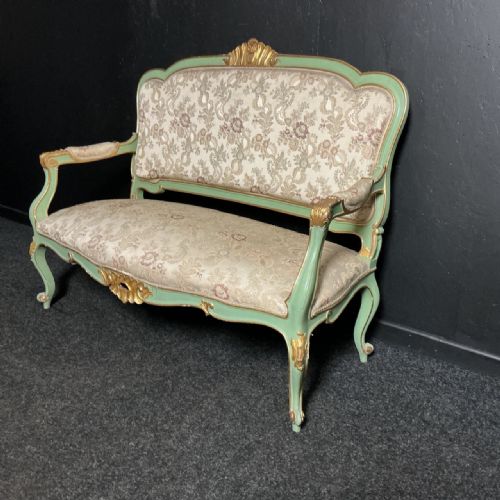
Upholstery techniques varied from traditional stuffed horsehair covered in silk, velvet, and antique textiles to woven cane panels fitted into open wood frames. Gilding was applied over gesso grounds on carved wood bases to achieve a brilliant metallic finish.
Periods represented span from eighteenth-century examples to mid-nineteenth-century Victorian revivals and twentieth-century interpretations.
What varies in quality
The depth and crispness of the hand-carved ornamentation separate standard revival pieces from finer examples. Sharp, undercut foliage and balanced asymmetrical cartouches indicate superior artisan skill during the shaping process.
The choice of primary wood and the integrity of the original giltwood or painted surface determine the visual weight of the furniture. Frames utilising figured walnut or original gold leaf retain greater historical character than later replacements.
The French Rococo Settee Glossary
- Canapé
- An antique French sofa featuring an upholstered back and seat on an exposed carved wooden frame. This form usually reflects Louis XV proportions and stylistic details.
- Bergere
- An enclosed upholstered armchair or settee with wooden sides filled with cane or upholstery. It provides a comfortable, deep seat enclosed by curved wooden arms.
- Giltwood
- Timber coated with a thin layer of gold leaf over a prepared gesso base. This finish creates a luminous, reflective surface popular on formal nineteenth-century salon seating.
- Rococo Revival
- A nineteenth-century design movement inspired by the flamboyant curves and naturalistic motifs of the mid-eighteenth century. Furniture from this period adapts earlier French forms into heavier Victorian room settings.
French Rococo Settee: Frequently Asked Questions
Where should I place a settee?
These settees fit well in formal reception rooms, large bedrooms, or dressing areas where they serve as accent seating. Their decorative backs make them suitable for placement against a wall or beneath a tall window.
Positioning them away from direct sunlight protects delicate silk, velvet, and textile upholstery from fading over time.
How do I care for antique upholstery?
Vacuum textile and velvet surfaces gently using a soft brush attachment to remove dust without snagging historic threads. Keep the furniture away from radiators and heating vents to prevent wood frames from drying out.
Professional textile conservationists should handle deeper cleaning or repairs for antique silk and original fabric covers.
How do I identify a revival piece?
Nineteenth-century revival pieces often display machine-sawn timber marks and assembly methods distinct from eighteenth-century originals. Examining the construction beneath the upholstery reveals the age of the wood and the joinery techniques used by the maker.
Stylistic cues such as heavier walnut scantlings and Victorian proportions also point towards nineteenth-century manufacturing dates.
What is the difference between a settee and a sofa?
The terms are often used interchangeably in antique listings to describe long upholstered seating for multiple people. Historically, a settee often featured an exposed wooden framework, whereas early sofas occasionally carried heavier, fully upholstered forms.
Both types serve identical functions in period interiors, offering comfortable seating styled with carved arms and backs.