





Brown Wood Settee
A brown wood settee brings warmth and sturdy elegance to a room, offering classic seating crafted from rich timber frames.
Brown Wood Settee
When searching for a brown wood settee, you are looking at substantial seating pieces built across several centuries, from eighteenth-century camel back designs to twentieth-century Edwardian inlays. These seating options appear in varied forms including lounge suites, chaise longues, banquette sofas, and carved walnut couches.
You are most likely to meet nineteenth-century examples and Edwardian variations on this page, often shaped from mahogany, walnut, or rosewood. Makers frequently applied intricate carvings, brass accents, or fabric and leather upholstery to these wooden frames.
The selection spans formal English Regency designs, French Louis XV styles, and vernacular country house seating. Each brown wood settee carries the structural hallmarks of its specific period, whether through spindle backs, turned legs, or inlaid motifs.
Materials and Construction Methods
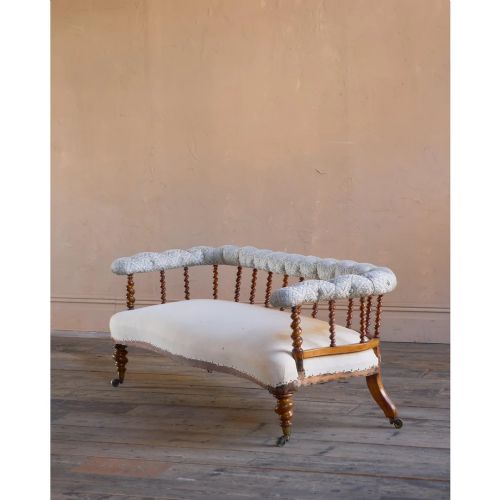
Cabinet makers constructed the foundational frames of these settees using dense hardwoods such as mahogany, walnut, teak, and rosewood, occasionally utilising bentwood techniques or simulated finishes. These timbers were carved, turned into bobbin shapes, or inlaid with lighter wood details to create decorative surfaces.
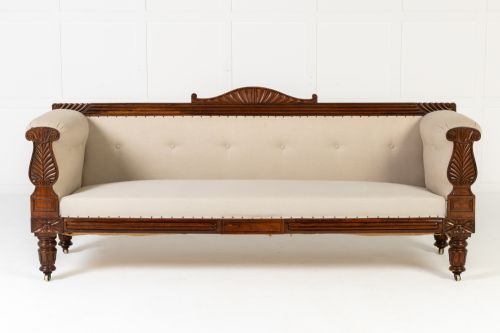
Upholstery methods varied from exposed cane panels to fully sprung seats covered in leather, velvet, textile, or fabric trims. Makers secured these coverings with brass tacks and incorporated carved armrests, herms, or lion hands directly into the wooden structure.
Listings feature mahogany, walnut, rosewood, teak, and zebrano timbers paired with leather, velvet, and cane.
Assessing Craftsmanship and Condition
The distinction between standard seating and superior examples rests in the depth and precision of the hand carving upon the wooden frame. Master carvers produced crisp floral motifs, figural herms, and balanced proportions that elevate the presence of the timber.
Integrity of the timber joints and the retention of original wood patination separate untouched historical pieces from heavily altered ones. Superior pieces maintain their structural rigidity alongside finely aged leather or textile coverings.
C. Hindley & Sons·Hampton & Sons·Thonet·Morison & Co - Edinburgh
The Brown Wood Settee Glossary
- Chippendale Revival
- A style drawing on eighteenth-century designs characterised by intricate chair-back structures and carved mahogany frames. These pieces emulate the lighter, ornamented aesthetic popularised by Thomas Chippendale.
- Bentwood
- A technique involving the steaming of wood until pliable, allowing craftsmen to bend it into curved structural forms without joints. This method defined lightweight yet durable frames common in later nineteenth-century production.
- Banquette
- A long upholstered seating form designed to fit against walls or within architectural interiors. These often feature exposed wooden bases and luxurious velvet or leather upholstery.
- Herm
- A sculptural pillar tapering downward, topped by a carved bust or head, integrated directly into the wooden framework of Regency settees. These architectural supports display high sculptural ambition.
- Serpentine front
- A furniture edge shaped with a central convex curve flanked by concave sweeps, creating a flowing undulating line. This contour appears on eighteenth-century sofa frames to add visual movement.
Brown Wood Settee: Frequently Asked Questions
How do I date a wooden settee?
Dating relies upon identifying the characteristic furniture styles, turning techniques, and timber selections associated with specific periods like the Regency or Edwardian eras. Subtle shifts in leg shapes, upholstery methods, and decorative inlays provide clear chronological markers.
Examining the construction of the underside and joint methods helps confirm the manufacturing period. Makers from different centuries applied distinct joinery standards that reveal the true age of the wooden frame.
Where were settees placed historically?
These seating pieces typically occupied formal reception rooms, grand hallways, and drawing rooms of country houses and urban townhouses. They provided social seating for gatherings and functioned as decorative focal points against panelled walls.
Veranda benches and larger lounge suites also served specialised domestic functions in semi-enclosed spaces or private chambers. Their placement depended entirely upon the scale of the interior architecture and the social habits of the household.
Are these settees comfortable for daily use?
Many historical settees offer firm support due to traditional horsehair or spring stuffing methods utilised by period makers. Fully restored examples with updated interior cushioning often balance historical integrity with modern comfort.
Pieces featuring rigid cane backs or carved wooden frames without plush upholstery feel more supportive than lounge oriented. Buyers frequently add loose cushions to adapt firmer antique seating for contemporary lounging requirements.
What is the difference between a sofa and a settee?
Historically, a settee often designated a lighter, narrower wooden seat with an upholstered or open back, whereas a sofa implied a fully upholstered lounging piece. Over time, these definitions overlapped significantly as makers experimented with hybrid forms.
Today, the terms are frequently used interchangeably across nineteenth and twentieth-century inventory. Examining the proportion of exposed wood versus upholstered surface provides the best clue to its specific historical typology.