


Gilt Four Glass Clock
A gilt four glass clock brings transparency and mechanical movement together, housing French horology inside bevelled glass panels.

Gilt Four Glass Clock
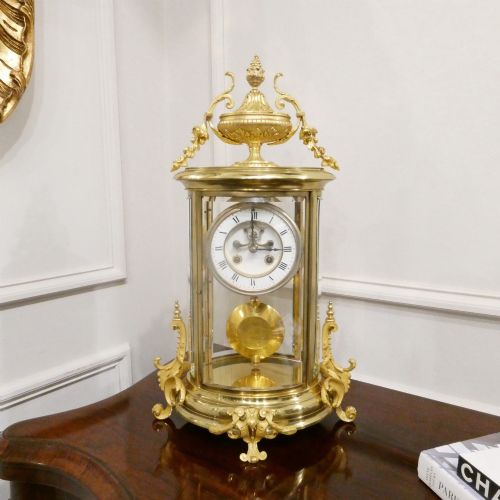
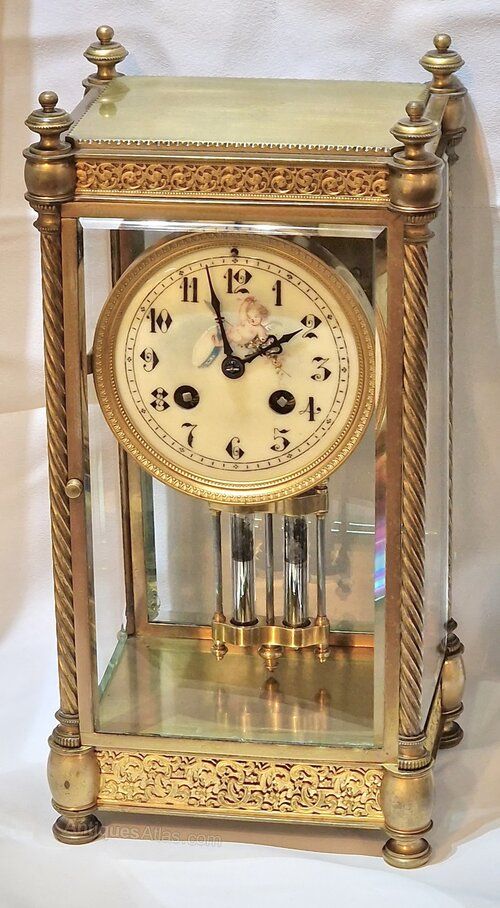
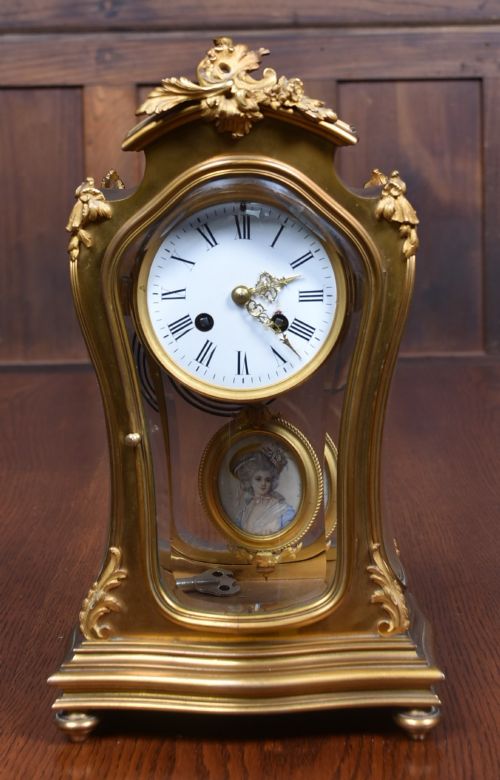
A gilt four glass clock is a mantel timepiece enclosed by glass panes on all four sides to display the swinging pendulum and movement. These objects appear frequently from nineteenth-century French makers, dating across the Victorian era.
The form typically rests upon a brass, bronze, or marble base with matching gilt framing. Specific examples incorporate decorative details such as cherub dials, ships wheel pendulums, or porcelain panels.
Most pieces function as mantel clocks, though certain models arrive accompanied by matching clock garnitures. Production spans the 1880s through 1900, reflecting French Rococo Revival, Neoclassical, and Napoleon III styles.
Materials and construction
Construction relies upon heavy brass, gilt bronze, or ormolu frameworks assembled to hold thick bevelled glass panes securely on four sides. Makers housed intricate mechanical movements within these transparent housings, often utilising enamel for the visible dials.
Metal components undergo gilding to achieve a bright or burnished finish that complements the polished glass edges. Certain housings incorporate contrasting materials like rouge marble, white marble, onyx, or mahogany alongside the primary metalwork.
Listings demonstrate a concentration of gilt four glass clocks originating from French workshops during the 1880s and 1890s.
Assessing quality
Quality rests in the weight and crispness of the gilt bronze or brass casting, alongside the complexity of the internal movement. Clocks featuring signed mechanisms by known makers or extended duration movements command greater attention.
Refinements such as painted porcelain panels, intricate pendulum designs like ships wheels, and hand-painted enamel dials elevate standard models into finer decorative objects.
Samuel Marti·Tiffany·Fabrique of Paris·Rodier
The Gilt Four Glass Clock Glossary
- Gilt bronze
- Metal alloy treated with a gold coating to provide a durable and lustrous surface finish. This material characterises the heavy frames of nineteenth-century French mantel clocks.
- Bevelled glass
- Glass panes shaped with an angled edge around the perimeter. These panels fit precisely into the brass or bronze framework of the clock case.
- Clock garniture
- A set comprising a mantel clock flanked by matching decorative objects such as urns or candelabra. Such sets share identical stylistic periods and materials.
- Enamel dial
- Metal clock face coated with fused glass powder to create a smooth white surface for painted numerals. These dials frequently feature delicate hand-painted floral garlands or makers' signatures.
Gilt Four Glass Clock: Frequently Asked Questions
What is a four glass clock?
A four glass clock is a mantel timepiece featuring glass panels on the front, back, and sides. This design allows light to pass through the case and reveals the movement from multiple angles.
Most examples originate from nineteenth-century French workshops and sit upon brass or marble bases. The pendulum typically hangs visibly between the glass walls.
How do you wind a four glass clock?
Winding requires a dedicated key inserted into specific winding holes on the enamel dial. Turning the key tensions the internal spring that drives the movement and strikes.
Care must be taken not to over-wind the mechanism. Many of these movements require regular attention to maintain accurate timekeeping.
Where should a four glass clock be placed?
These clocks suit prominent positions on mantelpieces, tables, or brackets where ambient light can pass through the glass panels. Placing them away from direct sunlight protects internal components and delicate dial paint.
A stable, level surface is essential for the pendulum to swing evenly. Movement stability directly affects the reliability of the clock.
Are these clocks strictly Victorian?
While many pieces align with the Victorian era, the majority originate from French makers working during the late nineteenth century. Styles span Napoleon III, Neoclassical, and Rococo Revival periods.
Date attributions typically range from the 1870s through 1900. Specific pieces display design characteristics associated with the Belle Epoque and Third Republic.