



French Regulator Clock
When you search for a french regulator clock, you find precision timepieces housed in glass, brass, and polished wood from the nineteenth and twentieth centuries.
French Regulator Clock
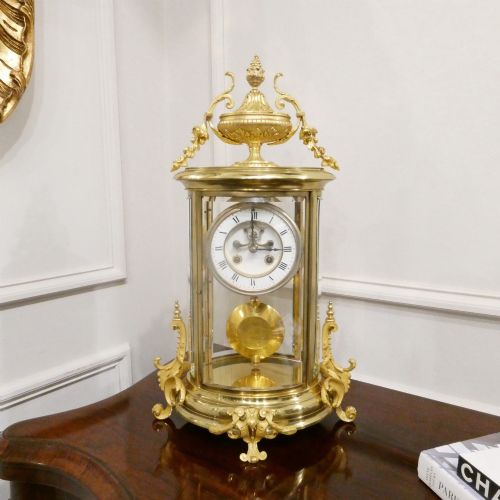
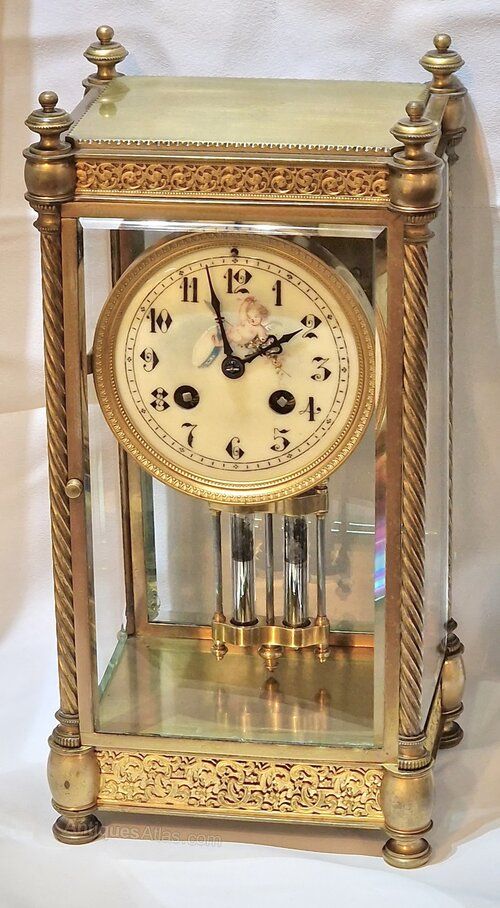
A french regulator clock encompasses precision timepieces designed to keep exact time, frequently taking the form of mantel clocks, wall clocks, and longcase clocks. The most common form on this page is the four glass crystal regulator clock, enclosed in glazed panels that reveal the internal movement.
These items span periods from the nineteenth century into the mid twentieth century, covering styles such as French Belle Epoque, Art Deco, Louis XV, and Second Empire. Makers such as Samuel Marti and L Epee produced notable examples featuring enamel dials and refined brass framing.
Materials and Construction
Construction relies heavily on brass, gilt bronze, ormolu, and heavy bevelled glass to create the characteristic transparent cases of four glass mantel clocks. Wooden variants utilise kingwood, walnut, mahogany, and oak, frequently enhanced with inlay or polished finishes.
Dial construction typically involves white enamel with painted Arabic or Roman numerals, sometimes accompanied by decorative painted scenes, moon-phase indicators, or visible escapements like the pinwheel or knife edge suspension.
French Regulator Clock Retail Price Guide 2026
Typical asking prices for french regulator clock among the pieces listed under this phrase on Sellingantiques today, from the lower quarter to the upper quarter. They describe what is for sale here now, not the wider market.
Listings feature clocks spanning the 1870s through the 1950s, using materials from brass and glass to kingwood and rouge marble.
Assessing Quality and Craftsmanship
The integration of decorative elements, such as hand-painted enamel panels, matched side urns in clock sets, and intricate dial details like cherubs or moon-phase complications, separates standard production pieces from higher grade examples.
Samuel Marti·L Epee·Henry Marc Paris·Valiant Paris
The French Regulator Clock Glossary
- Crystal Regulator
- A mantel clock featuring glass panels on four sides that expose the mechanical movement within. These clocks often include a mercury or compensating pendulum.
- Ormolu
- Gilt bronze produced by applying a mercury and gold amalgam to a bronze base, resulting in a rich metallic lustre. This technique appears widely on nineteenth-century clock mounts.
- Pinwheel Escapement
- A precision clock escapement utilising pins instead of traditional teeth on the escape wheel. It provides smooth impulse transfer and minimal friction for accurate timekeeping.
- Portico Clock
- A clock design supported by four columns resembling a classical temple facade. This architectural form often incorporates fine wood veneers and pendulum visibility.
French Regulator Clock: Frequently Asked Questions
What is a four glass clock?
A four glass clock is a mantel clock enclosed by glass panes on the front, back, and sides, allowing an unobstructed view of the mechanical movement and pendulum. The style gained popularity during the Victorian era and into the early twentieth century.
These pieces typically sit on a brass or gilt bronze base and feature a matching brass-rimmed enamel dial. Their transparent construction lets light pass through the entire mechanism.
How do I wind a crystal regulator?
Winding requires a matching key inserted into the winding holes on the enamel dial to tension the mainspring behind the movement. Care must be taken not to overwind the clock to avoid damaging the internal springs.
Many of these movements operate for eight days on a single wind, requiring regular weekly attention to maintain accurate timekeeping. The pendulum should be secured if the clock is moved.
Where should I place a wall regulator?
Wall regulators require a stable vertical surface, ideally a solid wall, to ensure the pendulum swings evenly and the escapement ticks consistently. Placing them away from direct sunlight and drafts preserves the wood cases and enamel dials.
These clocks serve as focal points in hallways, studies, or living rooms where their visible pendulums and swinging motion can be observed. Proper installation on a secure wall bracket is essential for operation.
How do I identify Art Deco clocks?
Art Deco pieces from the mid twentieth century display geometric forms, clean lines, and polished walnut or oak cases rather than ornate gilt bronze mounts. Their dials often feature stylised numerals and streamlined chapter rings.
These later clocks reflect a shift away from nineteenth-century revival styles toward minimalist design. They retain mechanical movements while adopting modern aesthetic principles.