
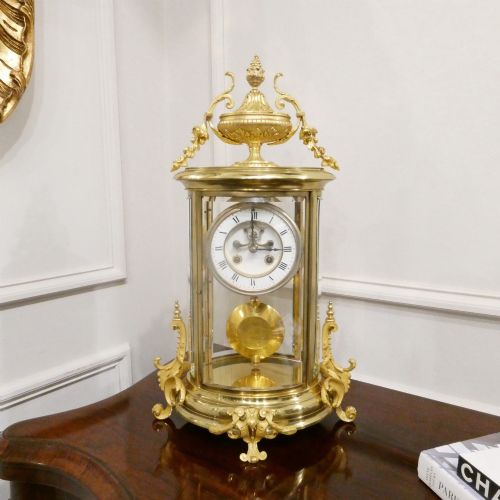
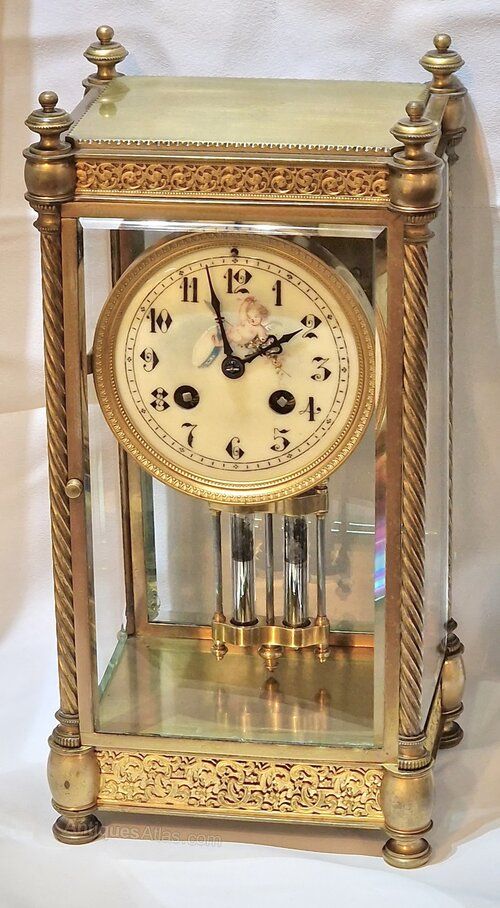
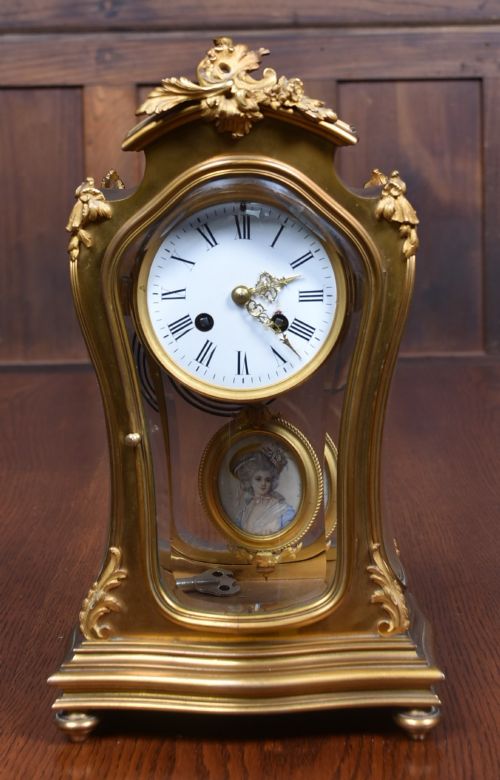


French Four Glass Mantel Clock
The french four glass mantel clock unites precision engineering with transparent casing to display intricate pendulum movements from every angle.
French Four Glass Mantel Clock
Most examples seen here originate from the late nineteenth century and Victorian periods, spanning styles from Neoclassical and Belle Epoque to Rococo Revival.
The format ranges from standard rectangular brass cases to oval, bow-fronted designs and larger architectural garnitures housing enamel dials.
What varies in quality
The weight and finish of the bronze or brass casting dictate the structural presence of the case, separating simple housings from finely chased ormolu mounts.
Complexity of the movement marks the upper tiers, where makers integrated striking mechanisms, moon-phase indicators, or mercury pendulums instead of standard timepieces.
Samuel Marti·AD Mougin·L Epee·Japy Freres·Vincenti
The French Four Glass Mantel Clock Glossary
- Four glass clock
- A mantel clock housed in a glazed brass frame that exposes the movement and escapement from all sides. These pieces often utilise mercury pendulums to maintain accurate timekeeping despite temperature shifts.
- Gorge case
- A stepped brass housing style with a distinctive flat top and pillared corners commonly found on nineteenth-century carriage and mantel clocks. This architectural layout provides robust support for heavy bevelled glass panels.
- Champleve
- An enamelling technique where troughs are carved into a metal surface, filled with vitreous paste, and fired before polishing. The resulting vibrant patterns frequently adorn the bezels and pillars of luxury French timepieces.
- Mercury pendulum
- A temperature-compensating pendulum utilising jars of liquid metal to counteract thermal expansion and contraction. This mechanism ensures consistent pendulum length and steady timekeeping throughout seasonal changes.
- Garniture
- A set comprising a central clock flanked by matching decorative objects such as urns or candelabra. These matched ensembles were designed to create a symmetrical arrangement on a mantelpiece.
French Four Glass Mantel Clock: Frequently Asked Questions
How do these clocks work?
These timepieces rely on a spring-driven or weight-driven mechanical movement regulated by a pendulum oscillating within the glass chamber. Tension from the mainspring powers the gear train, which drives the hands while the escapement controls the release of energy.
Energy flows through the wheels to the escapement, giving the pendulum regular impulses to keep time accurately. Many models include striking trains that sound the hours and half-hours on a gong or bell.
Where should I place one?
A sturdy, level surface away from direct sunlight and dampness provides the ideal environment for a mechanical clock. Mantelpieces, consoles, and heavy sideboards offer stable platforms that prevent vibrations from interfering with the pendulum's swing.
Because the bevelled glass panels permit visibility from all angles, freestanding placement on a table or desk allows light to pass through the movement. Ensuring the surface is completely flat is essential for the escapement to beat evenly.
How are different periods identified?
Stylistic details and maker signatures stamped on the back plate help determine the era of production. Late nineteenth-century models often feature heavy gilt-bronze casting and ornate champleve enamel, reflecting Belle Epoque tastes.
Simpler brass cases and standard dial layouts typically point toward mid-Victorian production dates. Maker marks from established Parisian foundries offer a reliable guide to the decade of manufacture.