
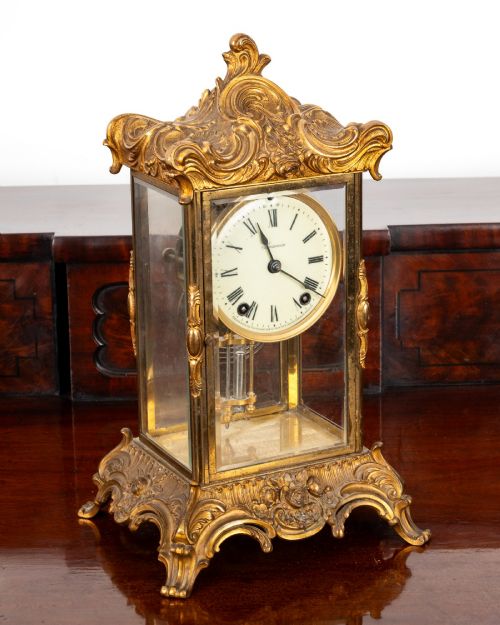


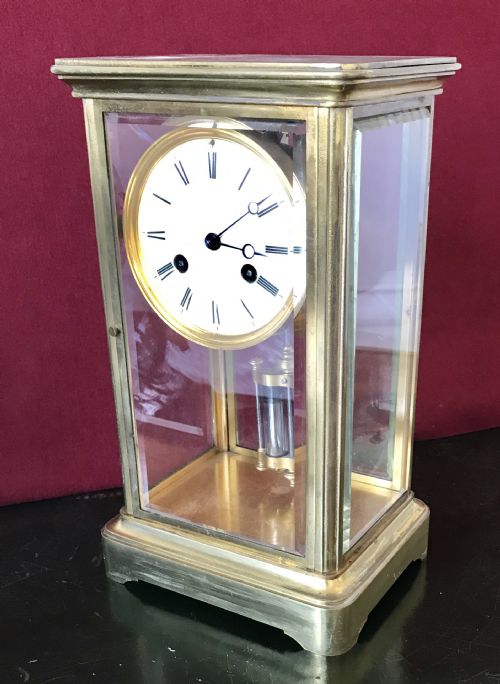
Brass Crystal Regulator
A brass crystal regulator brings together heavy cast metal and glass panels to display an intricate clock movement from every conceivable angle.
Brass Crystal Regulator
When you search for a brass crystal regulator, you are looking at mantel clocks designed to showcase their internal mechanics through glazed panels on all four sides. The pieces on this page span the Victorian era, the nineteenth century, and the Belle Epoque, with French makers dominating the selection.
Most examples you will meet take the form of mantel clocks or four-glass clocks housed in gilt brass, gilt bronze, or ormolu frames. These heavy enclosures often feature painted enamel dials and decorative panels in colours such as green, pink, and blue, framed by bevelled glass.
Makers such as Samuel Marti et Cie and L Epee produced these sophisticated timepieces during the latter half of the nineteenth century and into the twentieth century. Alongside standard upright models, you may encounter bow-fronted shapes and complete clock sets dating from the eighteen-eighties.
Distinctions in quality and execution
The weight and thickness of the cast brass or gilt bronze frame set the foundation for a superior piece, offering a more substantial feel than lighter alternatives. Finer examples display crisper detailing in the cast ornamentation and heavier bevels on the glass panels.
The execution of the enamel dial and the presence of signed movements by established makers like Samuel Marti elevate the standard of a clock. Painted details on the enamel panels show varying degrees of artistic skill, separating standard production models from more decorative works.
Brass Crystal Regulator Retail Price Guide 2026
Typical asking prices for brass crystal regulator among the pieces listed under this phrase on Sellingantiques today, from the lower quarter to the upper quarter. They describe what is for sale here now, not the wider market.
Listings feature items spanning from 1870 to 1960, with an emphasis on French production from the Victorian and Belle Epoque periods.
Ansonia New York·Samuel Marti et Cie·L Epee France
The Brass Crystal Regulator Glossary
- Crystal regulator
- A mantel clock housed in a glazed case with glass panels on all sides to reveal the movement. This design gained immense popularity in France during the nineteenth century.
- Bevelled glass
- Glass with an edge ground and polished to an acute angle. This technique catches the light and adds depth to the viewing windows.
- Ormolu
- Gilt bronze produced by applying a finely ground high-carat gold mercury amalgam to a bronze object. The process creates a rich, warm metallic finish.
- Enamel
- A glassy substance fused to a metal substrate through firing, used here for the clock face and decorative panels. It provides a smooth, durable surface for painted numerals.
- Paste stones
- Faceted glass stones set into metal mounts to simulate gemstones. They appear in decorative trims on select clock faces and bezels.
Brass Crystal Regulator: Frequently Asked Questions
What is a crystal regulator?
A crystal regulator is a mantel clock enclosed in a glass case with bevelled panes on all sides. This construction allows light to pass through the clock and exposes the entire movement to view.
Most examples feature heavy brass or gilt bronze frames, often accompanied by an enamel dial and a visible mercury or compensating pendulum swinging within.
Where were these clocks made?
The vast majority of these timepieces originate from France, particularly dating from the late nineteenth century through to the Belle Epoque. French workshops and foundries produced numerous variations of the four-glass mantel clock.
American firms such as Ansonia also produced their own interpretations of the style during a similar period.
How do I wind the clock?
Winding typically involves inserting a key into designated arbors on the enamel dial to tension the spring-driven movement. Care must be taken not to over-wind the mainspring.
Many of these movements include a small regulator square on the dial to adjust the speed of the pendulum for accurate timekeeping.
How do I style a crystal regulator at home?
Place the clock on a sturdy mantelpiece, sideboard, or desk where surrounding light can pass through the glass panels. Because the movement is visible from all angles, positioning it away from a flat wall enhances its appearance.
Keep the clock away from direct heat sources and vibrations to protect the delicate balance wheel and enamel components.