


Samuel Marti Clock
A samuel marti clock brings French horological artistry home through ornate casework and reliable nineteenth-century mechanical movements.
Defining the Samuel Marti Clock
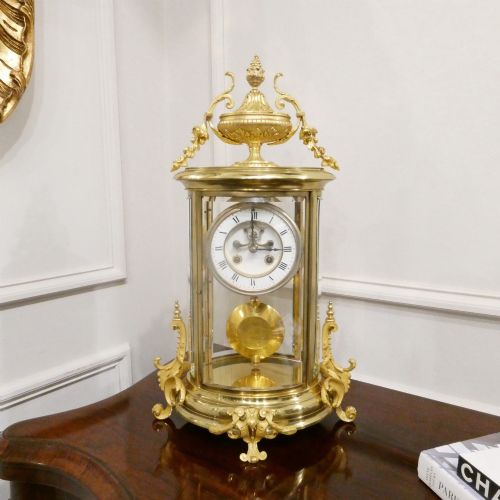
A samuel marti clock represents the output of a celebrated nineteenth-century French medal-winning movement maker whose mechanisms appear inside diverse decorative housings. These mantel clocks, wall clocks, and clock garnitures span the 1880s, 1890s, and 1900, capturing the aesthetic tastes of their era.
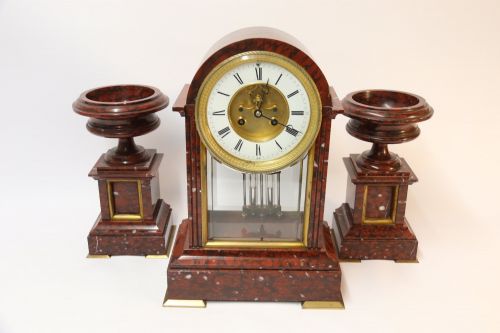
The most frequent encounter on this page is the four glass mantel clock, alongside striking architectural garnitures and ornate wall-hanging cartel clocks. Makers housed these quality French movements in brass, gilt bronze, marble, and wood.
Stylistic expressions range widely from classical Louis XIV and Louis XV interpretations to Rococo revival, Belle Epoque, and Art Nouveau. Each piece combines functional timekeeping with the sculptural ambition characteristic of French workshops from the period.
Materials and Construction
Casework combines cast metals like brass, ormolu, and gilt bronze with natural stones such as rouge marble, sienna marble, and onyx. Artisans also employed mahogany, tortoiseshell, and glass panels to enclose intricate brass movements.
Interiors rely on precision gear trains, often driving eight-day striking mechanisms produced in Parisian workshops. Dial faces frequently utilise white enamel with delicate numbering, protected behind bevelled glass panes.
Retail Price Guide 2026
Typical UK retail prices for samuel marti clock, calculated from the Sellingantiques database of over a million retail prices indexed since 2003. This retail price guide relies exclusively on Sellingantiques data; no external sources or auction records are used, so the figures do not describe the wider market.
Listings feature brass, gilt bronze, marble, tortoiseshell, and enamel across the nineteenth century.
The Spectrum of Quality
Quality reveals itself in the crispness of the cast bronze ornament and the depth of the gilding applied to the brass or ormolu mounts. Finer examples integrate complex materials like champleve enamel, tortoiseshell boullework, or matching garniture urns.
The sophistication of the movement and the intact preservation of fragile glass panels or delicate enamel dials elevate certain pieces. Architectural ambition, from simple gorge cases to elaborate portico designs, distinguishes standard production from exceptional works.
Samuel Marti·The Goldsmiths Company
The Samuel Marti Clock Glossary
- Garniture
- A set comprising a central clock accompanied by matching side ornaments such as urns or vases. These decorative sets traditionally adorned mantelpieces in nineteenth-century salons.
- Ormolu
- Gilt bronze created by applying a finely ground high-carat gold-mercury amalgam to a bronze object before firing. This historic French technique produces a distinctive warm metallic lustre.
- Boulle
- An elaborate marquetry technique using brass and tortoiseshell inlaid in contrasting patterns. Named after a famous cabinetmaker, it frequently decorates Louis-style clock cases.
- Champleve
- An enamelling technique where troughs are dug into a metal surface and filled with vitreous paste before firing. The resulting coloured patterns ornament clock dials and brass frames.
- Cartel clock
- A wall-mounted clock featuring an ornate decorative case made from metal or wood. These pieces hang directly on interior walls rather than resting on mantelpieces.
Frequently Asked Questions
How do I wind a Samuel Marti clock?
Winding requires a matching key inserted into the dial holes to tension the internal springs gently. Care must be taken not to over-wind the mechanism.
Most movements operate on an eight-day cycle, meaning weekly attention keeps the clock running accurately.
Where were these clocks made?
Production took place in France, primarily around Paris, during the nineteenth century. Parisian horologists and bronze-casters collaborated to create the movements and decorative cases.
Retailers across Europe, including prominent London firms, subsequently imported and sold these finished French timepieces.
How do I identify the style?
Styles follow historic French design periods visible in the casework ornamentation. Rococo examples display asymmetrical scrolls, while Louis XV and Louis XIV pieces use formal classical symmetry.
Belle Epoque and Art Nouveau designs introduce flowing floral motifs and richer cabinet timbers.