

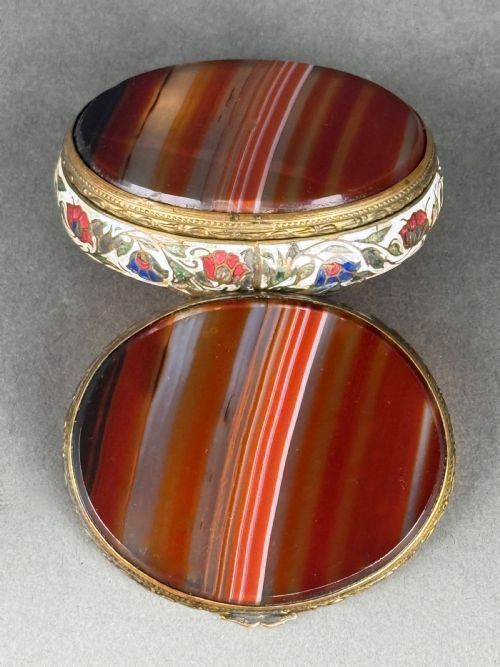


Gilt Enamel Trinket Box
A gilt enamel trinket box brings together polished metalwork and vibrant colour, serving as a small desk or dressing table essential.

Gilt Enamel Trinket Box
When you search for a gilt enamel trinket box, you encounter small decorative containers produced across the eighteenth, nineteenth, and early twentieth centuries. These pieces appear in forms ranging from pill boxes and patch boxes to larger jewellery caskets and music boxes.
The version you are most likely to meet on this page originates from English production centres like South Staffordshire, or from continental workshops in France and Austria. They combine metal mounts with vitreous enamel surfaces, often decorated with hand-painted scenes or rich cobalt and turquoise hues.
Makers utilised various base materials, pairing copper, brass, and silver with gilt finishes. Alongside traditional boxes, the selection includes specialised items featuring banded agate, porcelain, and glass.
Materials and construction
Craftsmen fused powdered glass to metal bases through high-temperature firing, creating smooth enamel surfaces on copper, bronze, or silver. This vitreous layer was frequently painted by hand with detailed landscapes, floral motifs, or figural subjects.
Gilt metal mounts, ormolu, and silver-gilt frames were then fitted to secure the box and provide functional hinges and clasps. Techniques such as champlevé, cloisonné, and guilloché added further texture and pattern beneath translucent enamel layers.
Gilt Enamel Trinket Box Retail Price Guide 2026
Typical asking prices for gilt enamel trinket box among the pieces listed under this phrase on Sellingantiques today, from the lower quarter to the upper quarter. They describe what is for sale here now, not the wider market.
Some tiny eighteenth-century patch boxes included hidden mirrors inside the lid for adjusting facial beauty spots.
Judging quality and execution
Quality rests upon the crispness of the metal gilding and the precision of the enamel work. Finer examples display smooth, evenly fired enamel free from major bubbling or extensive hairline cracking.
The detail in hand-painted miniatures and the snugness of the hinge fit also distinguish superior pieces. Well-executed mounts in chased ormolu and silver-gilt elevate the status of the box significantly.
Khlebnikov
The Gilt Enamel Trinket Box Glossary
- Champlevé enamel
- A technique where troughs are dug into a metal plate and filled with enamel powder before firing. This method produces bold patterns defined by metal lines.
- Ormolu
- A gilt bronze application used for mounts and decorative trims on boxes. It provides a bright golden finish that frames the enamel panels.
- Patch box
- A small container originally used to hold cosmetic beauty patches worn on the face. These eighteenth-century pocket items often included an interior mirror.
- Guilloché
- A decorative engine-turning technique engraved into metal beneath translucent enamel. It creates repeating geometric patterns that catch the light.
- Cloisonné
- A method where thin metal wires are soldered to a metal base to create compartments for enamel paste. The piece is then fired and polished flat.
Gilt Enamel Trinket Box: Frequently Asked Questions
What were small enamel boxes used for?
These containers held practical personal items such as snuff, pills, or cosmetic patches during the eighteenth and nineteenth centuries. Their small size made them convenient pocket accessories for polite society.
Over time, many transitioned into dressing table ornaments used to store rings, small brooches, and keepsakes.
How do I date an antique enamel box?
Dating relies on stylistic clues, mounting techniques, and historical attribution marks. Eighteenth-century English pieces often feature simple copper bases with characteristic turquoise interiors.
Later nineteenth-century examples from France and Austria display heavier revivalist mounts, machine-turned guilloché patterns, or distinct factory signatures.
How should I clean a gilt enamel box?
Enamel surfaces require gentle dusting with a soft, dry cloth to prevent scratching the glass layer. Avoid submerging antique boxes in water, particularly those with paper linings or exposed iron pins.
Metal gilt mounts can be wiped carefully with a dry microfibre cloth, keeping polishes away from the enamel body entirely.
Where were most antique enamel boxes made?
Production centred heavily around English workshops in Staffordshire, including Bilston, which specialised in copper and enamel snuff boxes. Continental output came largely from French porcelain and metalwork centres.
Viennese workshops also produced substantial quantities of gilt metal and enamel table cabinets and musical boxes during the nineteenth century.