
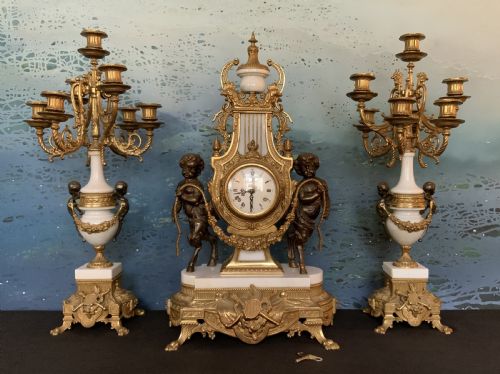


Gilt Brass Clock Set
When you select a gilt brass clock set, you acquire a coordinated mantel ensemble of a central timekeeper flanked by matching candelabras or urns.

Gilt Brass Clock Set
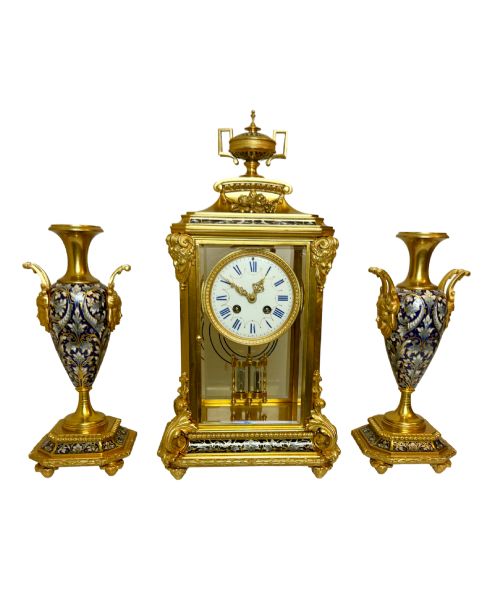
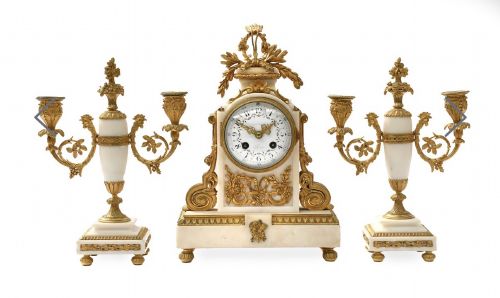
A gilt brass clock set combines a principal mantel clock with matching side pieces such as candelabras, urns, or inkwells to create a unified decorative arrangement. These ensembles originate predominantly from nineteenth-century French workshops, spanning styles from Rococo Revival and Second Empire to Louis XVI and Gothic designs.
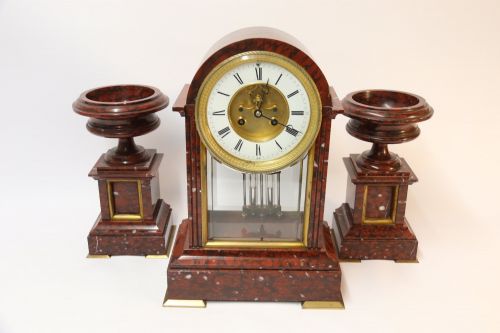
The most common configurations on this page include three-piece garnitures featuring a striking movement housed in gilt bronze, brass, or ormolu, accompanied by a pair of matching candleholders or vases. Many examples incorporate contrasting elements of marble, onyx, enamel, or porcelain within the clock case and its matching side pieces.
Dating ranges primarily from the Victorian era and the late nineteenth century through to the Edwardian period, with occasional variations in scale from large portico clocks to smaller boudoir sets. Collectors encounter these pieces utilised on mantelpieces, desks, and side tables as centrepieces of period interior decoration.
Determinants of quality
Mechanical complexity and the reputation of the movement maker also elevate a piece, with signed plates from established Parisian makers commanding greater recognition. The integration of high-grade materials, such as finely figured marble bases and unblemished enamel dials, separates ordinary production from exceptional workshop output.
Listings feature French and Italian pieces from the nineteenth century, incorporating materials like champlevé enamel, gilt bronze, and Sienna marble.
Samuel Marti·A D Mougin·Vincenti et Cie·Japy Freres·Deniere Paris·Louis Japy
The Gilt Brass Clock Set Glossary
- Garniture
- A decorative set of matching objects, usually consisting of a clock and a pair of flanking candelabras or urns designed to sit together on a mantelpiece.
- Ormolu
- Finely ground high-carat gold mercury-gilded to a bronze object, creating a rich golden finish characteristic of French decorative arts.
- Champlevé
- An enamelling technique where troughs are dug into the metal surface and filled with vitreous enamel before firing and polishing.
- Escapement
- The mechanism within the clock movement that controls the release of power from the gear train and gives the timepiece its ticking sound.
- Portico
- A architectural clock case design featuring supporting columns on either side of the suspended pendulum.
Gilt Brass Clock Set: Frequently Asked Questions
What is a clock garniture?
A clock garniture is a matched set comprising a central mantel clock accompanied by side ornaments such as candelabras, urns, or vases.
These pieces were designed to be displayed together on a mantelpiece or sideboard to create a balanced, symmetrical decorative scheme.
How do I wind the clock?
Most period movements require a specific metal key inserted into winding holes on the dial to tension the springs.
Care must be taken not to over-wind the mainsprings, which can cause internal damage to the gear train.
Are these clocks eight day movements?
Many nineteenth-century French sets utilise eight-day movements that require winding approximately once a week.
These mechanisms typically strike the hours and half-hours on a tuned bell or a coiled gong.
How do I identify the period?
Periods are identified through a combination of stylistic clues, such as Rococo curves, Neoclassical columns, or Gothic pointed arches, alongside maker signatures.
Many French movements carry stamped foundry marks and serial numbers on the backplate that help narrow down the date of manufacture.