
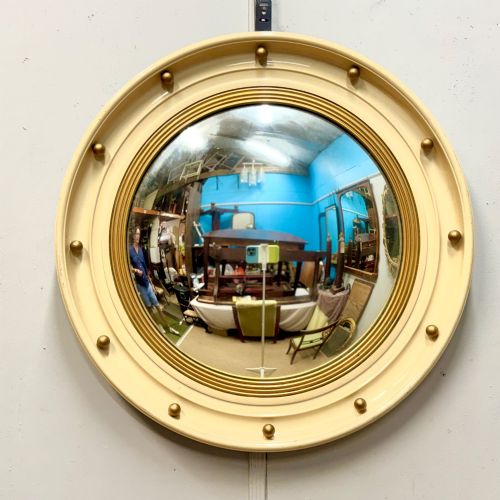


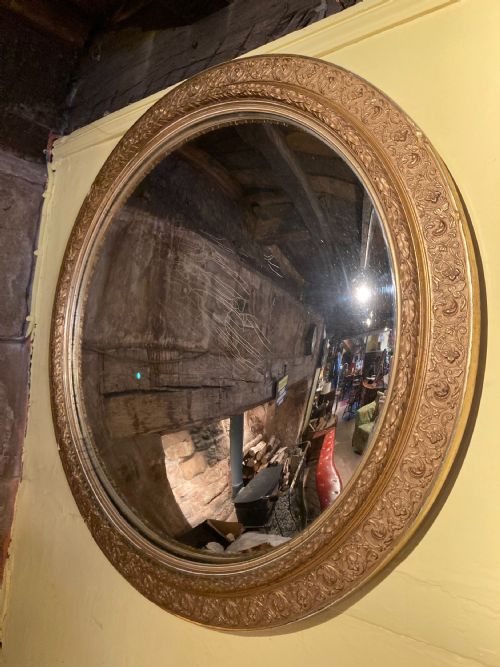


Gilded Porthole Mirror
These gilded porthole mirror pieces bring light and depth to a room through their curved convex glass.
Gilded Porthole Mirror
When you search for a gilded porthole mirror, you are looking at circular convex wall mirrors designed to throw light across an interior space. These pieces capture a wide, curved reflection that distorts the room in a pleasing and historic manner.
The versions you are most likely to meet on this page span the Regency, Victorian, and 19th century periods, often framed in giltwood or gesso. They take the form of wall mirrors and hall mirrors, occasionally featuring an ebonised slip within the circular frame.
Makers from the Regency era onwards favoured this round format for hallways and reception rooms where a single focal point was required. Their scale ranges from large wall pieces down to smaller hall mirrors intended for compact spaces.
How they were made
Carved wood and gesso form the foundation of these circular frames, providing a stable base for the application of gold leaf or paint. Artisans shaped the wood to receive intricate mouldings before applying the finishing layers.
Convex glass was blown or cast to achieve the distinct curving surface that defines the form. This curved glass sits deep within the frame, often separated from the outer moulding by an ebonised slip of wood.
Current listings feature convex mirrors spanning the Regency and Victorian periods, utilising materials such as giltwood, gesso, ebonised wood, and painted wood.
What varies in quality
The crispness of the gesso moulding and the depth of the original gilding set the finer examples apart from simpler pieces. A well-preserved frame retains sharp detail in its decorative elements rather than softened edges from repeated over-painting.
The clarity and condition of the convex glass plate also determine the character of the piece, with older glass showing subtle distortions and silvering changes that distinguish period works from later revivals.
The Gilded Porthole Mirror Glossary
- Convex glass
- A curved glass plate that bulges outward to create a wide-angled reflection of the room. This form was especially popular for domestic use during the Regency period.
- Giltwood
- Timber covered with a thin layer of gold leaf over a prepared gesso ground. It provides the bright reflective border characteristic of these frames.
- Gesso
- A plaster mixture applied to wood frames to create a smooth surface for gilding or painting. It allows for sharp decorative moulding.
- Ebonised slip
- A dark inner border, often made of blackened wood, placed between the mirror glass and the outer gilt frame. It creates a visual contrast that draws the eye inward.
- Girandole
- A wall mirror featuring attached candle branches or sconces designed to multiply candlelight. These pieces combine illumination with reflection.
Gilded Porthole Mirror: Frequently Asked Questions
What is a convex mirror?
A convex mirror is a circular looking glass with an outward-curving surface that captures a wide, panoramic view of the surrounding interior.
These pieces were historically placed in living spaces and halls to distribute natural light before the widespread use of electric illumination.
How were these mirrors used?
They served as decorative focal points in principal rooms and functional glass in narrow hallways to brighten darker corners.
Owners positioned them where their curved reflection could bounce light from windows across the entire space.
How do I date a convex mirror?
Dating relies on examining the construction methods of the timber frame, the composition of the gesso, and the characteristics of the mirror plate.
Earlier Regency examples often display distinct timber joinery and hand-carved details that differ from later 19th-century and revival pieces.
How do I hang a heavy mirror?
Secure hanging requires fixing directly into solid wall studs or using appropriate masonry anchors designed to take the substantial weight of wood and gesso frames.
Professional mirror hangers ensure the weight distributes evenly across robust picture wire or heavy-duty brackets.