

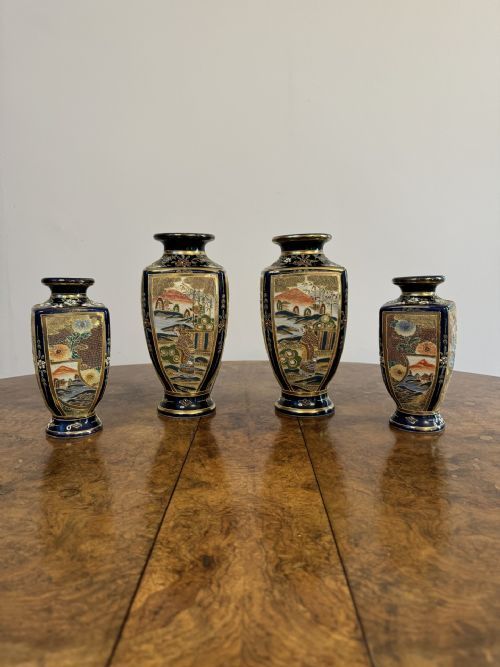
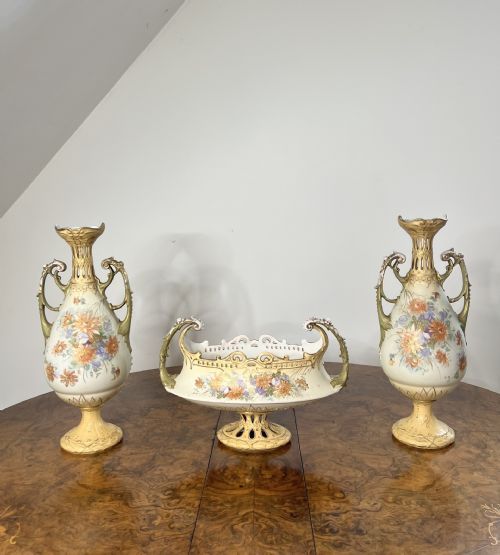


Gilded Porcelain Urn Set
These gilded porcelain urn set pieces combine ceramic bodies with rich metallic ornament, offering grand decorative presence for traditional rooms.
Gilded Porcelain Urn Set
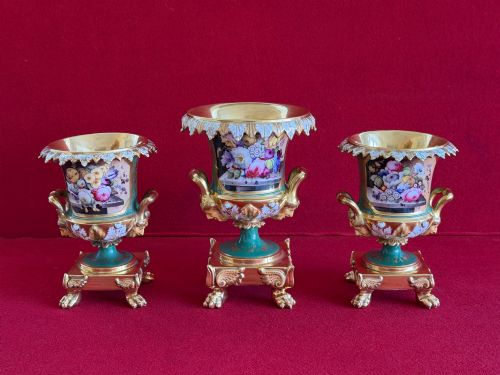
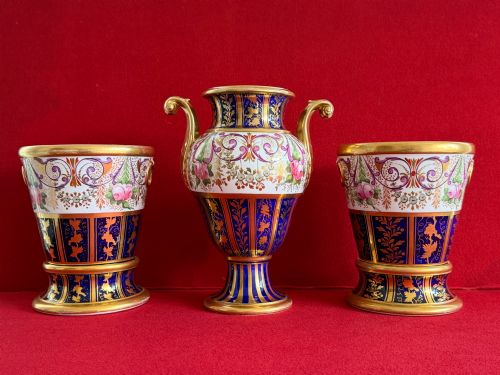
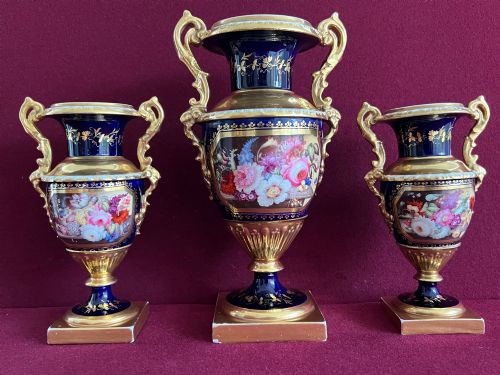
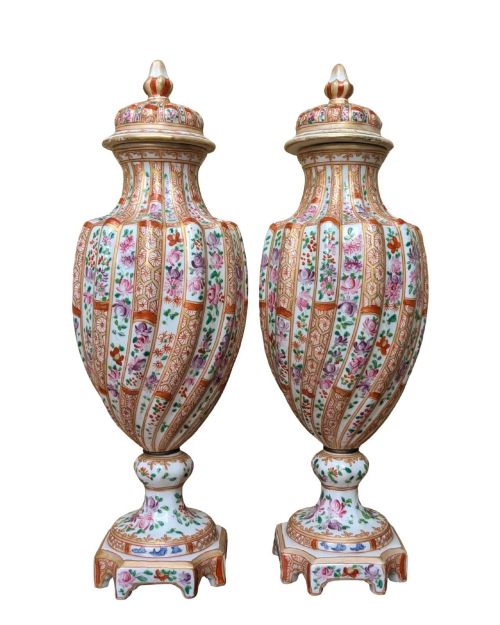
A gilded porcelain urn set comprises matching vessels designed to display together on mantelpieces, consoles or side tables. These decorative groupings typically arrive as pairs or sets of three, uniting central centrepieces with flanking side vases.
The pieces span European and Japanese traditions, taking forms such as garnitures, clock sets and vase groupings. European examples often show Continental factory origins, whilst Japanese works bring Imari, Kutani and Satsuma aesthetics to the market.
Makers from the eighteenth century onwards utilised diverse ceramic bodies, ranging from hard-paste porcelain and bone china to earthenware and ironstone. The grouping creates visual symmetry, a central arrangement balanced by matched companions.
How they were made
Potters formed the ceramic bodies by throwing or moulding clay before applying hand-painted scenes, floral motifs and enamels. Artisans then fired these pieces in kilns to fix the pigments permanently into the glaze.
Workers applied gold leaf, liquid gilding or gilt bronze mounts to accentuate handles, rims and borders. Ormolu mounts frequently secured the porcelain elements, combining metallic brilliance with ceramic form.
Gilded Porcelain Urn Set Retail Price Guide 2026
Typical asking prices for gilded porcelain urn set among the pieces listed under this phrase on Sellingantiques today, from the lower quarter to the upper quarter. They describe what is for sale here now, not the wider market.
The listings on this site span the eighteenth, nineteenth and early twentieth centuries, featuring porcelain, earthenware and gilt bronze.
What varies in quality
Quality rests upon the precision of the hand-painted decoration, the crispness of the porcelain moulding and the weight of the bronze or gilt mounts. Superior sets display detailed brushwork in the enameled scenes rather than simple transfer printing.
The depth and application of the gilding separate standard production from finer output, with burnished gold leaf retaining greater brilliance than flat metallic paint. Completeness within a garniture also dictates desirability, as surviving matched trios or pairs hold stronger decorative value.
Minton·Thomas Steel·Royal Vienna·KPM Berlin·Doulton Lambeth·Vincenti of Paris
The Gilded Porcelain Urn Set Glossary
- Garniture
- A set of matching decorative vases or urns designed to be displayed together on a mantelpiece or sideboard. These groupings commonly consist of three or five matching vessels.
- Ormolu
- Gilded bronze mounts used to decorate and support porcelain bodies. This technique involves applying a gold amalgam to bronze fixtures.
- Imari
- Japanese porcelain decorated in underglaze blue, iron red and gilt. The palette originated during the Edo period and proved highly influential in Europe.
- Earthenware
- Porous ceramic pottery fired at lower temperatures than porcelain. This material forms the heavier, opaque bodies seen in specific Victorian and ironstone pieces.
Gilded Porcelain Urn Set: Frequently Asked Questions
How do I style a garniture set?
Place the tallest urn or clock in the exact centre of your mantelpiece or sideboard to anchor the arrangement. Position the matching smaller vases symmetrically on either side to maintain visual balance.
Ensure adequate space around each vessel so the gilding and hand-painted details remain visible. Avoid overcrowding the pieces with other tall objects that might obscure their silhouette.
Were these sets meant to hold flowers?
Most antique garnitures served primarily as decorative ornaments rather than functional vases for water and fresh stems. Their complex gilding, metal mounts and enclosed lidded forms indicate they were created for display.
Using them for dried botanicals is acceptable, but water should be kept away from antique ceramic interiors and metallic mounts to prevent damage. Many pieces lack the interior glazing needed for regular floral use.
How do I tell European from Japanese sets?
European pieces frequently display neoclassical urn shapes, Paris porcelain scenes, or factory marks from Vienna, Berlin and France. Their gilding often interacts with Rococo Revival or Empire styling.
Japanese examples utilise distinct decorative palettes such as Satsuma earthenware, Kutani work, or Imari iron-red and blue motifs. The underlying clay and stylistic motifs reveal their Eastern origins immediately.
What is the difference between a garniture and a vase set?
A garniture specifically refers to a designed set of three or more matching vessels intended to unify a decorative scheme. These often include lidded urns or clock garnitures.
A simple vase set may just be a pair of identical vessels without the central hierarchy or varied heights typical of a true garniture arrangement.