
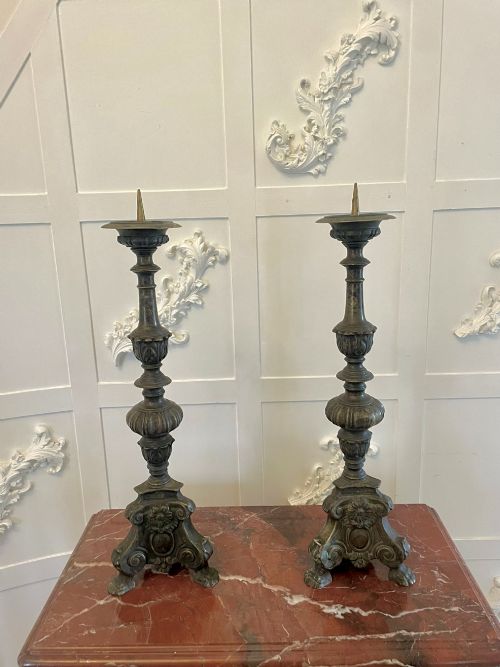
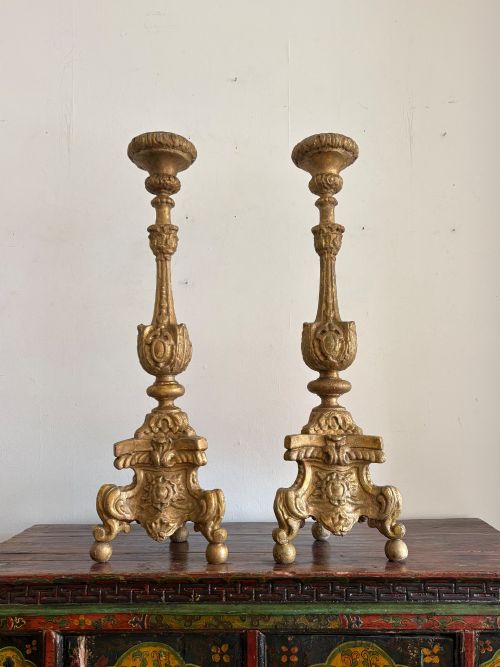
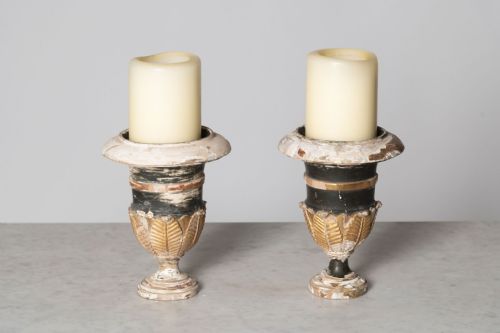


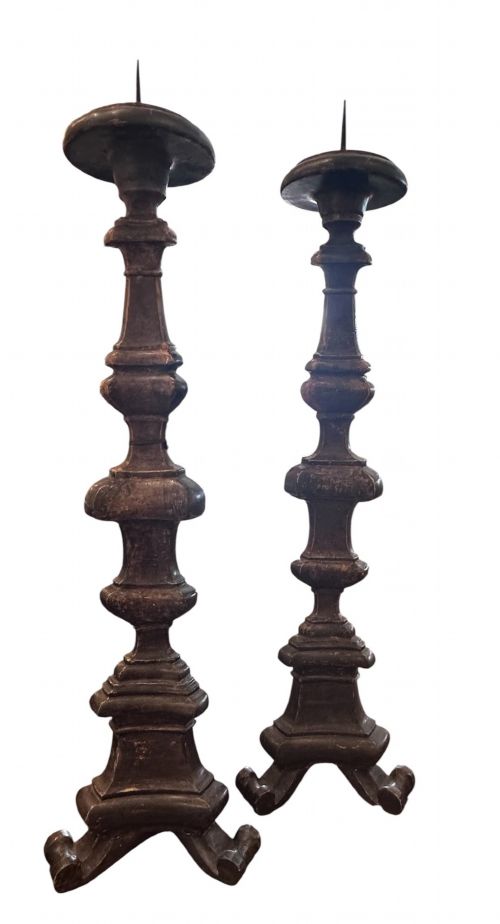


Gilded Altar Candle Holders
These gilded altar candle holders bring solemn ecclesiastical grandeur and rich metallic warmth into domestic rooms.
Gilded Altar Candle Holders
Gilded altar candle holders encompass ecclesiastical lighting fixtures originating from centuries of church and chapel interiors, taking the form of prickets, candlesticks, and candelabras. When searching for gilded altar candle holders, collectors encounter substantial devotional items designed for placement upon altars, often surviving in pairs or matching groups.
The objects span multiple periods, with examples emerging from the eighteenth century through to the early twentieth century, alongside Victorian revivals and continental interpretations. Forms vary from simple turned wooden shafts to elaborate sculpted shapes influenced by Italian Baroque, French Rococo, and Gothic traditions.
Makers and workshops across Italy and France produced these pieces using traditional timber carving, cast bronze, and heavy brass. Domestic adaptations appear among the selections, including pieces converted into table lamps or fitted with lamp bases while retaining their original devotional character.
Materials and construction
The underlying structure of these devotional objects relies heavily on carved wood, gesso, and giltwood, alongside cast metals such as bronze, brass, and iron. Artisans shaped timber by hand before applying layers of gesso to create a smooth surface suitable for receiving delicate applications of gold leaf or silver leaf.
Metal components, including heavy bronze and brass castings, utilise traditional foundry techniques to achieve intricate scrollwork and structural prickets designed to secure large altar candles. Wooden elements often exhibit deep hand-carving characteristic of Italian Baroque and French chateau styles, combining structural integrity with ornamental display.
Listings feature pieces spanning the eighteenth century to the early twentieth century, incorporating carved wood, giltwood, bronze, and brass.
Evaluating quality and execution
The distinction between standard execution and finer work lies in the depth of the hand-carving and the handling of the gilt surface. Superior pieces display crisp definition in floral motifs and scrolls, whereas simpler examples rely on flatter surface decoration and standard turning.
The preservation of the original gold leaf or gesso layer dictates the visual impact of the piece. Fine examples retain rich surface texture and authentic patination accrued over centuries of use, showing harmonious integration between the base material and the applied gilding.
The Gilded Altar Candle Holders Glossary
- Pricket
- A sharp metal spike atop a candlestick designed to impale the base of a large candle. This traditional liturgical fitting distinguishes altar candlesticks from standard domestic domestic lighting.
- Giltwood
- Timber that has been coated with a thin layer of gold leaf or gold paint. This technique provides the luxurious appearance of solid gold while utilising more accessible carved woods underneath.
- Gesso
- A plaster mixture applied to carved wood as a base for gilding or painting. It creates a smooth, receptive surface for gold leaf application.
- Candelabra
- A branched candlestick holding multiple lights. These larger fixtures provide enhanced illumination for ceremonial settings.
- Baroque
- An ornate artistic style characterised by exaggerated motion and clear detail. Italian and French pieces frequently employ these dramatic, sculptural forms.
Gilded Altar Candle Holders: Frequently Asked Questions
How do I clean giltwood safely?
Giltwood requires extremely gentle dusting with a soft, dry brush to prevent damage to the delicate gold leaf layer. Moisture and chemical cleaning agents must be avoided entirely.
Preserving the fragile surface ensures the original antique finish remains intact without wearing away the underlying gesso.
Can these candle holders be used with modern candles?
Pricket candlesticks require candles with hollow bases or drilled indentations to sit properly upon the metal spike. Standard taper candles will not balance correctly on a pricket.
Collectors often display them unlit as sculptural objects or use specialised candles designed to fit pricket fittings.
How do I date an antique candle holder?
Dating relies upon examining the tooling marks, wood species, and the composition of the gesso and metal castings. Eighteenth-century pieces typically show deeper, hand-chiselled carving compared to later Victorian revivals.
Comparing the style and material characteristics against established period examples helps determine the likely era of manufacture.