
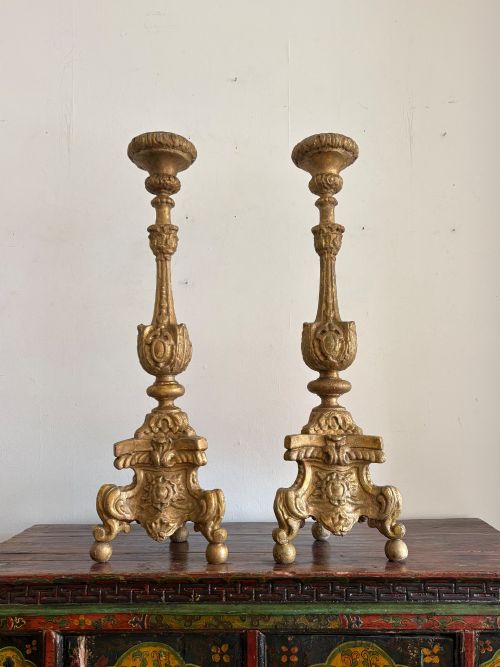
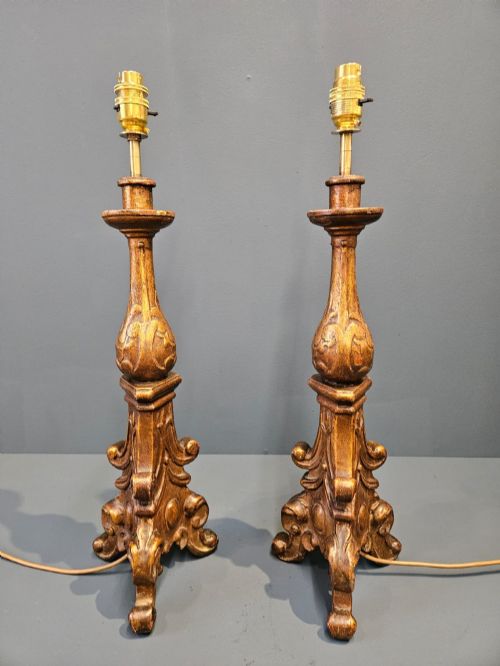


Baroque Giltwood Candlesticks
Baroque giltwood candlesticks bring lavish, carved warmth to a room, offering the bold scrolls and rich surfaces of past centuries.
Baroque Giltwood Candlesticks
When you search for baroque giltwood candlesticks, you encounter heavily carved wooden forms finished in gold leaf or gesso, often adapted over time into table lamps or standard lamps. The selection ranges from monumental eighteenth century Italian altar candlesticks to nineteenth century adaptations and later decorative pairs.
Italian, Spanish, and English origins dominate the styles, showing the heavy influence of regional baroque workshops. Many pieces began life as pricket sticks or altar candle holders before finding new life with modern electrical fittings.
How they were made
The foundation of each piece is carved wood, frequently shaped into robust scrolls, acanthus leaves, and figural elements such as Blackamoor figures. Artisans applied layers of gesso to smooth the wooden substrate before laying down delicate gold leaf or gilt finishes.
Polychrome accents sometimes supplement the gilding, adding depth and colour to the carved details. Brass fittings appear on pieces converted into lamps, integrating later electrical components with antique woodwork.
Some dramatic pairs feature carved Blackamoor figures doubling as sturdy structural supports for towering candle holders.
What varies in quality
The depth and vigour of the hand carving dictate the visual impact, with crisply defined scrolls standing far above softly worn or shallow execution. The integrity of the original gilt surface also defines the piece, as genuine layers of gold leaf age with a characteristic warmth compared to later metallic paints.
Proportion and scale separate ordinary examples from impressive altar-type pieces that command a room. The subtlety with which historical candlesticks have been adapted into lamps influences the overall coherence of the object.
The Baroque Giltwood Candlesticks Glossary
- Giltwood
- Wood that has been coated with gold leaf or a gilt finish. This surface gives the characteristic metallic gleam seen across baroque furnishings.
- Gesso
- A plaster-like mixture applied to carved wood to create a smooth base for gilding. It allows for crisp detail in the final ornamentation.
- Pricket stick
- A type of candlestick featuring a central spike to secure a large candle. These often originate from ecclesiastical settings.
- Altar candlestick
- A tall, substantial candle holder designed for use on a church altar. Many surviving examples from the eighteenth century measure considerable heights.
- Polychrome
- The practice of decorating wood surfaces in multiple colours. It often highlights specific carved details alongside the predominant gilding.
Baroque Giltwood Candlesticks: Frequently Asked Questions
Are these wired for modern lamps?
Many examples have been converted from traditional candle holders into functional table lamps or standard lamps over the years. This allows them to integrate easily into contemporary interiors while retaining their historic form.
Conversion methods vary, with some alterations preserving more of the original structure than others. Buyers frequently encounter pieces that accommodate standard modern bulbs.
How old are these pieces typically?
The selection spans several centuries, with prominent representation from the eighteenth and nineteenth centuries. Eighteenth century examples often originate from Italian or Spanish ecclesiastical workshops.
Later Victorian interpretations and pieces from the early twentieth century continue the heavy baroque aesthetic. Dating relies heavily on the style of the carving and the composition of the underlying wood and gesso.
Where were these candlesticks made?
Italian and Spanish workshops produced the vast majority of these heavily carved items, often for use in churches and chapels. English baroque interpretations also appear among surviving listings.
Regional differences emerge in the choice of motifs and the boldness of the carving. Italian pieces frequently display elaborate Florentine or Venetian stylistic traits.
How do I care for giltwood surfaces?
Giltwood requires gentle maintenance to protect the delicate gold leaf and underlying gesso from damage. Dusting should be done lightly with a dry, soft cloth without applying cleaning chemicals.
Keep these items away from direct sunlight and excessive moisture to prevent the wood from warping and the gilding from flaking.