


Georgian Berry Spoons
Georgian berry spoons are ornate serving pieces shaped for the table, prized for their embossed fruit motifs and silver-gilt bowls.
Georgian Berry Spoons
Georgian berry spoons are large serving flatware pieces typically decorated with fruit and foliage designs pushed out from behind the bowl. A buyer browsing this selection encounters pairs and individual spoons spanning the eighteenth and early nineteenth centuries. Many examples emerge alongside sifter spoons and dessert flatware, originating from English and Irish silver workshops.
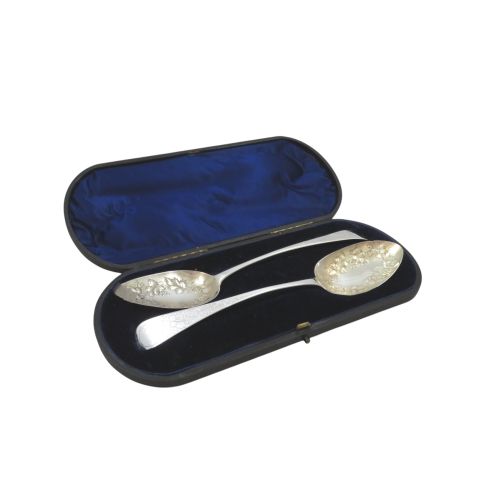
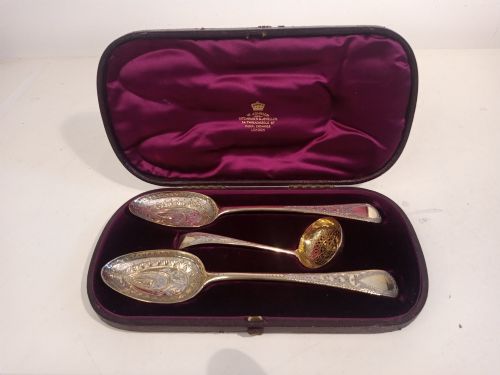
Makers often adapted plain earlier spoons by heavily embossing the bowls and stems decades after initial production, adding intricate fruit clusters and chased details. These modified utensils frequently appear housed in fitted presentation cases lined with velvet, silk, or leatherette. The forms include standard serving spoons alongside pierced sifter variations designed for sugar or fruit service.
Materials and construction
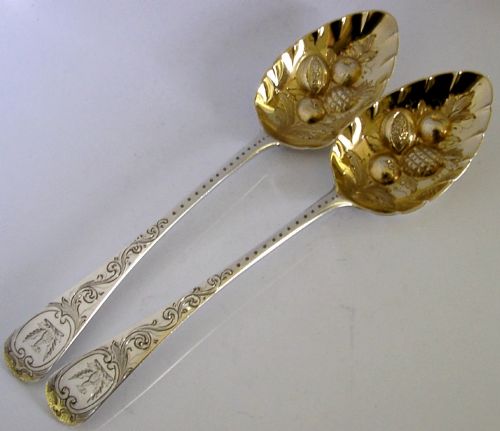
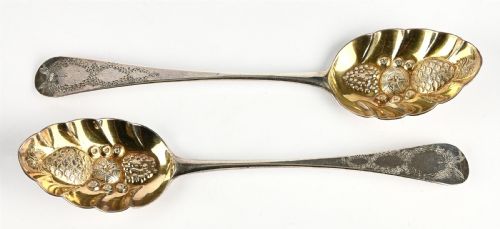
Silversmiths shaped these utensils from sterling silver, employing hammering and casting techniques before applying detailed repoussé and chasing to the bowl and handle. The technique pushes the metal outward from the reverse side to create raised berry and leaf patterns on the front surface. Many workshops then applied a gold wash or parcel gilt finish directly to the interior of the bowl to contrast with the bright silver handle.
Presentation containers utilise rigid leatherette outer shells lined with fitted velvet and silk interiors to secure the silverware. These fitted cases often accommodate pairs or matched sets with designated slots for serving spoons and associated sifter utensils.
Several families evidently enjoyed their fruit quite formally, commissioning custom crested serving spoons for the dining table.
Gradations of quality
The crispness of the chased fruit and leaf work dictates the visual distinction between standard and superior examples. Master silversmiths maintained sharp, deep relief in the embossed bowl ornamentation without thinning the structural silver wall excessively. Lesser pieces display softer, shallower stamping where the chased details blur into the surrounding metal.
The integration of original matching cases and the survival of an even silver-gilt wash inside the bowl elevate specific examples. Sets retaining their original fitted presentation boxes lined in clean velvet and silk demonstrate superior historical preservation.
peter & Anne Bateman·William Chawner II·R Hennell
The Georgian Berry Spoons Glossary
- Berry spoon
- A large serving spoon decorated with embossed fruit and foliage designs on the bowl.
- Silver-gilt
- Sterling silver coated with a thin layer of gold on the surface, frequently applied to the interior bowl of serving spoons.
- Repoussé
- A metalworking technique where the design is hammered into relief from the reverse side.
- Sifter spoon
- A pierced serving utensil designed for sprinkling sugar over fruit or desserts.
- Leatherette
- A synthetic material mimicking leather, commonly used for the exterior of nineteenth century presentation cases.
Georgian Berry Spoons: Frequently Asked Questions
What were berry spoons used for?
These large serving utensils were utilised at the dining table for serving soft fruits, berries, and desserts during the Georgian period. Their broad bowls accommodated bulky food items easily.
Over time, households also employed them for general serving duties and ceremonial table service alongside specialised sifter spoons.
Are original boxes common?
Fitted cases lined with velvet, silk, or leatherette survive with select antique sets from the period. These presentation boxes protected the silver from tarnish and damage during storage.
Many surviving pieces appear loose without cases, making boxed examples particularly notable for collectors.
How do you date these spoons?
Hallmarks stamped directly onto the sterling silver stem provide official assay office marks, date letters, and maker stamps. These small punches identify the exact year and city of manufacture.
Stylistic shifts in the handle patterns, such as feather edge or Onslow designs, offer additional chronological clues for identification.
Were all berry spoons made in the Georgian era?
The primary manufacturing period spans the eighteenth century through the early nineteenth century under Georgian and Regency reigns. Silversmiths occasionally repurposed older plain spoons by adding later Victorian decorative fruit embossing.
Examination of the original hallmarks against the style of the chasing helps determine the exact timeline of manufacture and decoration.