


Framed Paper Bird Prints
Framed paper bird prints bring historical ornithological illustration and natural history into domestic interiors through centuries of paper, ink, and watercolour.
Framed Paper Bird Prints
When you search for framed paper bird prints, you encounter works ranging from Georgian hand-coloured engravings to mid-century watercolour studies. The pieces span Georgian, Victorian, Edwardian, and mid-century periods, presenting avian subjects in varied artistic traditions.
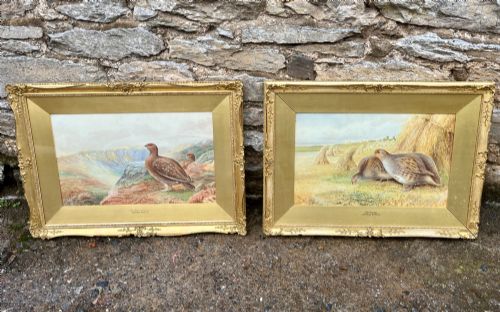
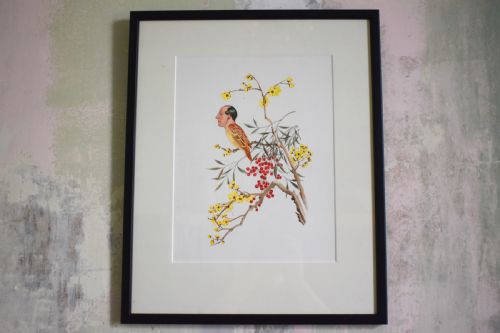
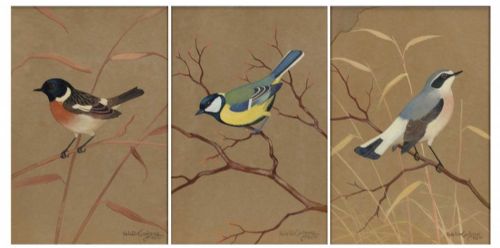
You meet ornithological studies, game bird watercolours, and satirical works housed behind glass in wood or giltwood frames. The selection includes single sheets and multi-part sets executed on paper.
The objects combine natural history recording with decorative art, reflecting the aesthetic priorities of their respective eras from nineteenth-century naturalism to mid-century realism.
Materials and execution
Makers utilised paper as the primary support, applying watercolour pigment, ink, and hand colouring to render detailed plumage and ornithological accuracy. Engraving techniques appear alongside direct brushwork.
Framing employed wood and giltwood, enclosing the works beneath glass to protect fragile paper surfaces from atmospheric degradation and handling over time.
Surrealist satire occasionally infiltrates the birdhouse, proving that nineteenth-century artists possessed a robust sense of humour regarding feathered subjects.
Distinctions in quality
Quality rests upon the precision of the draughtsmanship, the vibrancy of the watercolour pigment or hand colouring, and the fidelity of the ornithological observation. Skilled hand-finishing elevates engraved plates.
The preservation of the paper support and the harmony of the original wood or giltwood frame contribute substantially to the standing of an individual piece.
George Rankin·Ralston Gudgeon·George Edwards·R Lauritsch·Robin Hill·Paul-Louis Barruel·Eleazor Albin
The Framed Paper Bird Prints Glossary
- Engraving
- A printmaking process where an image is incised into a metal plate, holding ink to transfer fine lines onto paper. This technique enabled sharp detail in early ornithological illustrations.
- Hand colouring
- The application of watercolour pigment by hand to a printed outline. This process added realistic hues to monochrome engravings.
- Ornithological study
- A detailed artistic or scientific representation of a bird species. These works combined accurate anatomical observation with aesthetic composition.
- Giltwood
- Wood carved and coated with gold leaf or metallic powder for a reflective finish. Such frames frequently accompanied formal domestic art.
Framed Paper Bird Prints: Frequently Asked Questions
How should I hang framed paper bird prints?
Keep these works away from direct sunlight to prevent the watercolour pigment and paper from fading over time. Stable indoor humidity protects the paper and the wooden frames.
Group related sets together on neutral walls to allow the detail of the ornithological studies to dominate the field of vision.
Are these prints original period items?
The inventory spans specific historical periods including Georgian, Victorian, Edwardian, and mid-century eras. Each piece utilises period paper and printing or painting techniques appropriate to its date.
Examine the paper texture, ink quality, and framing materials to understand the historical context of manufacture.
How do I identify a hand-coloured engraving?
Look closely at the surface under magnification to distinguish printed lines from applied watercolour pigment. Hand-coloured plates often show subtle brush marks within the boundaries of the engraved outlines.
Early examples by makers like George Edwards demonstrate precise application of pigment over inked plates.
Why do some bird prints come in sets?
Natural history works were frequently published as bound volumes or serial folios that illustrators and collectors broke up for framing. Sets of four or more maintain the sequential arrangement intended by the publisher or artist.
Keeping multi-part sets together preserves their historical presentation and decorative impact on a wall.