
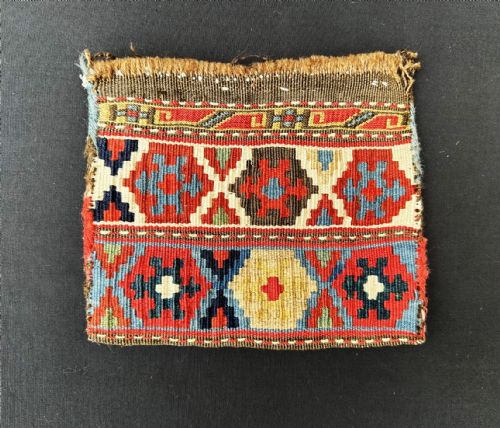
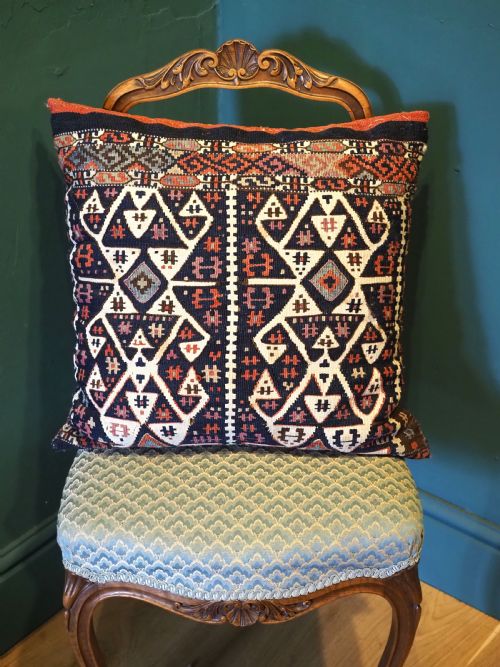

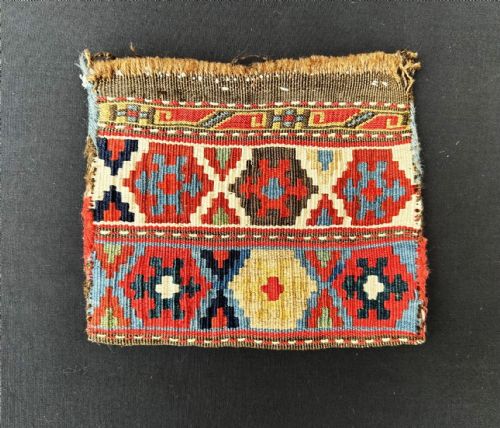


Flatweave Kilim Bag
A flatweave kilim bag brings nomadic textiles into modern rooms as durable storage or cushions.
Flatweave Kilim Bag
A flatweave kilim bag represents nomadic textile traditions from Persia, Anatolia, the Caucasus, and Central Asia created across the nineteenth and early twentieth centuries. These pieces encompass various functional storage forms, including saddle bags, salt bags, wheat sacks, and mafrash panels.
Buyers frequently encounter tribal objects bearing specific regional attributions such as Shahsavan, Yomut Turkmen, Luri-Bakhtiari, and Qashqa'i. The selection spans complete paired saddle bags with original backs to individual cushion conversions and fragments.
Materials and construction methods
Weavers constructed these textiles using hand-spun wool and cotton foundations, frequently incorporating goat hair and leather for structural reinforcement. Natural dyes provide the underlying palette across the regional tribal groups.
Techniques rely on slit-tapestry weaving and banded weft work to create flat-faced surfaces. Many examples retain original plain weave backs, metal elements, and tassels.
Several wheat sacks retain their original grain dust remnants hidden deep within the flatweave corners.
Factors separating quality tiers
Structural completeness dictates the upper tiers, with surviving pairs, intact backs, and original closures commanding attention. The integrity of the flatweave foundation and the precision of the tribal pattern directly influence the piece.
The sophistication of the natural dye palette and the fineness of the hand-spun wool separate standard utility pieces from exceptional tribal examples.
Yomut Turkmen·Shahsavan Nomads·Luri Bakhtiari Tribes·Tekke Turkmen
The Flatweave Kilim Bag Glossary
- Kilim
- A flatweave textile produced by tightly interweaving warp and weft strands without a pile. This technique creates a smooth, durable surface utilised for bags and coverings.
- Mafrash
- A large rectangular storage container or bedding chest panel woven by nomadic tribes. These pieces typically display banded designs or intricate geometric compartments.
- Tacheh
- A traditional tribal grain or wheat sack utilised by western Persian nomads. These textiles frequently feature distinctive flatweave patterns suited for conversion into cushions.
- Torba
- A small storage bag produced by Turkmen groups. These items hung inside tents to hold personal possessions or household goods.
- Juval
- A large Turkmen tent bag used for storage. They display characteristic gül motifs and banded flatweave construction.
Flatweave Kilim Bag: Frequently Asked Questions
What is a flatweave kilim bag?
A flatweave kilim bag is a functional textile made by nomadic tribes for storage, transport, or household organisation. These items served practical roles such as carrying grain, salt, or riding equipment.
Over time, collectors repurposed many surviving panels and complete containers into decorative cushions and wall hangings while retaining their original tribal motifs.
How were these bags used originally?
Nomadic groups utilised these textiles in daily camp life for packing belongings during seasonal migrations. Different shapes corresponded to specific tasks, such as saddle transport or tent storage.
Saddle bags rode across animals, while salt bags and wheat sacks held dry goods inside the dwelling structure.
How do I care for a flatweave kilim bag?
Protect these textiles by limiting direct exposure to strong sunlight, which can fade natural dyes over extended periods. Gentle vacuuming through a mesh screen helps remove dust without damaging the flatweave wool structure.
Professional textile cleaning is recommended for deeper maintenance rather than immersion in water.