




Feather Banded Side Table
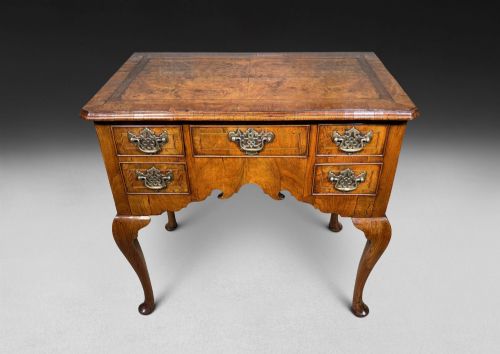
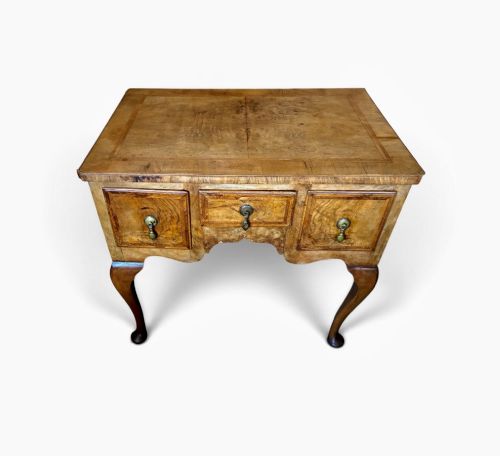
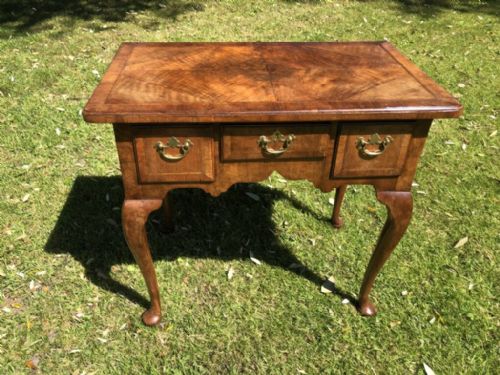
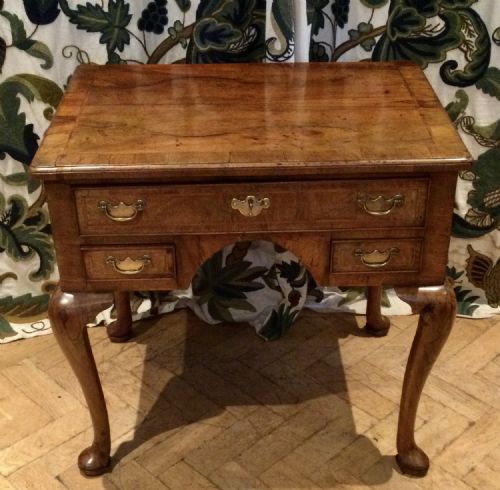
A feather banded side table brings the understated elegance of figured walnut and meticulous cross-banding into a room.
Feather Banded Side Table
A feather banded side table typically takes the form of a lowboy, providing a compact surface with one to three drawers set beneath the top. These pieces appear across the 18th Century, Georgian, and Edwardian periods, including specific revivals of earlier styles.
Makers shaped these tables in walnut, burr walnut, and oak, often applying quarter veneers to the surfaces. The most common iteration encountered here is the lowboy, sitting on slender legs designed for domestic utility and refined display.
How they were made
Cabinetmakers constructed these tables using solid oak for structural framing and secondary timbers, pairing them with walnut and burr walnut for the primary surfaces. Artisans cut thin veneers from heavily figured timber to create striking grain patterns across the top and drawer fronts.
Makers applied decorative banding around the edges of the top and drawers, using fine stringing and parallel cuts of veneer arranged at an angle to resemble a bird feather. Brass hardware, including drop handles and escutcheons, completed the construction.
Cabinetmakers carefully arranged angled veneers so the grain patterns mimic the symmetry of a bird's wing.
What varies in quality
The sophistication of the timber selection dictates the visual appeal, ranging from plain walnut boards to highly figured burr walnut enhanced by quarter veneering. The precision of the decorative banding and the retention of original surfaces separate standard examples from superior ones.
Proportion and the delicacy of the leg turning or cabriole shaping define the overall elegance of the piece. Tables retaining their original brass handles and patination command greater appreciation than those altered over time.
The Feather Banded Side Table Glossary
- Feather banding
- A decorative inlay technique using two strips of veneer cut diagonally and laid to meet at a central axis, creating a pattern resembling a feather. This delicate border frames the edges of table tops and drawer fronts.
- Lowboy
- A small dressing table or side table featuring one or more rows of drawers beneath a flat top. These pieces typically stand on four slender legs.
- Burr walnut
- Timber taken from the abnormal growth of a walnut tree, yielding intricate, swirling grain patterns. Cabinetmakers sliced this wood into thin veneers for high-status furniture.
- Quarter veneered
- A method where four symmetrical pieces of veneer, cut from the same log section, are arranged together to mirror their grain patterns. This creates a balanced, decorative geometric display on table tops.
- Lowboy
- An alternative designation for a low side table with drawers, frequently appearing in 18th Century and Georgian inventories.
Feather Banded Side Table: Frequently Asked Questions
What is a feather banded side table used for?
These tables served primarily as compact side furniture for holding small objects, writing instruments, or grooming items in domestic rooms. Today, they function well as decorative console tables or hallway surfaces.
Their modest proportions allow them to fit into tight spaces while providing surface area and concealed storage within the drawers.
How do I identify a Georgian feather banded side table?
Look for construction details typical of the 18th Century, such as oak drawer linings, hand-cut dovetails, and timber selection that prioritises walnut and burr walnut.
Stiles and rails will show the specific joinery methods of the period, while the presence of feather banding around the drawer edges points directly to Georgian cabinetmaking conventions.
What is the difference between a lowboy and a side table?
A lowboy is a specific type of side table defined by the inclusion of one to three drawers set directly beneath the top surface. Standard side tables might lack drawers entirely or feature different structural proportions.
In the context of walnut furniture from the 18th Century and Georgian eras, the terms often overlap when describing low-framed tables.
Are Edwardian examples authentic antiques?
Edwardian interpretations, particularly those in the Queen Anne Revival style, date from the early 20th Century and replicate the forms of earlier centuries. They represent a distinct period of revival craftsmanship rather than original 18th Century production.
Examining the secondary timbers and interior construction helps distinguish these later recreations from Georgian originals.