
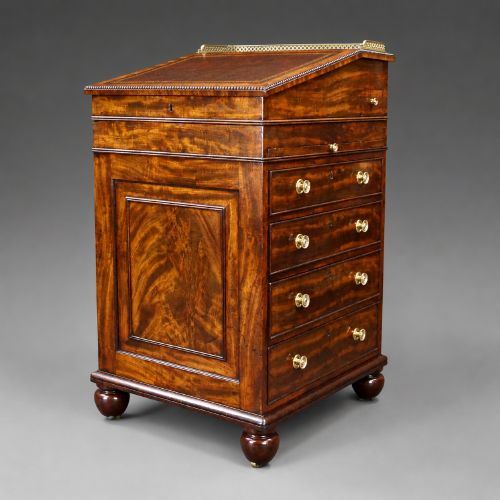

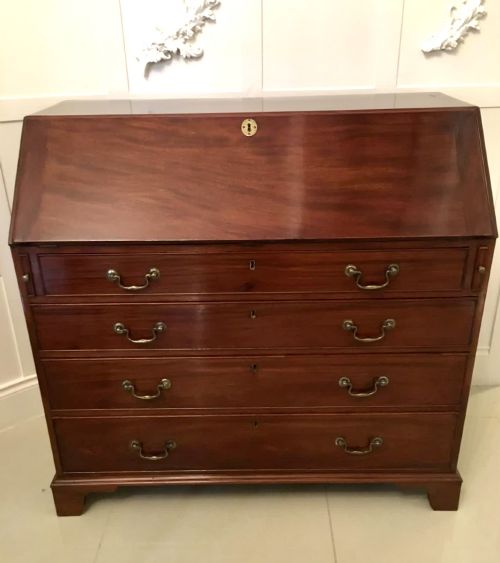
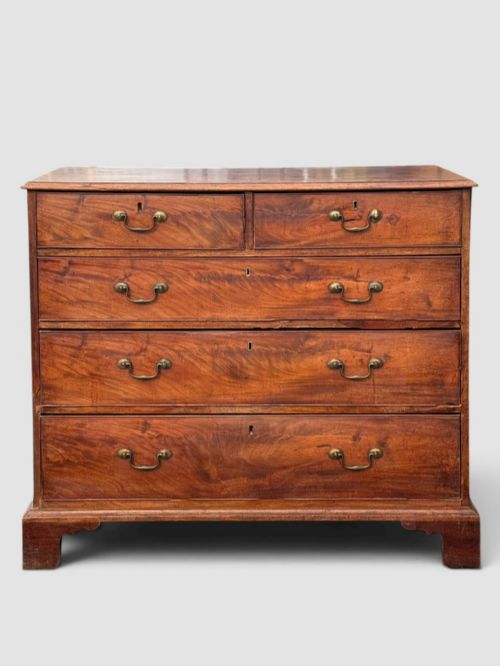
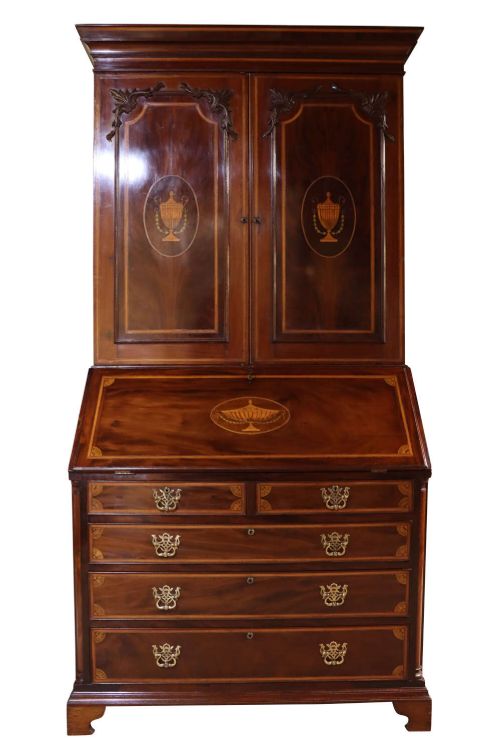


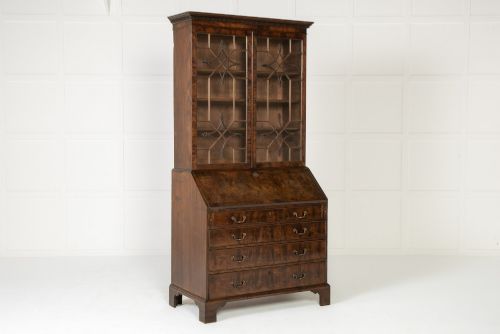

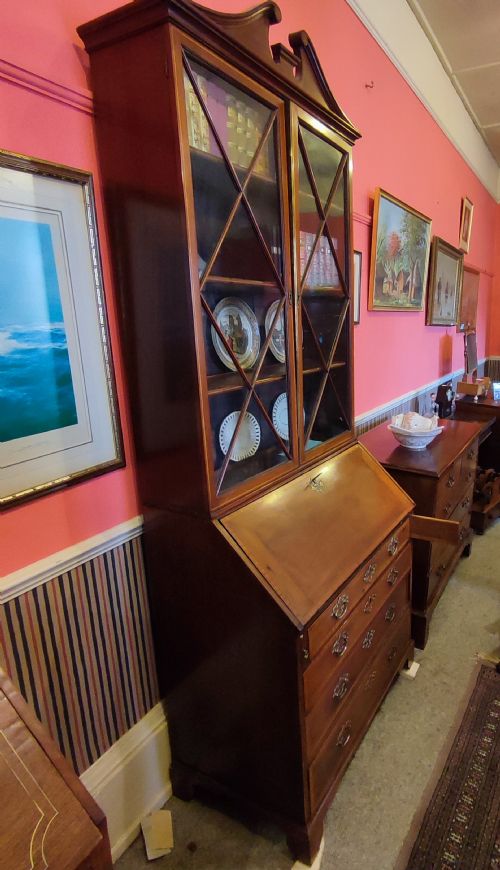
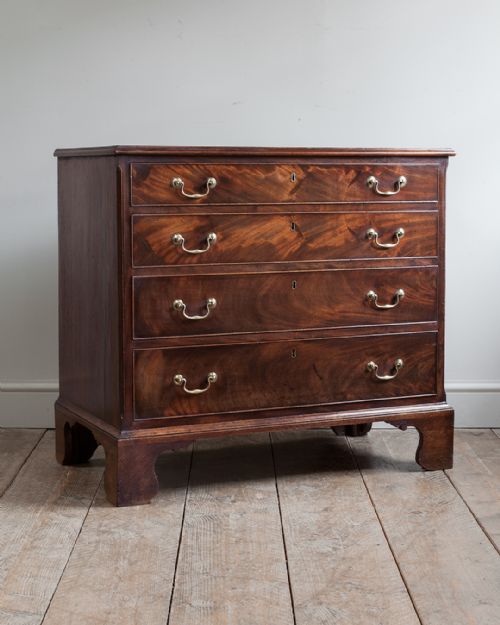

English Mahogany Bureau
An English mahogany bureau brings centuries of working heritage into a room, offering a private writing surface that folds away when the correspondence is done.
English Mahogany Bureau
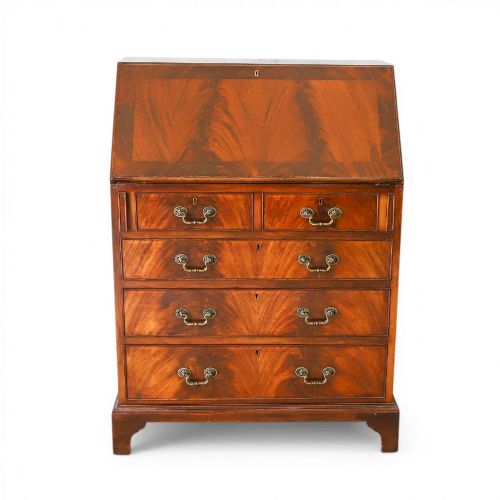
When you search for an english mahogany bureau, you encounter pieces designed for private correspondence and household accounts, typically featuring a sloping fall-front flap that opens to reveal a fitted interior of small drawers and pigeonholes.
The most common examples on this page date from the Georgian and 18th-century periods, alongside later Victorian and Edwardian iterations that retain the practical drop-lid writing compartment above graduated storage drawers.
Many variants extend into larger bureau bookcases with glazed upper cabinets, while others remain compact freestanding desks intended for parlour or bedchamber use.
Materials and Construction
Cabinet makers utilised dense timbers, most notably solid mahogany and figured flame mahogany veneer applied to secondary woods such as oak, creating robust carcases designed for daily domestic administration.
Internal compartments incorporate delicate joinery for secret drawers and pigeonholes, while brass handles, escutcheons, and glass panes furnish the functional and decorative hardware of the period.
Surface finishing relied on hand-polished wax applications that highlight the natural grain patterns and deep reddish-brown tones characteristic of the material.
Many pieces contain hidden compartments known only to the maker, waiting for a future owner to discover secret drawers.
Distinguishing Quality
The distinction between ordinary utility pieces and exceptional examples rests upon the selection of timber, particularly where symmetrical flame mahogany veneers are matched across the fall-front flap and drawer fronts.
Internal complexity dictates much of the merit, with superior desks offering intricate arrangement schemes, sliding wells, and hidden compartments rather than plain partitions.
Proportion and structural integrity, down to the original brass hardware and the crispness of any inlaid wood decoration, determine the standing of each cabinet.
Gillows of Lancaster·John McLean·Edwards and Roberts·George Faulkner Armitage·John Gregory London
The English Mahogany Bureau Glossary
- Fall-front
- A hinged writing flap that drops forward to provide a horizontal desk surface. When closed, it conceals the interior stationery compartments.
- Pigeonhole
- A small recessed compartment within a desk interior designed for storing letters and papers. These are frequently flanked by miniature drawers.
- Escutcheon
- A protective plate surrounding a keyhole. On better pieces, these are cast from brass and fitted flush into the wood.
- Skiver
- A panel of leather inset into the top of a writing surface. It provides a smooth texture for pen work.
English Mahogany Bureau: Frequently Asked Questions
How do I use a bureau daily?
Lower the hinged writing flap to reveal the internal compartments and utilise the flat surface for correspondence or laptop placement.
When finished, simply fold the flap upward and secure it with the key to keep your papers out of sight.
What fits inside the interior?
The interior houses an arrangement of small drawers, pigeonholes, and sometimes a central sliding well designed for historical stationery storage.
Modern users find these compartments ideal for organising letters, stamps, and small everyday stationery items.
How do I date an 18th-century piece?
Examine the drawer construction for hand-cut dovetails, the type of secondary wood used inside, and the overall simplicity or elaboration of the brass hardware.
Earlier Georgian examples often feature bracket feet and solid timber construction, whereas later variations introduce extensive veneering and different internal layouts.
Where should I place a bureau?
These pieces suit home studies, living rooms, or hallways where their compact footprint and vertical storage capacity can be fully appreciated.
Position them away from direct heat sources and strong sunlight to protect the polished mahogany surfaces and delicate veneers from drying out.