

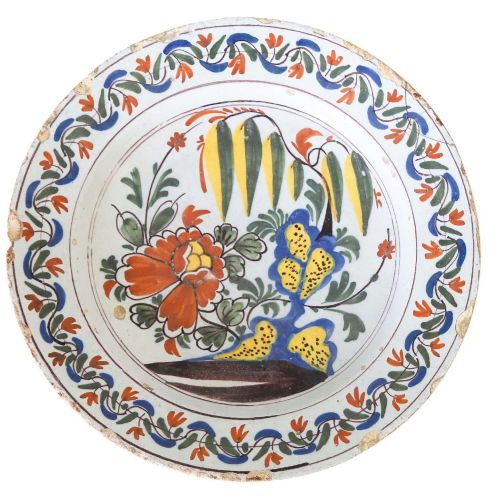


English Delftware Display Plate
An English delftware display plate is a tin-glazed earthenware dish from the eighteenth century that brings historic hand-painted charm to your wall or dresser.
English Delftware Display Plate
When you search for an english delftware display plate, you encounter eighteenth-century earthenwares shaped as chargers, platters, and decorative plates. These domestic objects survive from periods including Georgian and Dutch Baroque styles.
You meet both blue and white designs and polychrome decoration, often featuring floral motifs or Chinoiserie scenes. The forms range from small plates to large chargers intended for visual impact.
The inventory includes single examples alongside pairs and sets of three. Their origin spans eighteenth-century English and Dutch workshops working in tin-glazed ceramic.
How they were made
Potters formed these items from clay and earthenware bodies before applying an opaque tin glaze. This white surface provided the ground for hand-painted cobalt pigment and polychrome pigments.
Firing techniques of the eighteenth century fixed the pigments into the tin glaze, creating the characteristic surface sheen and visual depth seen on these chargers and plates.
Eighteenth-century potters painted floral scenes onto tin glaze, leaving permanent gardens that survived centuries of dining rooms.
What varies in quality
Quality rests in the confidence and clarity of the hand-painted decoration, whether a blue and white floral arrangement or a polychrome Chinoiserie scene. Crisp execution of brushwork distinguishes finer examples.
The smoothness and coverage of the tin-glazed earthenware surface also determine visual success. Well-preserved glazes retain their integrity across large chargers and smaller plates alike.
Lambeth Delft
The English Delftware Display Plate Glossary
- Tin Glaze
- An opaque white ceramic glaze containing tin oxide, providing the characteristic background for painted decoration. It absorbs cobalt pigment during painting.
- Charger
- A large decorative plate or platter intended primarily for display on a wall or dresser rather than dining use. These items form a significant portion of eighteenth-century survivals.
- Chinoiserie
- A European artistic style reflecting Chinese motifs and imaginary landscapes, frequently hand-painted on eighteenth-century plates and chargers. This aesthetic appears on English polychrome pieces.
- Polychrome
- Decoration utilising multiple colours of pigment rather than a single hue like blue and white. These pigments were applied by hand onto the tin glaze.
English Delftware Display Plate: Frequently Asked Questions
Were these plates used for dining?
Large chargers and decorative plates were generally produced for display on walls or sideboards rather than everyday dining use. Their tin-glazed surfaces were susceptible to scratching from cutlery.
Smaller plates occasionally served functional roles, but surviving examples from the eighteenth century largely functioned as visual pieces within Georgian interiors.
How do I hang a charger safely?
Displaying a large charger requires a specialised wall hanger with coated springs or a bespoke plate display stand that distributes the weight evenly across the ceramic body.
Avoid hanging pieces in direct sunlight or areas prone to dampness, as the earthenware and tin glaze benefit from stable atmospheric conditions.
What is the difference between blue and white and polychrome?
Blue and white delftware relies exclusively on cobalt pigment applied beneath or onto the tin glaze to create monochromatic designs of floral or scenic motifs.
Polychrome pieces incorporate additional pigment colours, such as reds, yellows, and greens, giving the hand-painted surface a more varied palette.