


Enamel Demitasse Spoons
These enamel demitasse spoons are small silver items decorated with vitreous colour, made for after-dinner coffee.
Enamel Demitasse Spoons
When you search for enamel demitasse spoons, you encounter small serving pieces designed specifically for after-dinner coffee cups. The items on this page span the nineteenth century through the mid twentieth century, covering periods such as eighteen ninety, nineteen hundred, and nineteen thirty.
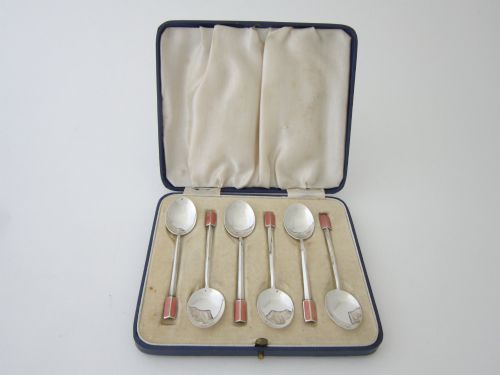
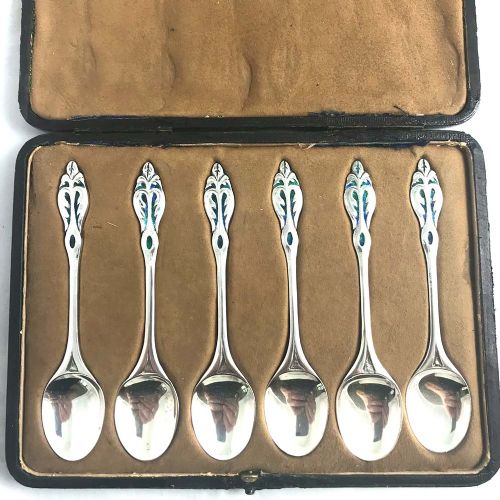
You meet both individual examples and complete cased sets of six, often housed in fitted boxes lined with velvet. Forms range from simple tea spoons and coffee spoons to matching silver mounted coffee cans and saucers.
The aesthetic of these pieces shifts across distinct design movements. Examples emerge in Art Deco, Art Nouveau, Arts and Crafts, and Imperial Russian styles.
How they were made
Maker's workshops built these items using sterling silver, solid silver, and silver gilt as the primary structural metal. Artisans applied vitreous enamel directly to the metal surface to create smooth, colourful decorative panels.
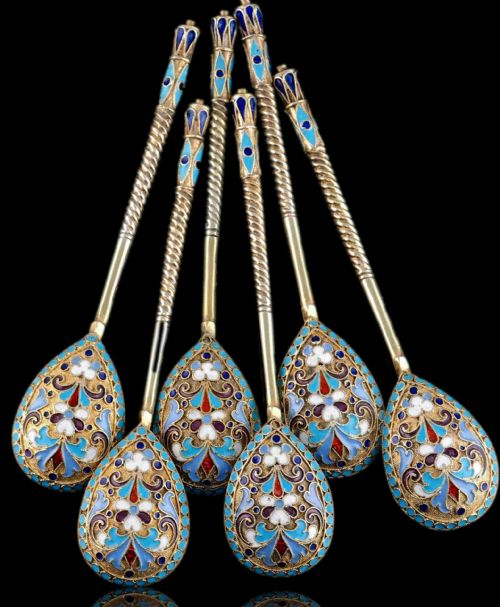
Techniques varied from plain enamelled bowls and stems to intricate cloisonné work, where thin metal wires formed the boundaries for different coloured glass pastes fired at high temperatures.
Listings feature sterling silver and silver gilt materials across Art Deco, Art Nouveau, and Imperial Russian styles dating from the nineteenth and twentieth centuries.
What varies in quality
Quality in these pieces rests primarily on the complexity of the metalwork and the precision of the enamel application. Sets featuring complete original cases command greater interest than assembled groups.
The presence of clear hallmarks, maker marks, and associated retail houses elevates the standing of a set. Hand-applied cloisonné cells executed with exact geometric or floral regularity represent the upper tier of production.
Dmitrii Nikolaevich Nikolaev·David Andersen·Vasily Agafonov·Liberty & Co
The Enamel Demitasse Spoons Glossary
- Demitasse
- A small cup used for serving after-dinner coffee, which dictates the diminutive scale of these spoons. These small vessels require appropriately proportioned cutlery.
- Vitreous enamel
- A material made by fusing powdered glass to a substrate by firing, usually between seven hundred and eight-five hundred degrees Celsius. This process produces a durable and glossy coloured surface.
- Silver gilt
- Silver that has been coated with a thin layer of gold on its exterior surface. This treatment provides a warm golden tone alongside the structural strength of silver.
- Cloisonné
- An ancient technique for decorating metalwork objects with coloured glass separated by strips of metal. Artisans solder flat wires to the metal base to form the design before filling the compartments with enamel.
- Solid silver
- Metal composed entirely of silver throughout its mass rather than being plated or filled. This term denotes substantial material quality in flatware.
Enamel Demitasse Spoons: Frequently Asked Questions
What are enamel demitasse spoons used for?
These small spoons are designed specifically to stir sugar into demitasse cups of strong after-dinner coffee. Their diminutive size ensures they fit comfortably beside small porcelain coffee cups.
Historically, they formed part of larger after-dinner tea and coffee services, often presented in fitted presentation boxes for formal entertaining.
How do I know if they are sterling silver?
Makers typically stamped pieces with official hallmarks indicating the silver standard, assay office, and year of manufacture. Examining the reverse of the handle usually reveals these small stamped marks.
Unmarked pieces may rely on terms such as solid silver or silver gilt, reflecting the metal composition used during manufacturing periods like the Art Deco era.
Are these spoons meant for daily use?
While sturdy enough for occasional use, the delicate vitreous enamel surfaces benefit from careful handling and gentle hand washing. Avoiding dishwashers preserves the glass and metal components.
Many sets survive in velvet-lined cases because previous owners treated them as special occasion tableware rather than everyday cutlery.
How can I tell Art Deco spoons apart from older styles?
Art Deco spoons from the nineteen thirties typically display clean geometric lines, stepped motifs, and stylised patterns. These designs contrast sharply with the flowing natural curves found in earlier Art Nouveau examples.
Russian pieces from the nineteenth century often feature dense cloisonné patterns and heavy silver gilt work that distinguish them from British production.