


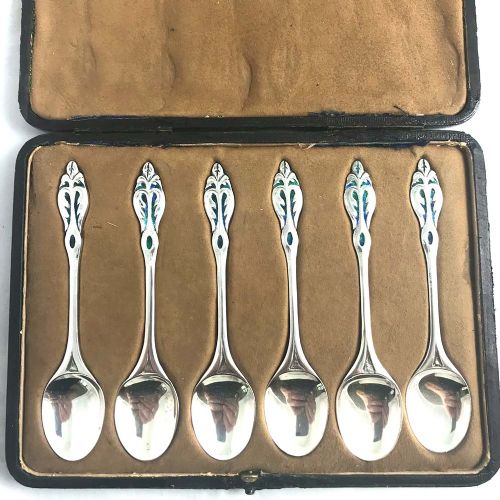


Edwardian Silver Teaspoons
Edwardian silver teaspoons are bright table silver crafted for the afternoon ritual, prized for their fine proportion and delicate cased presentation.
Edwardian Silver Teaspoons
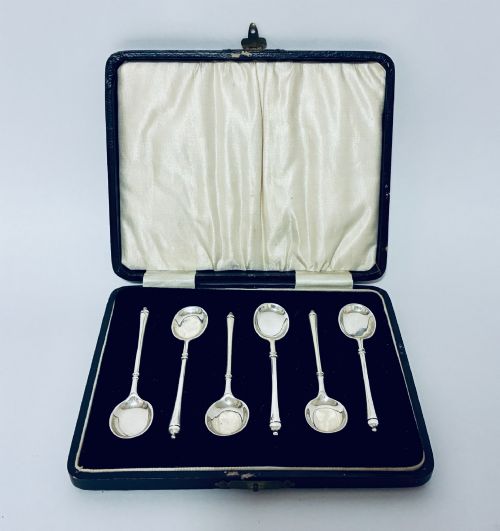
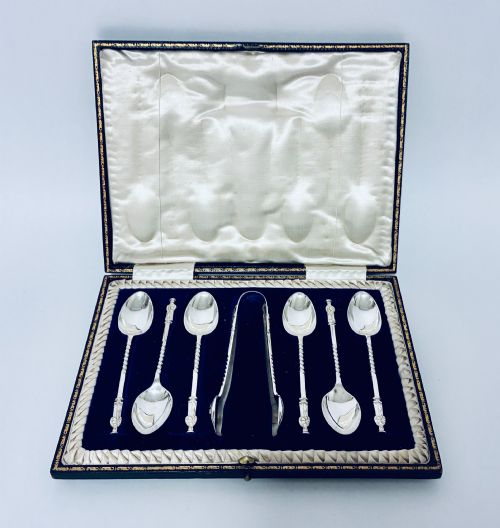
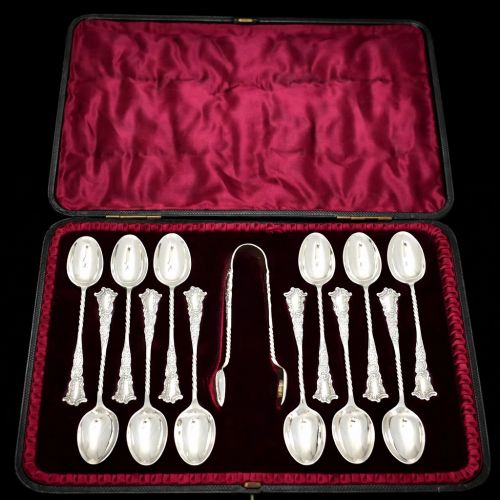
Edwardian silver teaspoons are typically found in matched sets, frequently accompanied by matching sugar tongs and fitted presentation boxes lined with silk, velvet, or satin. When you search for edwardian silver teaspoons, you encounter single items alongside complete boxed sets of six or twelve pieces.
The objects span cutlery forms including flatware, coffee spoons, and apostle spoons, alongside related silver items such as butter knives. Dating ranges across the period from the late Victorian era through the Edwardian years into the 1920s, 1930s, and 1950s.
Designs reflect the prevailing aesthetic movements of their manufacture, incorporating Arts and Crafts ideals, Art Nouveau curvature, and Art Deco geometry alongside traditional Kings pattern tablespoons and teaspoons.
Materials and construction
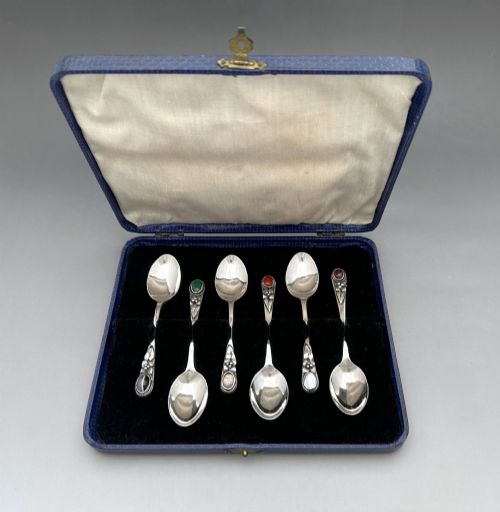
Pieces are formed from sterling silver and solid silver, occasionally finished with silver gilt or detailed with vitreous enamel. Selected items incorporate decorative semi-precious stones and agate inset into the handles.
Presentation cases utilise protective outer coverings of leatherette enclosing fitted interiors lined with textiles including velvet, silk, and satin to secure the cutlery.
Some sets include sugar tongs so small they demand the steady hand of a surgeon to lift a single cube.
Judgments of quality
Quality rests on the crispness of the original hallmarks, the retention of the original fitted case, and the integrity of the textile linings such as velvet and silk. Complete sets matching every spoon and pair of tongs retain greater cohesion than assembled groups.
The presence of specialist craftsmanship, such as applied enamel work or hand-set semi-precious stones, elevates the standard of manufacture beyond standard flatware production.
Walker & Hall·Cooper Brothers & Sons Ltd·Liberty & Co·Robert Stebbings·D&A
The Edwardian Silver Teaspoons Glossary
- Sterling silver
- A silver alloy containing 925 parts pure silver per thousand, standard for quality British silverware.
- Silver-gilt
- Silver that has been coated with a thin layer of gold on its surface, giving a warm golden appearance.
- Demi-tasse spoons
- Smaller spoons traditionally designed for serving coffee in small cups.
- Apostle spoons
- Spoons featuring the figure of an apostle cast or engraved upon the terminal of the handle.
- Kings pattern
- A traditional ornate cutlery pattern featuring a shell and scroll motif with a central rib.
Edwardian Silver Teaspoons: Frequently Asked Questions
How do I clean tarnished silver teaspoons?
Silver accumulates tarnish through exposure to the air, which can be gently removed using a specialised silver cloth.
Avoid harsh chemical dips, as these strip away the original patination and can damage delicate enamel or inset stones.
Are cased spoon sets complete?
Cased sets often retain their original complement of six or twelve spoons, sometimes accompanied by matching sugar tongs.
Inspect the fitted interior slots to confirm that every piece original to the presentation box remains present.
What is the difference between tea and coffee spoons?
Coffee spoons and demi-tasse spoons are visibly smaller in overall length than standard teaspoons.
This smaller scale suited the compact porcelain cups used for serving after-dinner coffee in the period.
How do I date silver hallmarks?
British silver bears stamped assay office marks, standard marks, and a distinct date letter corresponding to the year of testing.
Reference tables match these individual letters to specific alphabetic cycles used by offices such as London, Birmingham, and Sheffield.