



Silver Enamel Coffee Spoons
Silver enamel coffee spoons bring bright colour and neat geometric lines to the table, usually found in matched sets within fitted presentation cases.
Silver Enamel Coffee Spoons
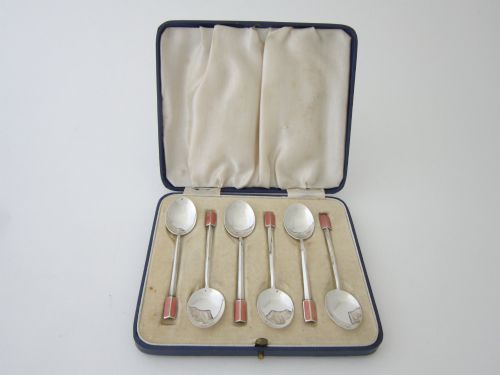
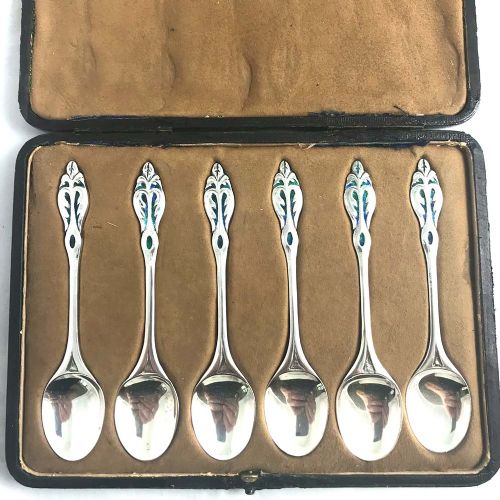
Silver enamel coffee spoons are small implements designed for after-dinner coffee or mocha, measuring significantly smaller than standard teaspoons. The selection spans distinct design movements, with twentieth-century Art Deco and mid-century Scandinavian pieces appearing most frequently alongside British provincial hallmarked sets.
Most examples survive as complete sets of six, often nestled inside original velvet or satin-lined leatherette cases. These sets frequently emerge from Birmingham workshops, Scandinavian makers, and Russian silversmiths active between the late nineteenth century and the mid-twentieth century.
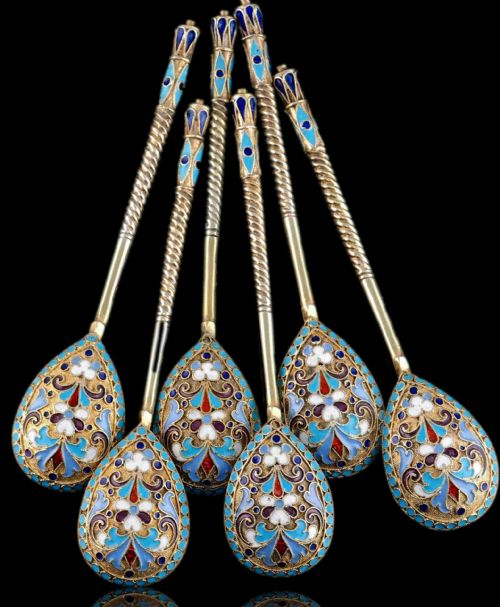
Buyers encounter various handle terminals, including coffee bean knops, seal tops, and card suits, alongside specialised forms like demitasse and mocha spoons. Many feature translucent coloured enamel over engine-turned guilloche backgrounds, while others display opaque cloisonné or basse taille work.
Materials and technique
Makers formed the bowls and stems from sterling silver or silver gilt, applying vitreous enamel directly onto the metal surface. Guilloche enamel required machine-turning precise geometric patterns into the silver base before applying translucent coloured glass paste, which allowed light to reflect through the pigment during firing.
Techniques varied by region and period, encompassing cloisonné work where thin wire formed individual cells for different enamel colours, and basse taille carving that created low relief beneath translucent layers. Workshops in Birmingham and Scandinavia utilised these specialised enamelling methods alongside traditional silversmithing to produce durable table wares.
Listings feature items spanning the Art Nouveau, Arts and Crafts, Art Deco, and mid-century periods, utilising silver, silver gilt, and vitreous enamel.
Quality differences
Quality rests upon the crispness of the engine-turning beneath the enamel and the uniformity of the glass surface across all pieces in a set. Superior sets maintain flawless, undamaged enamel without chips or hairline fractures, alongside clear hallmarks and retaining pins that remain tight within the stems.
The sophistication of the design execution separates standard commercial production from finer workshop output. Pieces designed by notable silversmiths or produced by recognised Scandinavian and British firms display heavier gauge silver gilt, more complex colour gradients, and intact original presentation boxes with unblemished linings.
Dmitrii Nikolaevich Nikolaev·David Andersen·Henry Clifford Davis·Walker and Hall·Turner and Simpson·Egon Lauridsen·Barker Ellis Silver Co·Liberty and Co
The Silver Enamel Coffee Spoons Glossary
- Guilloche
- An ornamental technique in which a precise, intricate mechanical pattern is engraved into a metal surface using a lathe. This method provides a textured background that shines through translucent enamel.
- Silver Gilt
- Sterling silver that has been coated with a thin layer of gold, often referred to as vermeil. This treatment protects the silver from tarnishing and adds a warm, rich tone to the spoon bowls.
- Cloisonne
- An ancient enamelling method where fine metal wires are soldered onto a metal base to create enclosed compartments. These cells are then filled with coloured glass paste and fired.
- Basse Taille
- A decorative technique where the metal ground is carved in low relief so that translucent enamel creates varying depths of colour. Light passes through the different thicknesses to produce shaded visual effects.
- Coffee Bean Knop
- A terminal shaped like a coffee bean attached to the end of the spoon handle. This form gained popularity in British silver design during the early and mid-twentieth century.
Silver Enamel Coffee Spoons: Frequently Asked Questions
How were silver enamel coffee spoons used?
These small spoons served primarily for stirring sugar into demitasse coffee after formal meals. Due to their delicate enamel surfaces, they saw use mainly on special occasions rather than daily dining.
Most sets remained stored in velvet-lined presentation cases when not in use, which accounts for the high survival rate of undamaged sets today.
Are these spoons made of solid silver?
British examples typically bear silver hallmarks indicating sterling standard, while many continental European pieces utilise similar high-purity silver standards. Some items feature a gold wash known as silver gilt over the sterling base.
The enamel itself consists of powdered glass fused to the metal through high-temperature kiln firing, rather than modern synthetic resin or paint.
How do I identify Art Deco spoons?
Art Deco pieces display distinct geometric motifs, symmetrical lines, and sharp angles that break away from earlier organic Victorian styles. The enamel work on these spoons often utilises bold contrasting colours or subtle pastel guilloche patterns.
Many of these sets date from the nineteen-thirties and feature streamlined handles with coffee bean or stepped terminals.
Why do some sets come in presentation boxes?
Makers and retailers originally packaged these luxury items in fitted leatherette cases lined with satin and velvet to protect the delicate enamel from scratching. These boxes often retain the original retailer marks or maker stamps on the inner satin lid.
Finding a complete set within its original fitted case adds considerable historical context for collectors.
Where were most of these spoons manufactured?
Production centred around major silversmithing hubs, notably the Jewellery Quarter in Birmingham, England, alongside prominent workshops in Norway and Denmark. Russian silversmiths also produced notable cloisonné sets during the late nineteenth and early twentieth centuries.
Each region imparted distinct stylistic traits, from British coffee bean handles to Scandinavian guilloche work.