
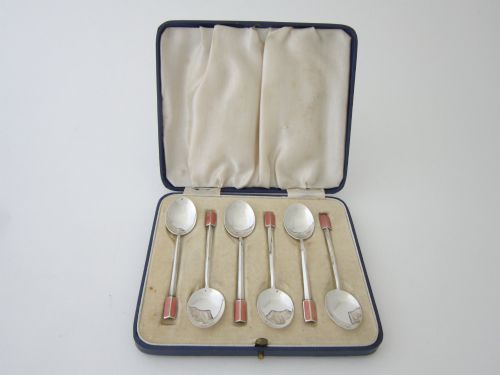


Art Deco Teaspoons
Art deco teaspoons are bright table silver shaped by the bold geometries of the interwar years, offering a sharp modernist accent to daily tea.
Art Deco Teaspoons
Art deco teaspoons encompass small silver cutlery pieces fashioned during the decades spanning the 1920s through the 1950s. You will frequently encounter cased sets of six, often accompanied by matching coffee spoons in fitted presentation boxes.
The objects take the form of standard teaspoons or smaller coffee spoons, frequently showcasing the linear motifs and geometric styling characteristic of the period. Many examples originate from English assay offices, particularly Sheffield, reflecting standard manufacturing centres of the era.
Single spoons and partial sets appear alongside complete cased collections, giving buyers various ways to acquire these silver items. The overarching style remains strictly art deco, unified by clean angles and purposeful ornamentation.
Materials and Construction
Makers shaped these teaspoons primarily from sterling silver and silver gilt, frequently applying vitreous enamel to the handles for vibrant colour. Basse-taille enamel techniques also appear, laying translucent enamel over an engine-turned background to create patterned depth.
Cases utilise protective exteriors of leatherette or satin linings paired with internal velvet beds to secure the cutlery. Hallmarks stamped directly into the silver provide official records of the metal standard and the year of assay.
Listings feature items spanning the 1920s to the 1950s, executed in sterling silver, enamel, and velvet.
Evaluating Craft and Condition
Quality rests on the crispness of the geometric design and the preservation of any applied enamel work. Intact enamel surfaces without chipping elevate a set significantly above pieces showing loss or heavy surface scratching.
The presence of an original fitted case lined in velvet or satin alters the desirability of the silverware. Comprehensive hallmarks and clear maker attribution add further weight to individual pieces and sets.
Walker and Hall·Harrods
The Art Deco Teaspoons Glossary
- Sterling silver
- A silver alloy containing 92.5 percent pure silver by mass, forming the primary metal for these spoons. It provides the necessary durability for daily cutlery use.
- Vitreous enamel
- Glass fused to metal at high temperatures, creating smooth, coloured ornamentation on the spoon handles. This technique produces the bright hues typical of the style.
- Silver gilt
- Sterling silver that has been coated with a thin layer of gold, giving the metal a warm yellow tone. This finish appears on specific coffee spoons in the selection.
- Engine turned
- A mechanical engraving method that cuts precise geometric patterns into the metal surface. It creates a textured background visible beneath translucent enamel layers.
- Basse-taille
- An enamelling technique where a low-relief pattern is carved into metal before applying translucent enamel. Light passes through the coloured glass to reveal the underlying design.
Art Deco Teaspoons: Frequently Asked Questions
Are these spoons suitable for daily use?
Solid silver spoons withstand regular use, though pieces with delicate enamel handles require greater care during handling and washing. Many owners reserve enamelled sets for special occasions.
Check the security of the bowl and handle join before regular use. Storing them in their original fitted case prevents scratching.
How do I identify the date of manufacture?
Look for hallmarks stamped on the back of the spoon stem, which include assay office symbols and date letters. These official marks indicate the exact year the piece was tested and marked.
Sheffield and other English offices recorded these details meticulously. Reference marks against hallmarking guides to confirm the production decade.
What is the difference between tea and coffee spoons?
Coffee spoons are noticeably smaller in overall length and bowl size than standard teaspoons. They were designed for smaller cups served after meals.
Both types share the same art deco stylistic vocabulary. Sets frequently combine matching sugar tongs or alternate in scale within a single presentation box.