



Silver Enamelled Teaspoons
Silver enamelled teaspoons are small, decorative vessels of precious metal and vitreous glass that bring bright colour to the table.
Silver Enamelled Teaspoons
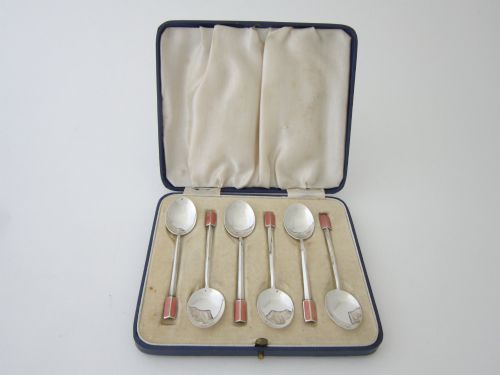
Silver enamelled teaspoons appear across several distinct decades, with the Art Deco period yielding numerous matching sets. These pieces range from solitary items to fitted cased sets of six, sometimes accompanied by satin or leatherette linings.
Most examples originate from British makers such as Liberty and Harrods, alongside continental European workshops including Norwegian and Russian producers. Alongside standard teaspoons, the selection frequently includes smaller coffee spoons and commemorative club items.
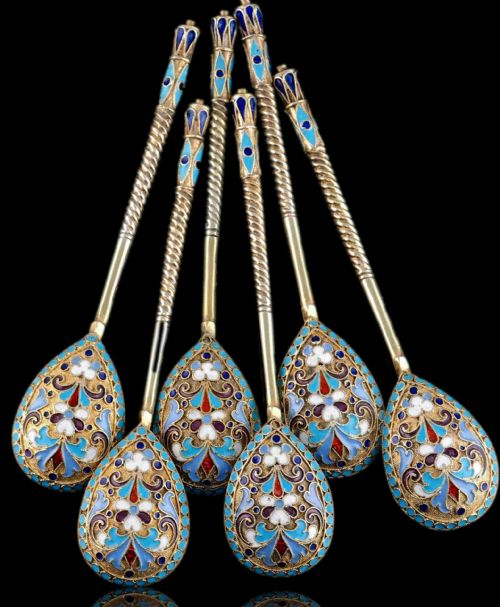
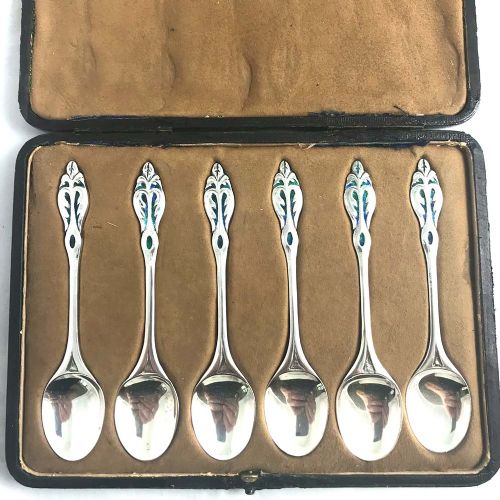
Collectors encounter both solid silver and sterling silver bases, often enriched with silver gilt. The decorative schemes embrace styles from Art Nouveau and Arts & Crafts to bold geometric Art Deco designs and Imperial Russian cloisonne.
How they were made
Craftsmen formed the spoon bowls and handles from solid silver or sterling silver, occasionally applying a layer of silver gilt to the interior surfaces. This metalwork provided a sturdy structural chassis to receive the glass ornamentation.
Vitreous enamel was fused to the silver base through high-temperature firing, bonding powdered glass directly to the metal. Techniques such as cloisonne created distinct compartments of colour, resulting in smooth, polished surfaces.
One exceptional set celebrates the Tamesis sailing club, proving that even tea time once required nautical backing.
What varies in quality
The sophistication of the enamel work dictates the distinction between standard production and superior pieces. Complex multi-coloured cloisonne patterns and intact gilding elevate the status of a set.
Original fitted presentation boxes lined with satin or leatherette contribute significantly to the integrity of a set. Maker attribution, particularly pieces associated with prominent firms like Liberty or David Andersen, also distinguishes finer examples.
Dmitrii Nikolaevich Nikolaev·David Andersen·Vasily Agafonov·Liberty and Co
The Silver Enamelled Teaspoons Glossary
- Vitreous enamel
- A material made by fusing powdered glass to a metallic substrate at high temperatures. This glass coating provides durable colour and a glossy finish.
- Silver gilt
- Silver that has been coated with a thin layer of gold on its surface. This treatment protects the underlying metal and adds a warm tone to the spoon bowl.
- Cloisonne
- An ancient decorative technique where metal wires are soldered to the base to form compartments. These cells are then filled with enamel paste before firing.
- Sterling silver
- An alloy of silver containing precise proportions of metal to ensure durability. It serves as the primary structural material for these spoons.
Silver Enamelled Teaspoons: Frequently Asked Questions
How do I clean silver enamelled teaspoons?
Clean these spoons gently using warm soapy water and a soft cloth to protect the delicate glass surface. Avoid abrasive silver dips that can harm the enamel.
Dry the pieces thoroughly immediately after washing to prevent moisture damage to the metal and any remaining fitted box linings.
Are these spoons safe to use for tea?
These spoons are generally suitable for light everyday use, though many owners prefer to reserve them for special occasions. The glass enamel is stable, but acidic liquids should not be left in contact with the metal for extended periods.
Hand washing is essential to preserve the vintage materials and prevent thermal shock to the fused glass.
What periods do these spoons date from?
The available pieces span the late nineteenth century through to the middle of the twentieth century. The majority cluster around the Art Deco era of the 1920s and 1930s.
Earlier examples from the late nineteenth century often reflect Imperial Russian or Arts and Crafts traditions, while later sets display geometric modernist lines.
Why do some sets come in presentation boxes?
Many high-quality sets were retailed in fitted boxes lined with satin or leatherette to protect the delicate enamel during storage and transport. Department stores and luxury drapers frequently supplied these custom cases for presentation as gifts.
Complete cased sets maintain higher collector interest because the packaging preserves the spoons together in their original state.