



Enamelled Silver Spoons Set
These enamelled silver spoons set items bring together bright vitreous colour and solid metal work, offering a polished centrepiece for afternoon tea.
Enamelled Silver Spoons Set
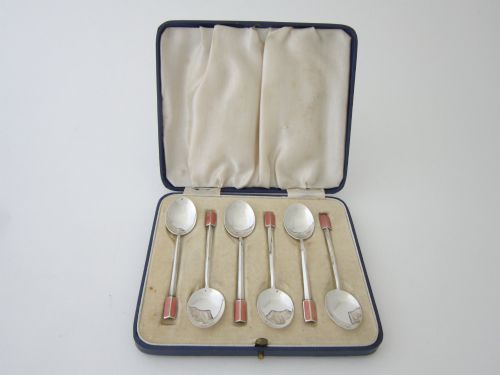
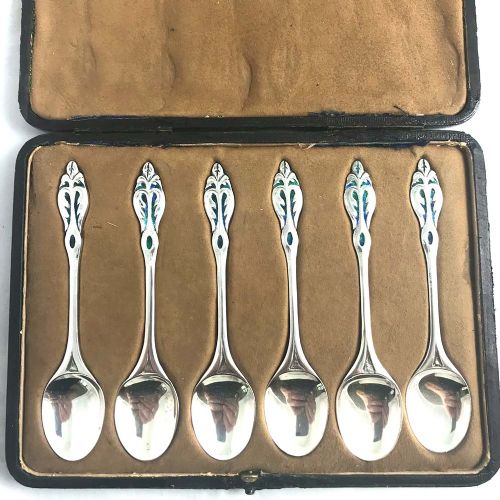
When you search for an enamelled silver spoons set, you are looking at matched groups of small cutlery decorated with glass fusion work, most commonly coffee spoons and teaspoons. These sets frequently arrive housed in their original fitted boxes lined with satin or velvet, preserved alongside leatherette outer cases.
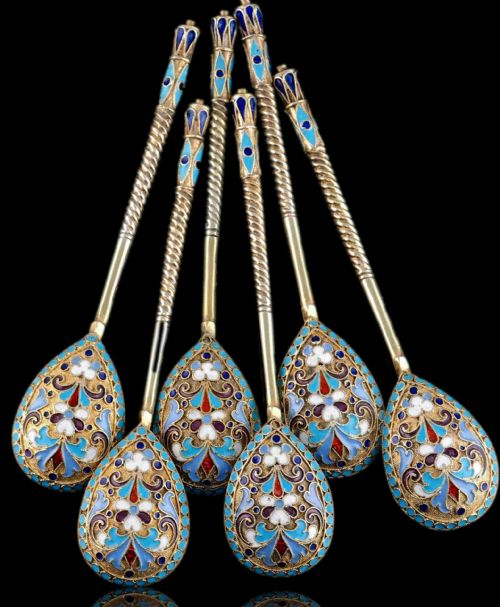
The pieces on this page span from the late nineteenth century through to the mid-twentieth century, capturing distinct shifts in design. You will encounter geometric Art Deco compositions, sinuous Art Nouveau motifs, and traditional Russian Revival cloisonne work alongside British club commemoratives.
Most examples you meet are configured in sets of four or six, occasionally accompanied by matching sugar tongs, forks, or porcelain coffee cans and saucers. They serve both as decorative display items and functional tableware for guests.
Materials and construction
The foundation of these items relies on solid sterling silver, occasionally finished with a layer of silver gilt to provide a warm golden tone over the metal. Makers applied vitreous enamel by fusing powdered glass to the silver base at high temperatures, creating a smooth and durable coloured surface.
Detailed patterns were formed using techniques such as cloisonne, where thin metal wires create compartments for different enamel colours. Many British examples were hallmarked in assay offices like Birmingham and London, while Scandinavian and Russian workshops utilised their own distinct regional standards.
The collection spans several decades, with items originating from the late nineteenth century through to the mid-twentieth century.
Distinguishing quality across the range
The distinction between standard production and finer work lies primarily in the precision of the enamel application and the weight of the silver. Superior sets exhibit uniform glass fusion without surface pitting, alongside crisp detailing in the underlying metalwork and wire compartments.
Original presentation matters greatly, with complete cased sets retaining their proper satin and velvet linings holding higher regard among collectors. The complexity of the design, from simple guilloche patterns to intricate multi-coloured pictorial motifs, also defines the upper tiers of the selection.
Dmitrii Nikolaevich Nikolaev·David Andersen·Liberty & Co
The Enamelled Silver Spoons Set Glossary
- Vitreous Enamel
- Glass powder melted onto a metal substrate at high heat to form a durable coloured coating. This material provides the brilliant hues seen across the bowls and handles of these utensils.
- Silver Gilt
- Sterling silver that has been coated with a thin layer of gold. This treatment was frequently applied to the interior bowls of spoons to prevent tarnishing from food acids.
- Cloisonne
- A decorative technique where thin metal strips are soldered to a metal base to create compartments for enamel paste. This method produces intricate geometric or pictorial patterns on the finished pieces.
- Guilloche
- An ornamental pattern mechanically engraved into the metal base beneath translucent enamel. It allows light to reflect through the coloured glass in geometric waves or sunbursts.
- Hallmark
- A series of official marks stamped onto precious metal items to indicate the maker, assay office, and year of testing. British pieces typically show these marks on the reverse of the stem.
Enamelled Silver Spoons Set: Frequently Asked Questions
How were these spoon sets originally used?
These small utensils were designed for specific social rituals such as serving afternoon tea, after-dinner coffee, or specialty sweets. They were often kept in fitted boxes and reserved for entertaining guests.
Because they were intended for light use rather than heavy daily dining, many surviving sets remain in remarkably well-preserved condition today.
What is the difference between coffee spoons and teaspoons?
Coffee spoons are noticeably smaller and feature shorter handles, designed to fit into demitasse cups alongside coffee cans and saucers. Teaspoons are slightly larger to accommodate standard teacups and saucers.
Both types frequently appear with vibrant enamel decoration on the reverse of the bowl or along the handle.
How do I care for enamelled silver?
Enamel is essentially glass, meaning it requires gentle handling to prevent chipping or scratching against hard surfaces. Clean the pieces using warm soapy water and a soft cloth rather than aggressive silver dips.
Store them in their original fitted cases or lined boxes to protect both the delicate glasswork and the underlying silver from unnecessary friction.
How can I tell Art Deco from earlier styles?
Art Deco pieces, typically dating from the 1920s and 1930s, favour clean geometric lines, bold symmetry, and streamlined forms. Earlier Victorian and Art Nouveau examples from the late nineteenth century lean towards flowing natural curves and organic motifs.
Looking at the assay marks and box styles can also help confirm the era of production.