
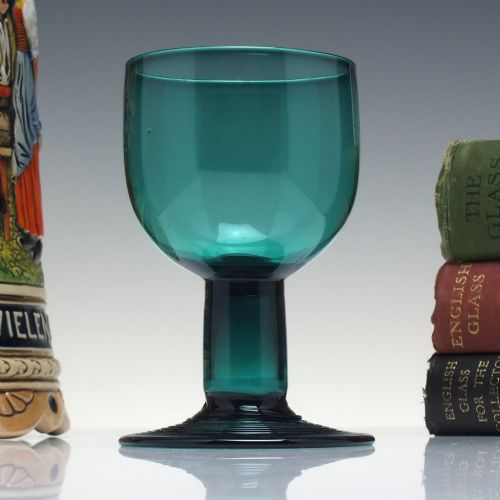

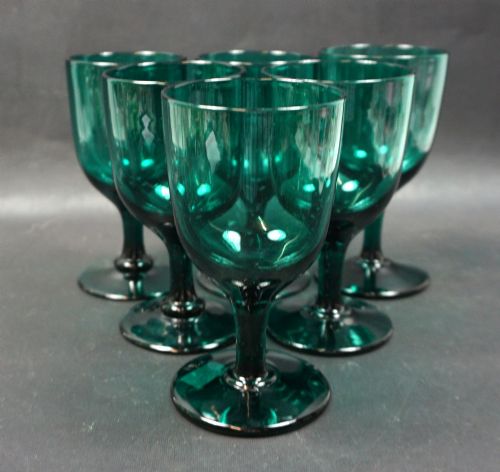


Emerald Green Wine Glass
These emerald green wine glass pieces bring rich colour to the table, spanning Georgian and Victorian periods with distinct hand-blown charm.
Emerald Green Wine Glass
An emerald green wine glass is a drinking vessel defined by its striking hue, appearing across Georgian, Victorian, and early twentieth-century eras. The most common examples met on this page are nineteenth-century Victorian pieces and sets originating around eighteen hundred.
Forms extend beyond standard wine glasses to include hock glasses, dram glasses, and larger table decanters. English Bristol styles and continental Baccarat or St Louis variants frequently emerge in these listings.
Buyers encounter these items singly, in pairs, or in matched sets of six and eight. Each piece reflects the functional dining habits and decorative tastes of its specific period.
What varies in quality
Quality differences lie in the depth and uniformity of the green glass and the precision of any cut or enamelled decoration. Crisp facets and balanced proportions separate finer examples from simpler production wares.
The integrity of the material, whether standard glass or heavy lead crystal, dictates the heft and resonance of the vessel. Maker attribution, particularly to known houses like Baccarat or St Louis, further distinguishes specific pieces.
Listings feature periods spanning from seventeen fifty through the nineteen thirties, encompassing Georgian, Victorian, and Art Deco styles.
Baccarat·St Louis·Massenet
The Emerald Green Wine Glass Glossary
- Lead glass
- Glass containing lead oxide to increase brilliance, weight, and clarity. This material allows for sharper cutting and a clearer ring when struck.
- Cased glass
- Glass made of two or more distinct layers of different colours fused together before blowing. The outer layer is often cut away to reveal the contrasting colour beneath.
- Hock glass
- A tall-stemmed wine glass traditionally used for German white wines. These often feature coloured bowls such as emerald green.
- Biedermeier
- A Central European style spanning the mid-nineteenth century known for clean lines and functional elegance. Pieces from this period frequently display precise geometric cutting.
- Dram glass
- A small historical drinking vessel intended for spirits. They appear in early nineteenth-century contexts alongside standard wine glasses.
Emerald Green Wine Glass: Frequently Asked Questions
Can I use these for dinner parties?
Many buyers choose to use these antique vessels for special dining occasions. Handle them with care due to their age and delicate hand-blown construction.
Hand-washing is essential after use, and storage should protect the rims and stems from knocks. Modern dishwashers will damage the glass and any applied enamel.
What defines Bristol green glass?
Bristol green refers to a deep, characteristic dark green shade produced in English glasshouses around the turn of the nineteenth century. This coloration became synonymous with West Country production.
Sets of wine glasses and decanters from this tradition frequently appear in Georgian and Victorian collections.
How can I date an old wine glass?
Dating relies on observing the form, weight, pontil mark on the base, and decorative style. Georgian and Victorian manufacturing techniques leave distinct physical traces.
Comparing pieces against documented examples from periods like eighteen fifty or nineteen twenty helps narrow the date of manufacture.