



Embroidered Hearth Guard
An embroidered hearth guard stands ready to shield the room from the blaze while displaying fine needlework.
Embroidered Hearth Guard
An embroidered hearth guard, commonly listed as a fire screen, protects the face from the intense heat of an open fire while adding colour to the room. The pieces seen here largely date from the Victorian and Georgian periods, spanning the nineteenth century.
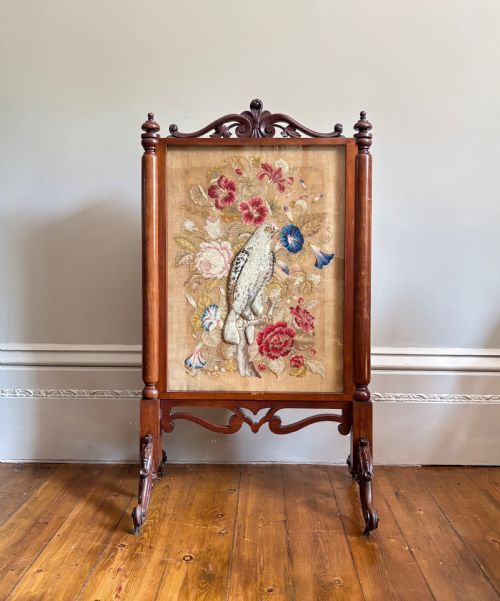
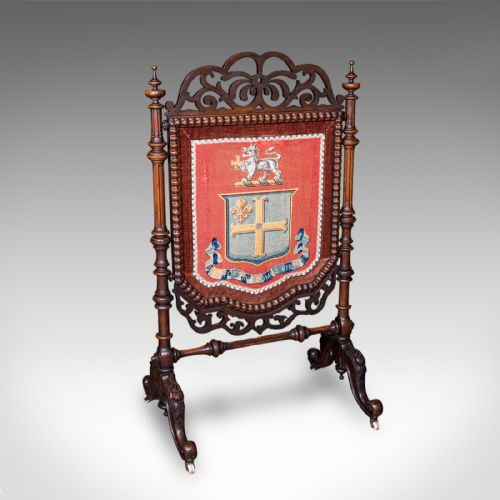
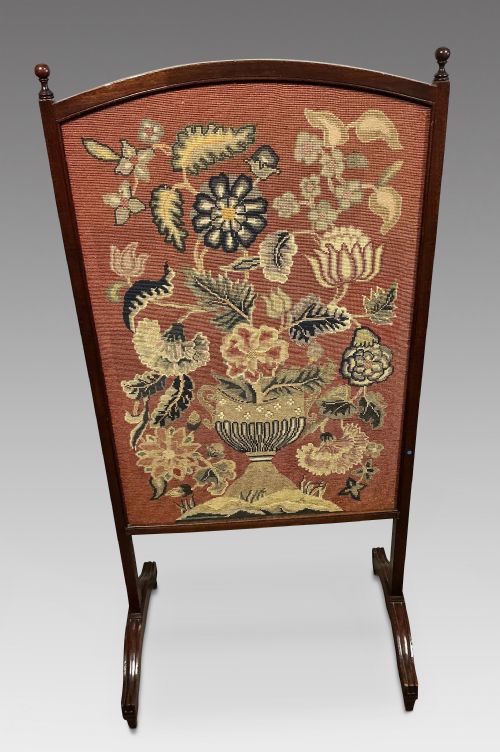
Makers utilised textiles extensively for the central display, incorporating Berlin work, needlepoint, canvas, silk, and tapestry. These panels often depict armorial bearings, coats of arms like the Clan Maclellan, or floral and avian motifs.
Materials and construction
The frames rely on traditional cabinet timbers including mahogany, walnut, rosewood, and giltwood, frequently featuring carved detailing characteristic of the Regency, Rococo Revival, and Art Nouveau styles.
Needlework panels demand meticulous hand sewing using wool and silk threads upon a canvas or textile foundation, stretched firmly within the wooden or brass framework to maintain tension.
Embroidered Hearth Guard Retail Price Guide 2026
Typical asking prices for embroidered hearth guard among the pieces listed under this phrase on Sellingantiques today, from the lower quarter to the upper quarter. They describe what is for sale here now, not the wider market.
Parrots feature in the tapestry work, bringing tropical colour right to the fireside.
Judging quality in a screen
Quality rests upon the crispness of the timber carving and the density of the needlework stitches within the panel. Fine execution shows in the intricate detail of heraldic coats of arms or tapestries.
The sophistication of the mechanical adjustment mechanism on pole screens or cheval frames separates standard utility items from finer parlour pieces.
The Embroidered Hearth Guard Glossary
- Berlin work
- A style of counted-thread embroidery popular in the nineteenth century that used brightly coloured wools on canvas. It allowed makers to create complex pictorial scenes and heraldic designs with ease.
- Cheval screen
- A standing fire screen supported by two sturdy side pillars and feet, allowing the framed panel to remain upright without a central pole. These versions offer a wide viewing area for large embroidered panels.
- Pole screen
- A tall, slender vertical stand featuring a sliding panel that can be adjusted in height. The arrangement allows the user to angle the textile shield against the radiant heat of the hearth.
- Needlepoint
- A form of canvas work stitched by hand using a needle and various yarn threads. It provides a durable surface suitable for frequent handling near a fireplace.
Embroidered Hearth Guard: Frequently Asked Questions
What is an embroidered hearth guard?
An embroidered hearth guard is a decorative screen placed in front of a fireplace to block excessive heat.
They combine a supportive wooden or metal frame with a hand-stitched textile panel.
How were these screens used?
They were positioned between the seated occupants and the open fire to protect complex complexions from scorching.
When the fire burned low, the screen remained to hide the empty grate and decorate the room.
What woods were used for frames?
Cabinet makers utilised dense hardwoods such as mahogany, walnut, and rosewood for durability and rich grain.
Giltwood and brass also appear in specific decorative styles.